The Cool-Core Bias in X-ray Galaxy Cluster Samples I: Method And Application To HIFLUGCS
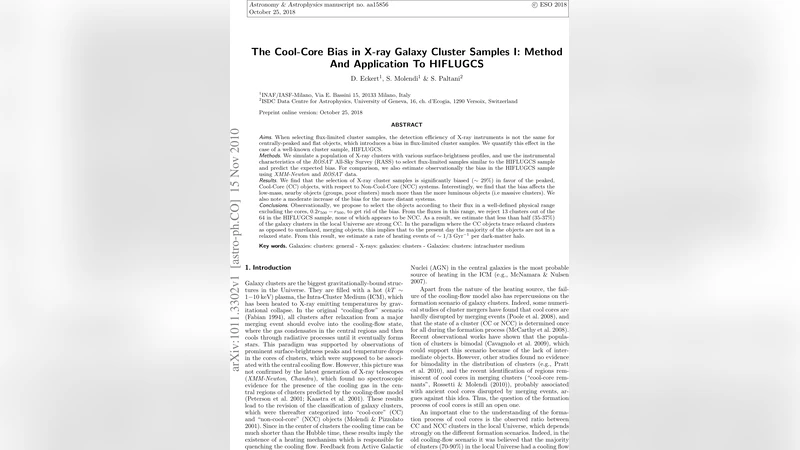
When selecting flux-limited cluster samples, the detection efficiency of X-ray instruments is not the same for centrally-peaked and flat objects, which introduces a bias in flux-limited cluster samples. We quantify this effect in the case of a well-known cluster sample, HIFLUGCS. We simulate a population of X-ray clusters with various surface-brightness profiles, and use the instrumental characteristics of the ROSAT All-Sky Survey (RASS) to select flux-limited samples similar to the HIFLUGCS sample and predict the expected bias. For comparison, we also estimate observationally the bias in the HIFLUGCS sample using XMM-Newton and ROSAT data. We find that the selection of X-ray cluster samples is significantly biased ($\sim29%$) in favor of the peaked, Cool-Core (CC) objects, with respect to Non-Cool-Core (NCC) systems. Interestingly, we find that the bias affects the low-mass, nearby objects (groups, poor clusters) much more than the more luminous objects (i.e massive clusters). We also note a moderate increase of the bias for the more distant systems. Observationally, we propose to select the objects according to their flux in a well-defined physical range excluding the cores, $0.2r_{500}-r_{500}$, to get rid of the bias. From the fluxes in this range, we reject 13 clusters out of the 64 in the HIFLUGCS sample, none of which appears to be NCC. As a result, we estimate that less than half (35-37%) of the galaxy clusters in the local Universe are strong CC. In the paradigm where the CC objects trace relaxed clusters as opposed to unrelaxed, merging objects, this implies that to the present day the majority of the objects are not in a relaxed state. From this result, we estimate a rate of heating events of $\sim1/3$ Gyr$^{-1}$ per dark-matter halo.
💡 Research Summary
The paper addresses a subtle but important selection bias that afflicts flux‑limited X‑ray galaxy‑cluster samples: clusters with centrally peaked surface‑brightness profiles (Cool‑Core, CC) are preferentially detected over those with flatter profiles (Non‑Cool‑Core, NCC). Using the well‑studied HIFLUGCS sample as a test case, the authors combine Monte‑Carlo simulations of a synthetic cluster population with the instrumental characteristics of the ROSAT All‑Sky Survey (RASS) to quantify the magnitude of this bias.
In the simulations, clusters are assigned realistic β‑model surface‑brightness profiles, with CC objects modeled by a narrow, high‑central‑density component and NCC objects by a broader, lower‑central‑density component. The synthetic population follows a standard mass function and a mass‑temperature scaling relation. By applying the RASS point‑spread function, background noise, exposure map, and the HIFLUGCS flux limit (≈2 × 10⁻¹¹ erg s⁻¹ cm⁻² in the 0.1–2.4 keV band), the authors generate mock flux‑limited samples. The outcome shows that, for a given underlying mass distribution, CC clusters are about 29 % more likely to enter the sample than NCC clusters. The bias is strongest for low‑mass (M₅₀₀ ≲ 3 × 10¹⁴ M⊙) and nearby (z ≲ 0.05) systems, where the core contributes a larger fraction of the total flux. For massive, distant clusters the effect diminishes but remains non‑negligible.
To verify the simulation results, the authors re‑analyse the actual HIFLUGCS data using ROSAT and XMM‑Newton observations. They measure the flux in an annulus that excludes the core, specifically the radial range 0.2 r₅₀₀ – r₅₀₀, for all 64 clusters. When the sample is re‑selected based on this “core‑excluded” flux, 13 objects fall below the flux threshold; intriguingly, all 13 were originally classified as CC. Consequently, the revised sample contains 51 clusters, of which only 18–19 (≈35–37 %) are CC. This is substantially lower than the ≈50 % CC fraction reported in earlier HIFLUGCS‑based studies, confirming that the original sample was biased toward CC systems.
The implications are twofold. First, any cosmological or astrophysical inference that relies on flux‑limited X‑ray samples—such as the cluster mass function, scaling relations, or estimates of the baryon fraction—must account for the CC/NCC selection bias, otherwise the derived parameters will be systematically skewed. Second, under the widely‑adopted paradigm that CC clusters trace relaxed, dynamically settled systems while NCC clusters are associated with recent mergers, the revised CC fraction suggests that the majority of local clusters are not in a relaxed state. By interpreting the CC fraction as a steady‑state balance between cooling (which creates CCs) and heating events (mergers, AGN outbursts), the authors estimate a heating‑event rate of roughly one per 3 Gyr per dark‑matter halo (≈0.33 Gyr⁻¹).
Practically, the authors propose a simple mitigation strategy: select clusters based on their flux measured in the 0.2 r₅₀₀ – r₅₀₀ annulus, thereby removing the dominant contribution of the bright core. This approach requires only standard imaging data and can be readily applied to upcoming large‑area X‑ray surveys such as eROSITA. By adopting core‑excluded fluxes, future samples will be far less susceptible to the CC bias, leading to more reliable measurements of cluster demographics and, consequently, tighter constraints on cosmological models.
Comments & Academic Discussion
Loading comments...
Leave a Comment