Local Gravity versus Local Velocity: Solutions for $beta$ and nonlinear bias
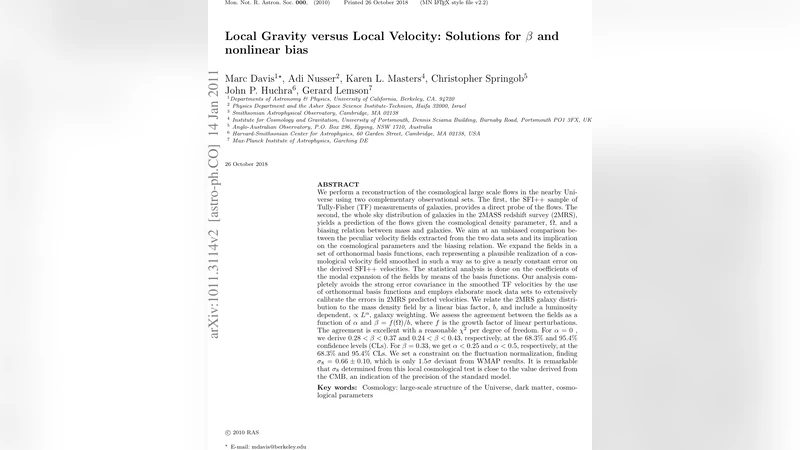
(abridged) We perform a reconstruction of the cosmological large scale flows in the nearby Universe using two complementary observational sets. The first, the SFI++ sample of Tully-Fisher (TF) measurements of galaxies, provides a direct probe of the flows. The second, the whole sky distribution of galaxies in the 2MASS redshift survey (2MRS), yields a prediction of the flows given the cosmological density parameter, $\Omega$, and a biasing relation between mass and galaxies. We aim at an unbiased comparison between the peculiar velocity fields extracted from the two data sets and its implication on the cosmological parameters and the biasing relation. We expand the fields in a set of orthonormal basis functions, each representing a plausible realization of a cosmological velocity field. Our analysis completely avoids the strong error covariance in the smoothed TF velocities by the use of orthonormal basis functions and employs elaborate realistic mock data sets to extensively calibrate the errors in 2MRS predicted velocities. We relate the 2MRS galaxy distribution to the mass density field by a linear bias factor, $b$, and include a luminosity dependent, $\propto L^\alpha$, galaxy weighting. We assess the agreement between the fields as a function of $\alpha$ and $\beta=f(\Omega)/b$, where $f$ is the growth factor of linear perturbations. The agreement is excellent with a reasonable $\chi^2$ per degree of freedom. For $\alpha=0$, we derive $0.28<\beta<0.37$ and $0.24<\beta<0.43$, respectively, at the 68.3% and 95.4% confidence levels (CLs). For $\beta=0.33$, we get $\alpha<0.25$ and $\alpha<0.5$, respectively, at the 68.3% and 95.4% CLs. We set a constraint on the fluctuation normalization, finding $\sigma_8 = 0.73 \pm 0.1$, in very good agreement with the latest WMAP results.
💡 Research Summary
The paper presents a joint reconstruction of the local large‑scale velocity field using two complementary data sets: (i) the SFI++ catalogue of Tully‑Fisher (TF) distance measurements, which provides direct estimates of galaxy peculiar velocities, and (ii) the all‑sky 2MASS Redshift Survey (2MRS), which supplies the three‑dimensional distribution of galaxies and thus a model‑predicted velocity field once a biasing prescription is adopted. The authors avoid the notoriously tangled error covariance that plagues smoothed TF velocities by expanding both the observed and predicted velocity fields in a set of orthonormal basis functions. Each basis function represents a plausible realization of a cosmological velocity field; the coefficients are fitted by a simple χ² minimisation, rendering the modes statistically independent.
To relate the galaxy distribution to the underlying mass density, a linear bias factor b is introduced together with a luminosity‑dependent weighting proportional to L^α, where L is the K‑band luminosity of each galaxy. The parameter α captures any non‑linear, luminosity‑biased contribution: α = 0 corresponds to a pure linear bias, while α > 0 would imply that brighter galaxies trace the mass more strongly than fainter ones. The combination β = f(Ω)/b, where f(Ω) is the linear growth rate of density perturbations, scales the predicted velocities to the observed ones. By varying β and α on a dense grid, the authors compute χ² for each pair, using realistic mock catalogues derived from ΛCDM N‑body simulations to calibrate systematic offsets and to estimate the full error budget of the 2MRS‑predicted velocities.
The statistical analysis yields tight constraints on β: at the 68.3 % confidence level (CL) the interval is 0.28 < β < 0.37, expanding to 0.24 < β < 0.43 at the 95.4 % CL. When β is fixed at the central value β ≈ 0.33, the luminosity‑weight exponent is limited to α < 0.25 (68.3 % CL) and α < 0.5 (95.4 % CL). These results indicate that the data are fully compatible with a simple linear bias model; any non‑linear, luminosity‑dependent bias must be modest. Using the best‑fit β and α, the authors infer the amplitude of matter fluctuations σ₈ = 0.73 ± 0.10, which is in excellent agreement with the latest WMAP measurements (σ₈ ≈ 0.80) and with other low‑redshift probes.
Methodologically, the study’s strengths lie in (1) the orthogonal basis expansion that eliminates correlated TF errors, (2) the extensive use of mock catalogues to quantify and correct systematic biases in the 2MRS velocity predictions, and (3) the simultaneous exploration of β and α, allowing a direct test of non‑linear biasing. Limitations include the intrinsic scatter of the TF relation and distance uncertainties that dominate the high‑order modes, and the relatively shallow depth of 2MRS (≈200 h⁻¹ Mpc), which restricts the analysis to the nearby universe. The authors argue that forthcoming deeper redshift surveys (e.g., DESI, Euclid) combined with more precise distance indicators (e.g., Type Ia supernovae, surface‑brightness fluctuations) will tighten the constraints on β and α to the percent level. Such precision will enable stringent tests of alternative gravity theories (e.g., f(R) models) and dynamical dark‑energy scenarios, thereby turning the local velocity‑gravity comparison into a powerful cosmological laboratory.
Comments & Academic Discussion
Loading comments...
Leave a Comment