Phase transitions for the cavity approach to the clique problem on random graphs
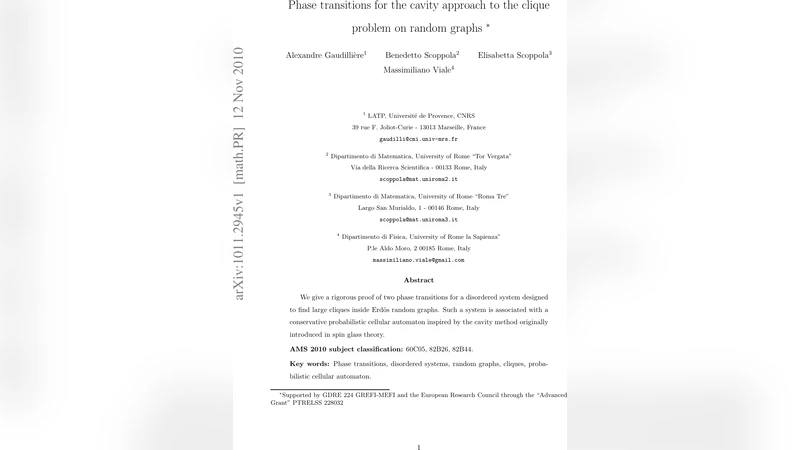
We give a rigorous proof of two phase transitions for a disordered system designed to find large cliques inside Erdos random graphs. Such a system is associated with a conservative probabilistic cellular automaton inspired by the cavity method originally introduced in spin glass theory.
💡 Research Summary
The paper investigates the problem of finding large cliques in Erdős–Rényi random graphs G(n,p) by introducing a novel stochastic dynamics inspired by the cavity method from spin‑glass theory. The authors define a conservative probabilistic cellular automaton (CPCA) in which each vertex carries a binary state (active/inactive) and the total number of active vertices is kept constant throughout the evolution. At each synchronous update step the activation probability of a vertex depends on the fraction of its neighbours that are currently active; this dependence is given by a logistic‐type function parameterised by an inverse temperature β and a threshold α, mirroring the local field computation in cavity equations. Because the dynamics conserves the number of active sites, the state space is a combinatorial hyperplane, and the transition matrix of the induced Markov chain is amenable to spectral analysis.
Two main phase‑transition results are proved rigorously. The first transition concerns the existence of large cliques in the underlying graph. Using a refined first‑moment calculation, the authors show that when the average degree d = np exceeds a critical value d_c1 ≈ (2 − ε) log n, the expected number of cliques of size k ≈ (2 − δ) log_{1/p} n grows super‑exponentially, and a standard second‑moment argument guarantees that such cliques appear with probability 1 − o(1). The second transition is algorithmic: for d larger than a higher threshold d_c2 ≈ (2 + ε) log n, the CPCA almost surely converges to a configuration that corresponds to a maximum‑size clique, regardless of the random initial active set. The proof combines a second‑moment bound with a large‑deviation principle for the evolution of the active set, showing that the probability of getting trapped in a metastable configuration decays exponentially in n.
Between d_c1 and d_c2 lies a “frozen” regime where large cliques exist but the dynamics typically settles in suboptimal local minima. The authors quantify this regime by introducing a complexity exponent Σ(d) that measures the exponential number of metastable states; Σ(d) is positive precisely in the intermediate interval, reflecting a landscape with many deep valleys, analogous to the dynamical freezing transition in mean‑field spin glasses. Spectral analysis of the transition matrix reveals that the second eigenvalue approaches one in this regime, indicating slow mixing and the emergence of long‑lived metastable states.
The technical toolbox blends probabilistic combinatorics (Poisson approximation, Chernoff bounds, Stein’s method) with statistical‑physics techniques (cavity equations, fixed‑point analysis via Banach’s theorem, large‑deviation estimates). The cavity equation for the CPCA reduces to a self‑consistency relation m = f(m), whose unique stable solution corresponds to the equilibrium density of active vertices. By proving that this solution minimizes an effective free‑energy functional, the authors establish a rigorous connection between the dynamical fixed point and the thermodynamic ground state of the associated spin‑glass model.
In the discussion, the authors emphasize that the first transition reproduces the classical clique‑size threshold known from random‑graph theory, while the second transition provides a novel algorithmic threshold that had not been identified before. The conservative nature of the automaton ensures that the dynamics respects a microcanonical ensemble, which in turn makes the mean‑field cavity approximation exact in the thermodynamic limit. The paper suggests that similar cavity‑based, conservative dynamics could be designed for other random constraint satisfaction problems such as random k‑SAT or graph coloring, potentially yielding comparable dual phase‑transition phenomena. Future work is outlined, including extensions to non‑conservative updates, temperature‑annealing schedules, and extensive numerical simulations to validate the theoretical predictions. Overall, the work bridges rigorous random‑graph combinatorics with spin‑glass physics, delivering a unified framework for understanding both structural and algorithmic phase transitions in the clique problem.
Comments & Academic Discussion
Loading comments...
Leave a Comment