Built-up structure criticality
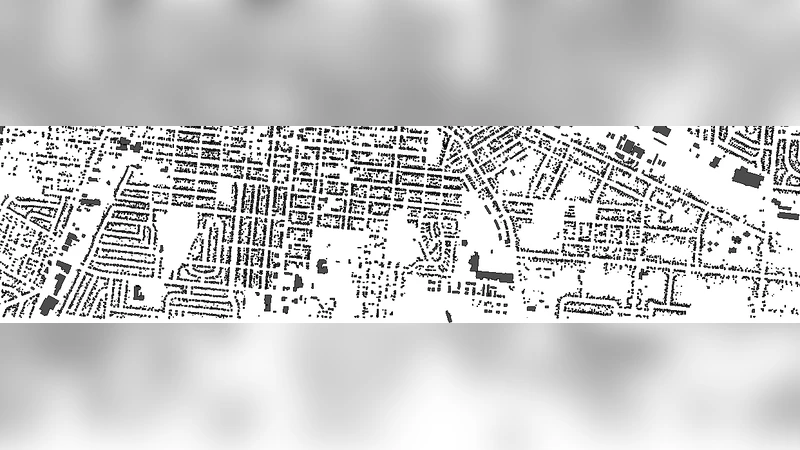
The built-up land represents an important type of overall landscape. In this paper the built-up land structure in the largest cities in the Czech Republic and selected cities in the U.S.A. is analysed using the framework of statistical physics. We calculate the variance of the built-up area and the number variance of built-up landed plots in discs. In both cases the variance as a function of a disc radius follows a power law. The obtained values of power law exponents are comparable through different cities. The study is based on cadastral data from the Czech Republic and building footprints from GIS data in the U.S.A.
💡 Research Summary
The paper investigates whether the spatial organization of built‑up land in large urban areas exhibits statistical‑physics‑type criticality. Using cadastral records from the Czech Republic and GIS‑derived building footprints from selected U.S. cities, the authors construct two complementary representations of the urban fabric: (1) a point set consisting of the centroids of individual parcels and (2) a planar set where each parcel contributes its actual built‑up area. For each city they perform a “disc‑sampling” experiment: a large number of circular windows of radius r are placed uniformly at random over the study area, and within each window the total built‑up area A(r) and the number of parcels N(r) are recorded. By averaging over all windows they obtain the mean ⟨A(r)⟩, ⟨N(r)⟩ and the corresponding variances Var
Comments & Academic Discussion
Loading comments...
Leave a Comment