The converse problem for the multipotentialisation of evolution equations and systems
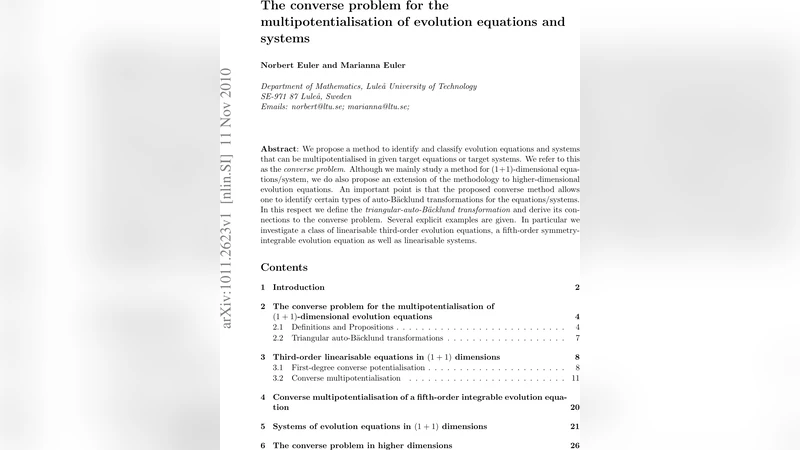
We propose a method to identify and classify evolution equations and systems that can be multipotentialised in given target equations or target systems. We refer to this as the {\it converse problem}. Although we mainly study a method for $(1+1)$-dimensional equations/system, we do also propose an extension of the methodology to higher-dimensional evolution equations. An important point is that the proposed converse method allows one to identify certain types of auto-B"acklund transformations for the equations/systems. In this respect we define the {\it triangular-auto-B"acklund transformation} and derive its connections to the converse problem. Several explicit examples are given. In particular we investigate a class of linearisable third-order evolution equations, a fifth-order symmetry-integrable evolution equation as well as linearisable systems.
💡 Research Summary
The paper introduces a novel “converse problem” framework for the multipotentialisation of evolution equations and systems. Traditional potentialisation starts from a given nonlinear evolution equation and introduces auxiliary potential variables to obtain a new, often linear, equation. In contrast, the authors fix a target equation (or system) in advance—typically a well‑understood linear or symmetry‑integrable equation—and then work backwards to identify all original equations that can be transformed into the target via successive potentialisations.
The core methodology consists of three steps. First, one selects a target equation (E_T) together with its conservation law(s). The associated flux operator (D) is extracted from the conservation law. Second, the inverse of (D) is applied to reconstruct the original dependent variable(s) and the differential operator (L) that defines the original equation (E_O: L(u)=0). This reconstruction may require the introduction of a hierarchy of potential variables (\phi^{(1)}, \phi^{(2)},\dots). Third, by composing the forward and backward transformations, the authors obtain explicit relations between distinct solutions of (E_O); these relations constitute what they call a “triangular‑auto‑Bäcklund transformation”. Unlike classical Bäcklund transformations, the triangular form links two solutions through intermediate potential variables, allowing one solution to generate another automatically.
The paper demonstrates the approach on several representative examples in (1+1) dimensions. For a third‑order linear target equation (w_t = w_{xxx}), the converse construction yields the nonlinear KdV‑type equation (u_t = u_{xxx}+3u u_x). Two successive potentialisations produce a triangular‑auto‑Bäcklund transformation that differs from the standard KdV Bäcklund map and provides a new mechanism for generating solutions. A second example uses a fifth‑order linear target (w_t = w_{xxxxx}); the inverse procedure recovers the Sawada–Kotera equation (u_t = u_{xxxxx}+5u u_{xxx}+5u_x u_{xx}+5u^2 u_x). Again, a novel auto‑Bäcklund transformation emerges, illustrating the power of the converse method for higher‑order integrable systems.
The authors extend the theory to coupled systems. By fixing a linear 2×2 target system and introducing two potential variables, they reconstruct a nonlinear coupled system and derive a system‑wide triangular‑auto‑Bäcklund transformation. This shows that multipotentialisation is not limited to scalar equations but can be applied to vector‑valued evolution equations.
Finally, the paper sketches an extension to higher spatial dimensions, such as (2+1)‑dimensional evolution equations. Here the conservation laws involve vector fluxes, and the inverse operator becomes a combination of gradient and divergence operators. Although the algebraic complexity grows dramatically, the authors provide symbolic‑computation scripts (Mathematica/Maple) that automate the inverse construction. They argue that the converse framework can, in principle, be applied to any evolution equation possessing a suitable conservation law, opening a systematic route to discover new integrable models and their auto‑Bäcklund transformations.
In conclusion, the work reframes potentialisation as a bidirectional problem, introduces the concept of triangular‑auto‑Bäcklund transformations, and supplies a constructive algorithm for generating both the original equations and their solution‑generating transformations. The methodology unifies several known integrable cases, yields new transformation formulas, and suggests promising directions for future research in higher‑dimensional and multi‑component nonlinear dynamics.
Comments & Academic Discussion
Loading comments...
Leave a Comment