Delay Times and Rates for Type Ia Supernovae and Thermonuclear Explosions from Double-detonation Sub-Chandrasekhar Mass Models
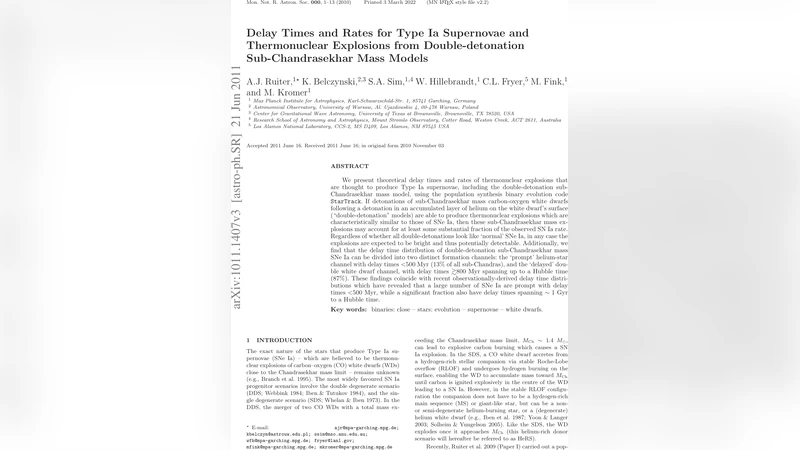
We present theoretical delay times and rates of thermonuclear explosions that are thought to produce Type Ia supernovae, including the double-detonation sub-Chandrasekhar mass model, using the population synthesis binary evolution code StarTrack. If detonations of sub-Chandrasekhar mass carbon-oxygen white dwarfs following a detonation in an accumulated layer of helium on the white dwarf’s surface (“double-detonation” models) are able to produce thermonuclear explosions which are characteristically similar to those of SNe Ia, then these sub-Chandrasekhar mass explosions may account for at least some substantial fraction of the observed SN Ia rate. Regardless of whether all double-detonations look like ’normal’ SNe Ia, in any case the explosions are expected to be bright and thus potentially detectable. Additionally, we find that the delay time distribution of double-detonation sub-Chandrasekhar mass SNe Ia can be divided into two distinct formation channels: the ‘prompt’ helium-star channel with delay times <500 Myr (~10% of all sub-Chandras), and the ‘delayed’ double white dwarf channel, with delay times >800 Myr spanning up to a Hubble time (~90%). These findings coincide with recent observationally-derived delay time distributions which have revealed that a large number of SNe Ia are prompt with delay times <500 Myr, while a significant fraction also have delay times spanning ~1 Gyr to a Hubble time.
💡 Research Summary
This paper presents a comprehensive theoretical investigation of the delay‑time distribution (DTD) and event rates of thermonuclear explosions that are candidates for Type Ia supernovae (SNe Ia), focusing on the double‑detonation sub‑Chandrasekhar mass scenario. Using the binary population synthesis code StarTrack, the authors evolve millions of binary systems under a range of initial mass ratios, orbital periods, and metallicities, tracking pathways that lead to a carbon‑oxygen white dwarf (CO WD) acquiring a helium‑rich layer. When the helium layer reaches a critical mass (≈0.05–0.1 M☉), a surface helium detonation is triggered; the resulting shock compresses and heats the underlying CO core, igniting a second detonation that disrupts the WD. This “double‑detonation” mechanism can produce a bright thermonuclear explosion even when the WD mass is well below the Chandrasekhar limit (0.8–1.1 M☉).
The simulations reveal two distinct formation channels that dominate the sub‑Chandrasekhar DTD. The first, termed the “prompt helium‑star channel,” involves a relatively massive donor that evolves into a helium‑rich star after a common‑envelope phase. Mass transfer from this helium star onto the CO WD builds up the helium layer on a short timescale (< 500 Myr). This channel accounts for roughly 10 % of all double‑detonation events and naturally reproduces the observed population of SNe Ia with very short delay times (≤ 500 Myr). The second, the “delayed double‑white‑dwarf channel,” consists of binaries where two low‑mass stars each become white dwarfs. Gravitational‑wave radiation gradually shrinks the orbit; after ≳ 800 Myr, the less massive WD transfers helium‑rich material onto its companion, again reaching the critical helium mass. This channel supplies about 90 % of the events and yields a broad DTD extending from ~1 Gyr to a Hubble time, matching the observed long‑tail of SNe Ia delay times.
Quantitatively, the authors find that double‑detonation sub‑Chandrasekhar explosions could contribute 10–30 % of the total SN Ia rate in a Milky Way‑like galaxy, depending on assumptions about the efficiency of helium accumulation and the stability of mass transfer. The prompt channel, despite its modest fractional contribution, is essential for reproducing the high‑frequency “young” SN Ia component seen in recent surveys. The delayed channel provides a steady background of events that explains the bulk of the SN Ia population at intermediate and old ages.
The paper also explores the sensitivity of the results to metallicity and to variations in the initial binary parameter distributions. Lower metallicity slightly reduces the efficiency of helium‑layer growth, modestly lowering the overall double‑detonation rate, but the overall shape of the DTD remains robust. The authors discuss that the observable properties of the explosions (peak luminosity, spectral features, light‑curve shape) depend on the mass of the underlying CO core and the thickness of the helium shell. Consequently, not all double‑detonation events will appear identical to “normal” SNe Ia; some may manifest as sub‑luminous or spectroscopically peculiar transients. Nevertheless, the explosions are intrinsically bright, making them readily detectable in current and upcoming wide‑field surveys.
In conclusion, the study demonstrates that double‑detonation sub‑Chandrasekhar mass models provide a viable and potentially dominant pathway for producing a substantial fraction of SNe Ia, especially when both the prompt helium‑star and delayed double‑WD channels are considered. The theoretical DTD aligns well with observationally derived distributions that show a bimodal structure—a prompt component (< 500 Myr) and a delayed component extending to several gigayears. The authors recommend further high‑resolution hydrodynamic explosion modeling and systematic comparison with large SN Ia samples to refine the predicted rates, constrain the relative importance of the two channels, and identify observational signatures that can unambiguously confirm the double‑detonation origin of a subset of SNe Ia.
Comments & Academic Discussion
Loading comments...
Leave a Comment