Glassy state of native collagen fibril
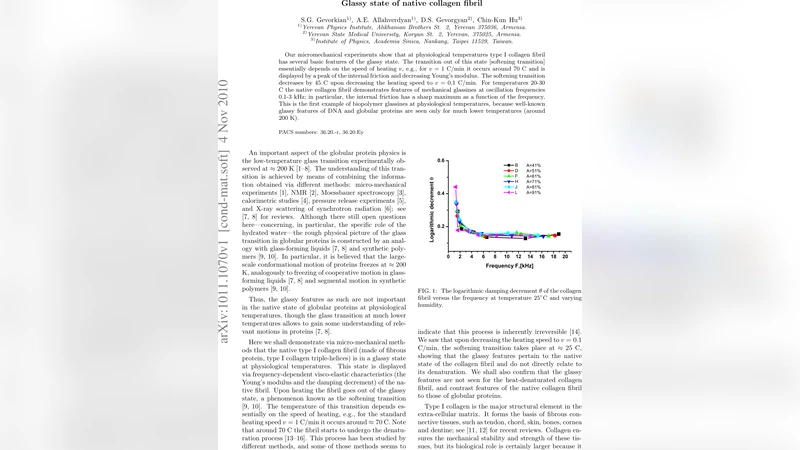
Our micromechanical experiments show that at physiological temperatures type I collagen fibril has several basic features of the glassy state. The transition out of this state [softening transition] essentially depends on the speed of heating v, e.g., for v=1 C/min it occurs around 70 C and is displayed by a peak of the internal friction and decreasing Young’s modulus. The softening transition decreases by 45 C upon decreasing the heating speed to v=0.1 C/min. For temperatures 20-30 C the native collagen fibril demonstrates features of mechanical glassines at oscillation frequencies 0.1-3 kHz; in particular, the internal friction has a sharp maximum as a function of the frequency. This is the first example of biopolymer glassines at physiological temperatures, because well-known glassy features of DNA and globular proteins are seen only for much lower temperatures (around 200 K).