An interface between physics and number theory
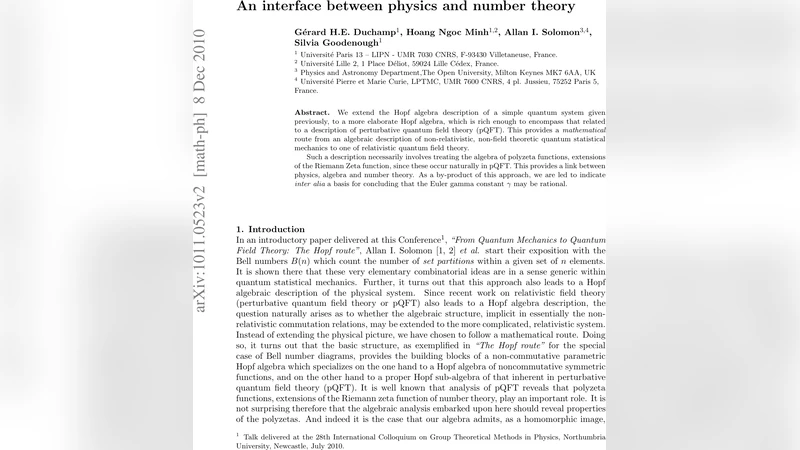
We extend the Hopf algebra description of a simple quantum system given previously, to a more elaborate Hopf algebra, which is rich enough to encompass that related to a description of perturbative quantum field theory (pQFT). This provides a {\em mathematical} route from an algebraic description of non-relativistic, non-field theoretic quantum statistical mechanics to one of relativistic quantum field theory. Such a description necessarily involves treating the algebra of polyzeta functions, extensions of the Riemann Zeta function, since these occur naturally in pQFT. This provides a link between physics, algebra and number theory. As a by-product of this approach, we are led to indicate {\it inter alia} a basis for concluding that the Euler gamma constant $\gamma$ may be rational.
💡 Research Summary
The paper sets out to build a bridge between non‑relativistic quantum statistical mechanics and relativistic perturbative quantum field theory (pQFT) by means of Hopf algebras. It begins with a review of a “basic” Hopf algebra that is sufficient to encode the algebraic structure of simple quantum systems such as harmonic oscillators or spin chains. In this elementary setting, the algebraic operations (product, coproduct, antipode) correspond to physical processes like time evolution, composition of subsystems, and taking adjoints. However, this modest Hopf algebra cannot capture the combinatorial complexity of Feynman diagrams that appear in pQFT.
To address this limitation the authors turn to the Connes–Kreimer Hopf algebra of rooted Feynman graphs. In that construction the coproduct encodes the insertion of sub‑graphs, the product is the disjoint union of graphs, and the antipode implements the BPHZ subtraction scheme. Crucially, the combinatorics of this Hopf algebra mirrors the algebra of multiple zeta values (MZVs), also known as poly‑zeta functions. An MZV of depth k is defined by
\
Comments & Academic Discussion
Loading comments...
Leave a Comment