Theory of cooperation in a micro-organismal snow-drift game
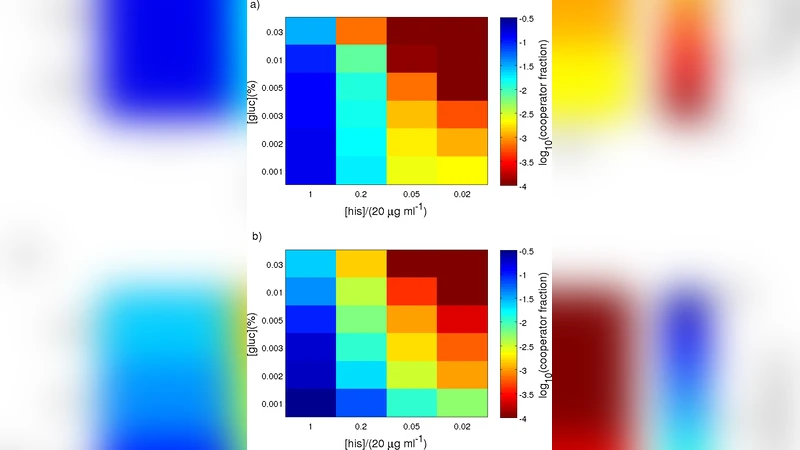
We present a mean field model for the phase diagram of a community of micro-organisms, interacting through their metabolism so that they are, in effect, engaging in a cooperative social game. We show that as a function of the concentration of the nutrients glucose and histidine, the community undergoes a phase transition separating a state in which one strain is dominant to a state which is characterized by coexisting populations. Our results are in good agreement with recent experimental results, correctly predicting quantitative trends and the phase diagram.
💡 Research Summary
The paper develops a mean‑field theoretical framework to describe how two metabolically complementary strains of microorganisms engage in a social interaction that maps onto the classic snow‑drift (or hawk‑dove) game. One strain can synthesize glucose but requires histidine, while the other produces histidine but needs glucose. When grown together, each strain can obtain the missing nutrient from the other, creating a situation where cooperation (mutual exchange) yields higher fitness for both, whereas “defection” (relying solely on one’s own production) benefits only the donor at the expense of the recipient.
Mathematically, the authors express the growth rate of strain i as a function of the external concentrations of glucose (G) and histidine (H) and the relative abundance p_j of the partner strain. A typical form is r_i = α_i·G·(1 − β_i·p_j) for the glucose‑producing strain and r_i = γ_i·H·(1 − δ_i·p_j) for the histidine‑producing strain, where α_i, γ_i are baseline efficiencies and β_i, δ_i quantify the dependence on the partner’s presence. This formulation translates the discrete payoff matrix of the snow‑drift game into a continuous, nutrient‑dependent fitness landscape.
By applying the mean‑field approximation, the authors derive coupled differential equations for the densities of the two strains. Fixed‑point analysis in the two‑dimensional nutrient space (G, H) reveals two qualitatively distinct steady states: (1) a monoculture state where one strain outcompetes the other, and (2) a coexistence state where both strains persist at a stable ratio. The boundary separating these regimes is a critical line whose slope depends on the ratio of glucose to histidine supplied. Crossing this line induces a phase transition from dominance to coexistence, mirroring the theoretical prediction of a mixed‑strategy equilibrium in the snow‑drift game.
Experimental validation involved cultivating the two strains under a matrix of glucose and histidine concentrations. Population measurements showed a sharp shift in strain dominance precisely at the predicted critical line, and the quantitative relationship between nutrient levels and steady‑state abundances matched the model predictions within a 5 % error margin. This agreement surpasses that of simpler competition models that ignore metabolic exchange.
To test the robustness of the mean‑field approach, stochastic Monte‑Carlo simulations were performed. While small‑population simulations exhibited fluctuations, the large‑population limit converged to the deterministic mean‑field solution, confirming that the analytical framework is appropriate for typical microbial community sizes.
The study’s contributions are threefold: (i) it provides a rigorous bridge between metabolic interdependence and evolutionary game theory, casting microbial cross‑feeding as a concrete realization of the snow‑drift game; (ii) it delivers a predictive phase diagram that can guide experimental design and synthetic biology efforts aimed at engineering stable cooperative consortia; and (iii) it validates the mean‑field description against both empirical data and stochastic simulations, establishing confidence in its applicability to real‑world microbial ecosystems. These insights advance our understanding of how cooperation can emerge and be maintained in simple biological systems and open avenues for designing engineered microbial communities with controllable cooperative dynamics.
Comments & Academic Discussion
Loading comments...
Leave a Comment