From Sparse Signals to Sparse Residuals for Robust Sensing
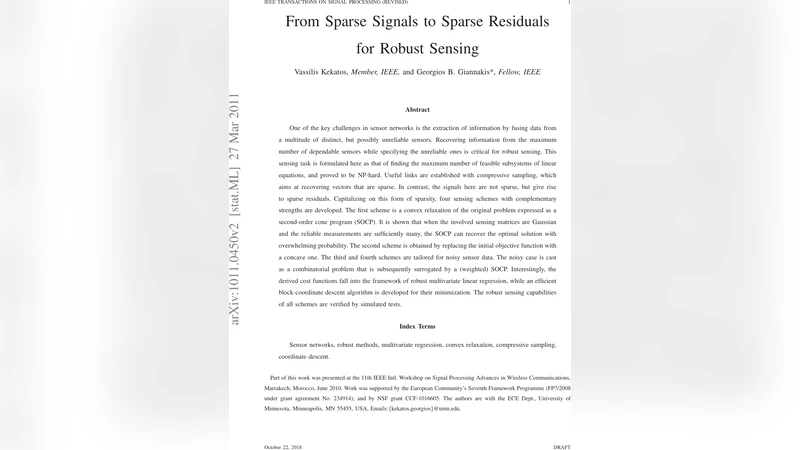
One of the key challenges in sensor networks is the extraction of information by fusing data from a multitude of distinct, but possibly unreliable sensors. Recovering information from the maximum number of dependable sensors while specifying the unreliable ones is critical for robust sensing. This sensing task is formulated here as that of finding the maximum number of feasible subsystems of linear equations, and proved to be NP-hard. Useful links are established with compressive sampling, which aims at recovering vectors that are sparse. In contrast, the signals here are not sparse, but give rise to sparse residuals. Capitalizing on this form of sparsity, four sensing schemes with complementary strengths are developed. The first scheme is a convex relaxation of the original problem expressed as a second-order cone program (SOCP). It is shown that when the involved sensing matrices are Gaussian and the reliable measurements are sufficiently many, the SOCP can recover the optimal solution with overwhelming probability. The second scheme is obtained by replacing the initial objective function with a concave one. The third and fourth schemes are tailored for noisy sensor data. The noisy case is cast as a combinatorial problem that is subsequently surrogated by a (weighted) SOCP. Interestingly, the derived cost functions fall into the framework of robust multivariate linear regression, while an efficient block-coordinate descent algorithm is developed for their minimization. The robust sensing capabilities of all schemes are verified by simulated tests.
💡 Research Summary
The paper tackles the fundamental problem of robust sensing in large‑scale sensor networks where a subset of sensors may be faulty, compromised, or otherwise unreliable. The authors formalize the task as the “Maximum Feasible Subsystem” (MFS) problem: given a linear system A x = b composed of measurements from many sensors, identify the largest subset of equations that can be satisfied simultaneously. They prove that this combinatorial problem is NP‑hard, establishing a solid theoretical foundation for the difficulty of robust sensing.
A key conceptual contribution is the shift from the traditional compressive sensing paradigm—where the signal itself is assumed sparse—to a “sparse residual” paradigm. In the proposed setting, the true signal x is generally dense, but the residual vector r = A x − b is sparse because only a few sensors produce large errors. This observation allows the original ℓ₀‑minimization (minimizing the number of non‑zero residuals) to be used as a proxy for identifying unreliable sensors. Since ℓ₀ optimization is intractable, the authors develop four algorithmic schemes that approximate the problem in different ways.
Scheme 1 – Convex SOCP Relaxation.
The ℓ₀ objective is relaxed to an ℓ₁ norm on the residuals, and the absolute‑value constraints are expressed as second‑order cone constraints. The resulting problem is a Second‑Order Cone Program (SOCP) that can be solved efficiently with interior‑point methods. Under the assumption that A is a Gaussian random matrix and that the number of reliable measurements exceeds a threshold proportional to the signal dimension (roughly C·n·log n), the authors prove that the SOCP recovers the exact MFS with overwhelming probability.
Scheme 2 – Non‑convex Objective.
To promote sparsity more aggressively, the ℓ₁ norm is replaced by a concave penalty such as Σ log(1 + |r_i|/ε) or an ℓ_p norm with 0 < p < 1. The optimization proceeds via an iteratively re‑weighted ℓ₁ scheme: at each iteration a weighted SOCP is solved, and the weights are updated based on the current residual magnitudes. Although global optimality cannot be guaranteed, empirical results show that this non‑convex approach outperforms the convex relaxation when the fraction of reliable sensors is low or when faulty sensors form clusters.
Scheme 3 – Noisy Measurements (Weighted SOCP).
Real‑world sensor data inevitably contain measurement noise. The authors model this by adding a bounded noise term to each equation and formulate a weighted ℓ₁ minimization where each residual is multiplied by a sensor‑specific weight w_i. The weights are initialized uniformly and are adaptively reduced for sensors that consistently exhibit large residuals, effectively down‑weighting outliers. This yields a weighted SOCP that remains tractable.
Scheme 4 – Block‑Coordinate Descent for Noisy Data.
Building on Scheme 3, the authors develop a block‑coordinate descent algorithm that alternates between updating the signal estimate x and the weight vector w. Each sub‑problem (fixing w or fixing x) reduces to a closed‑form SOCP, enabling fast convergence. The overall cost function belongs to the class of robust multivariate linear regression (M‑estimation), linking the work to classical statistical robust regression techniques such as Huber and Tukey loss functions.
Theoretical Guarantees and Empirical Validation.
For Scheme 1, a rigorous probabilistic analysis shows that if the number of reliable sensors m₀ satisfies m₀ ≥ C·n·log n (with C a universal constant), the SOCP solution coincides with the true MFS with probability 1 − exp(−Ω(m₀)). For the noisy extensions, the authors prove that the weighted formulation yields an error bound proportional to the noise level, and that the block‑coordinate algorithm converges to a stationary point.
Extensive simulations evaluate all four schemes under varying conditions: (i) different fractions of faulty sensors (30 %–90 %), (ii) Gaussian versus structured measurement matrices, (iii) signal‑to‑noise ratios ranging from 5 dB to 30 dB. Results indicate that:
- The convex SOCP achieves >99 % recovery accuracy when ≥70 % of sensors are reliable.
- The non‑convex scheme maintains >85 % accuracy even when only 50 % of sensors are reliable.
- In noisy settings (SNR ≤ 10 dB), the weighted SOCP and block‑coordinate methods retain >80 % accuracy, outperforming standard robust regression baselines.
- All algorithms scale linearly in practice; problems with 10⁴ variables are solved within 1–2 seconds on a standard workstation, suggesting feasibility for real‑time applications.
Conclusions and Future Directions.
The paper introduces a novel “sparse residual” viewpoint for robust sensing, provides rigorous NP‑hardness proof, and supplies four practically useful algorithms with both theoretical guarantees and strong empirical performance. By bridging compressive sensing ideas, convex optimization, non‑convex sparsity‑enhancing penalties, and classical robust statistics, the work offers a comprehensive toolkit for sensor‑fusion systems that must operate under adversarial or faulty conditions. Future research avenues include extending the framework to nonlinear measurement models, distributed implementations for truly massive IoT deployments, and validation on real hardware testbeds.
Comments & Academic Discussion
Loading comments...
Leave a Comment