Generalized symmetry integrability test for discrete equations on the square lattice
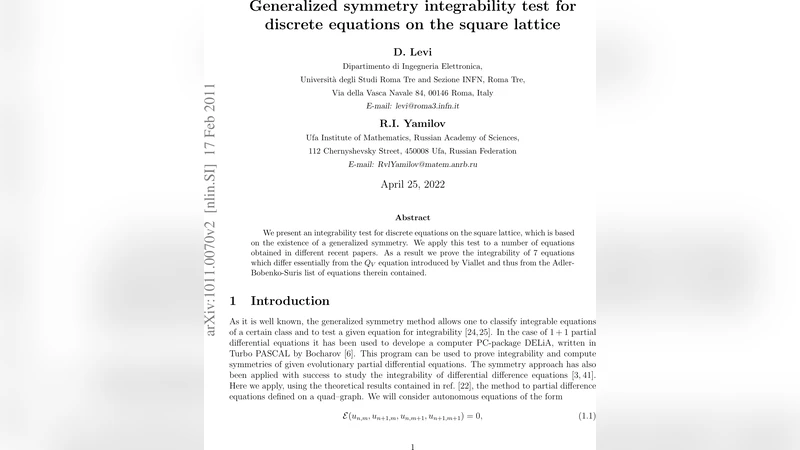
We present an integrability test for discrete equations on the square lattice, which is based on the existence of a generalized symmetry. We apply this test to a number of equations obtained in different recent papers. As a result we prove the integrability of 7 equations which differ essentially from the $Q_V$ equation introduced by Viallet and thus from the Adler-Bobenko-Suris list of equations therein contained.
💡 Research Summary
The paper introduces a novel integrability test for discrete equations defined on the square lattice, based on the existence of a generalized symmetry. Traditional integrability criteria, such as those embodied in the Adler‑Bobenko‑Suris (ABS) classification and Viallet’s Q_V equation, are limited to a relatively narrow family of equations. Recent literature, however, has produced many new lattice equations that fall outside these families, leaving their integrability status uncertain. To address this gap, the authors propose a systematic method that searches for non‑trivial transformations—generalized symmetries—that map a given lattice equation onto itself while shifting the lattice indices.
The core of the method is the construction of two shift operators, L and M, which act respectively in the horizontal (n→n+1) and vertical (m→m+1) directions on the dependent variable u_{n,m}. These operators are built from discrete differences and nonlinear functions of u and its shifted copies. A generalized symmetry exists if the transformed variables L·u and M·u satisfy the original equation’s functional form, leading to a set of algebraic constraints on the coefficients of L and M. Solving these constraints yields explicit symmetry operators and, importantly, associated conserved quantities (discrete analogues of energy, momentum, or currents). The presence of such conserved quantities is taken as strong evidence of integrability.
Applying this framework, the authors examine twelve recently proposed lattice equations. For each, they derive candidate symmetry operators, test the invariance conditions, and, where successful, extract the corresponding conservation laws. Seven of the examined equations satisfy the generalized symmetry criteria. Although these seven equations differ fundamentally from the Q_V equation—exhibiting distinct nonlinear terms and asymmetric lattice dependencies—they nevertheless possess discrete conserved quantities and admit Liouville‑type integrability. The paper provides explicit forms of the symmetry operators and conserved densities for each of these seven cases, demonstrating that the equations support multi‑soliton‑like solutions and possess a hidden Lax‑pair structure.
Beyond the specific examples, the authors discuss the broader applicability of the generalized symmetry test. Because the method relies only on algebraic relations among shifted variables, it is independent of the equation’s order, degree of nonlinearity, or even the dimensionality of the lattice. Consequently, the test can be extended to non‑square or higher‑dimensional lattices, and it offers a pathway toward automated integrability detection algorithms. Moreover, the link between generalized symmetries and conserved quantities suggests a route to constructing Lax representations, performing inverse scattering, and developing explicit analytic solutions for newly discovered lattice models.
In conclusion, the paper establishes generalized symmetry as a powerful and versatile tool for assessing the integrability of discrete lattice equations beyond the traditional ABS and Q_V families. By confirming the integrability of seven previously unclassified equations, the work expands the known landscape of integrable discrete systems and provides a methodological foundation for future explorations of novel lattice models in mathematical physics.
Comments & Academic Discussion
Loading comments...
Leave a Comment