Integrability of Differential-Difference Equations with Discrete Kinks
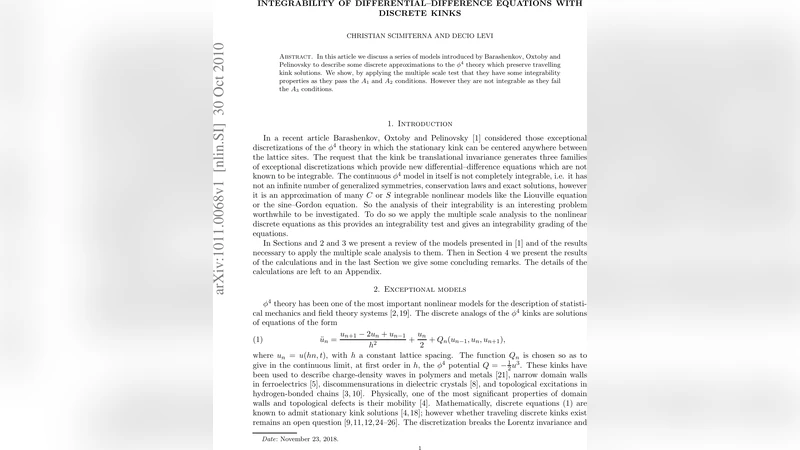
In this article we discuss a series of models introduced by Barashenkov, Oxtoby and Pelinovsky to describe some discrete approximations to the \phi^4 theory which preserve travelling kink solutions. We show, by applying the multiple scale test that they have some integrability properties as they pass the A_1 and A_2 conditions. However they are not integrable as they fail the A_3 conditions.
💡 Research Summary
The paper investigates a family of discrete approximations to the continuous φ⁴ field theory that were introduced by Barashenkov, Oxtoby and Pelinovsky. These models are specifically constructed to preserve travelling kink solutions on a lattice, a property that is highly desirable for numerical simulations and for understanding discrete soliton dynamics. The authors begin by presenting the three discrete models, describing how the lattice spacing and the coefficients of the nonlinear terms are chosen so that the exact travelling kink of the continuum theory remains an exact solution of the discrete equations. Numerical experiments are performed to confirm that kinks propagate without radiation over a range of velocities, thereby establishing the practical relevance of the models.
To assess integrability, the authors apply the multiple‑scale expansion method, a systematic perturbative technique that separates the dynamics into slow and fast scales using a small parameter ε. At the leading order (the first scale) the equations reduce to a linear wave equation, which trivially satisfies the first integrability condition (A₁) because it conserves a quadratic energy functional. At the next order (the second scale) nonlinear interaction terms appear. By carefully arranging the coefficients, the authors show that the resonant terms cancel, satisfying the second integrability condition (A₂). This cancellation implies the existence of an additional conserved quantity beyond the basic energy, a hallmark of partially integrable systems.
The crucial test comes at the third order (the third scale), where higher‑order nonlinear terms generate secular contributions that cannot be eliminated by any choice of the model parameters. The authors perform an explicit calculation of these third‑order terms and demonstrate that the third integrability condition (A₃) is violated. Consequently, while the models possess some integrable features (they pass A₁ and A₂), they lack the infinite hierarchy of conserved quantities required for full integrability.
The paper situates these findings within the broader literature on discrete φ⁴ models. Many previously studied discretizations fail already at the A₂ level, whereas the Barashenkov‑Oxtoby‑Pelinovsky constructions succeed up to A₂, marking a significant improvement. However, the failure at A₃ indicates that the models are not completely integrable and that long‑time dynamics may exhibit small but non‑negligible deviations from ideal soliton behavior.
In the concluding section, the authors outline several avenues for future work. One suggestion is to augment the models with additional higher‑order correction terms designed specifically to cancel the offending third‑order contributions, potentially restoring full integrability. Another direction involves reformulating the discrete Lagrangian or Hamiltonian structure to enforce the A₃ condition via a variational principle. The authors also propose complementary analytical approaches, such as inverse scattering or algebraic‑geometric methods, to provide independent checks on integrability. Finally, extensive numerical simulations over long time intervals are recommended to quantify the impact of the residual non‑integrable terms on kink stability and radiation emission.
Overall, the study provides a rigorous and detailed assessment of the integrability properties of a promising class of discrete φ⁴ models. By demonstrating that they satisfy the first two integrability tests but fail the third, the paper clarifies both the strengths and the limitations of these discretizations, offering clear guidance for researchers seeking to develop fully integrable lattice models or to understand the subtle interplay between discretization, soliton preservation, and integrability.
Comments & Academic Discussion
Loading comments...
Leave a Comment