Trapped, Two-Armed, Nearly Vertical Oscillations in Disks with Toroidal Magnetic Fields
We have examined trapping of two-armed ($m=2$) nearly vertical oscillations (vertical p-mode) in vertically isothermal ($c_{ rm s}=$ const.) relativistic disks with toroidal magnetic fields. The magne
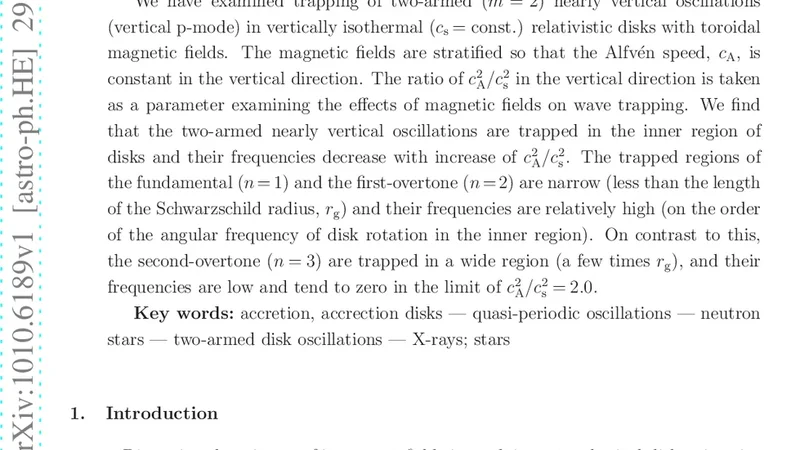
We have examined trapping of two-armed ($m=2$) nearly vertical oscillations (vertical p-mode) in vertically isothermal ($c_{\rm s}=$ const.) relativistic disks with toroidal magnetic fields. The magnetic fields are stratified so that the Alfv{'e}n speed, $c_{\rm A}$, is constant in the vertical direction. The ratio of $c_{\rm A}^2/c_{\rm s}^2$ in the vertical direction is taken as a parameter examining the effects of magnetic fields on wave trapping. We find that the two-armed nearly vertical oscillations are trapped in the inner region of disks and their frequencies decrease with increase of $c_{\rm A}^2/c_{\rm s}^2$. The trapped regions of the fundamental ($n=1$) and the first-overtone ($n=2$) are narrow (less than the length of the Schwarzschild radius, $r_{\rm g}$) and their frequencies are relatively high (on the order of the angular frequency of disk rotation in the inner region). On contrast to this, the second-overtone ($n=3$) are trapped in a wide region (a few times $r_{\rm g}$), and their frequencies are low and tend to zero in the limit of $c_{\rm A}^2/c_{\rm s}^2=2.0$.
💡 Research Summary
The paper investigates the trapping of two‑armed ($m=2$) nearly vertical oscillations—also known as vertical p‑modes—in relativistic accretion disks that are vertically isothermal and permeated by toroidal magnetic fields. The authors adopt a simplified yet physically motivated disk model: the sound speed $c_{\rm s}$ is constant in the vertical direction, while the toroidal magnetic field is stratified such that the Alfvén speed $c_{\rm A}$ remains uniform with height. This construction reduces the magnetic influence to a single dimensionless parameter, the ratio $c_{\rm A}^2/c_{\rm s}^2$, which the study varies systematically to explore its impact on wave trapping.
The analysis begins with the linearized magnetohydrodynamic (MHD) equations in a general relativistic framework, assuming a thin Keplerian disk around a non‑rotating (Schwarzschild) black hole. By separating variables in the azimuthal ($\varphi$) and vertical ($z$) directions, the authors reduce the problem to a radial wave equation that can be written in a Schrödinger‑like form, \
📜 Original Paper Content
🚀 Synchronizing high-quality layout from 1TB storage...