The influence of collimation on the appearance of relativistic jets
The question of the collimation of relativistic jets is the subject of a lively debate in the community. We numerically compute the apparent velocity and the Doppler factor of a non homokinetic jet us
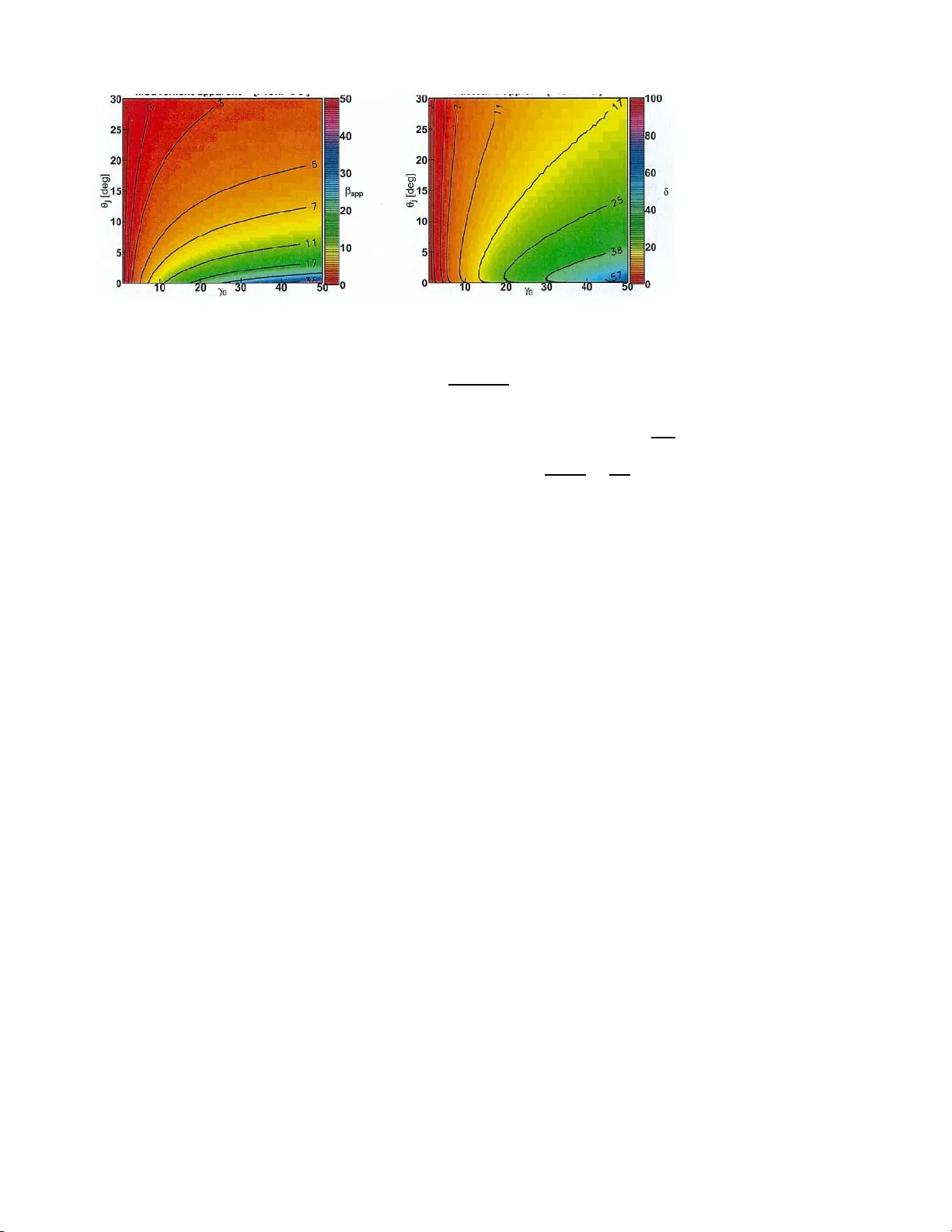
The question of the collimation of relativistic jets is the subject of a lively debate in the community. We numerically compute the apparent velocity and the Doppler factor of a non homokinetic jet using different velocity profile, to study the effect of collimation on the appearance of relativistic jets (apparent velocity and Doppler factor). We argue that if the motion is relativistic, the high superluminal velocities are possible only if the geometrical collimation is smaller than the relativistic beaming angle $\gamma^{-1}$. In the opposite case, the apparent image will be dominated by the part of the jet traveling directly towards the observer resulting in a smaller apparent velocity. Furthermore, getting rid of the homokinetic hypothesis yields a complex relation between the observing angle and the Doppler factor, resulting in important consequences for the numerical computation of AGN population and unification scheme model.
💡 Research Summary
The paper investigates how the geometric collimation of relativistic jets influences their observable properties, specifically the apparent (super‑luminal) velocity and the Doppler boosting factor. Departing from the traditional assumption of a homogeneous (single‑Lorentz‑factor) jet, the authors construct numerical models in which the bulk Lorentz factor γ varies with polar angle θ from the jet axis. Two representative angular profiles are explored: a Gaussian decline γ(θ)=γ₀ exp
📜 Original Paper Content
🚀 Synchronizing high-quality layout from 1TB storage...