Surveying the Dynamic Radio Sky with the Long Wavelength Demonstrator Array
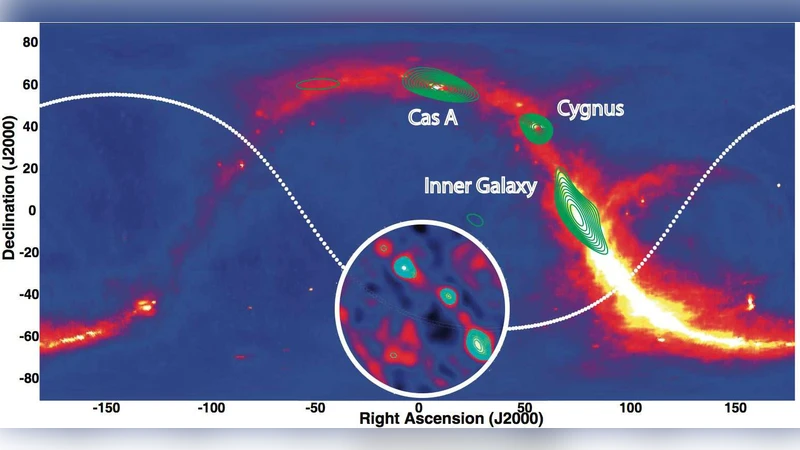
This paper presents a search for radio transients at a frequency of 73.8 MHz (4 m wavelength) using the all-sky imaging capabilities of the Long Wavelength Demonstrator Array (LWDA). The LWDA was a 16-dipole phased array telescope, located on the site of the Very Large Array in New Mexico. The field of view of the individual dipoles was essentially the entire sky, and the number of dipoles was sufficiently small that a simple software correlator could be used to make all-sky images. From 2006 October to 2007 February, we conducted an all-sky transient search program, acquiring a total of 106 hr of data; the time sampling varied, being 5 minutes at the start of the program and improving to 2 minutes by the end of the program. We were able to detect solar flares, and in a special-purpose mode, radio reflections from ionized meteor trails during the 2006 Leonid meteor shower. We detected no transients originating outside of the solar system above a flux density limit of 500 Jy, equivalent to a limit of no more than about 10^{-2} events/yr/deg^2, having a pulse energy density >~ 1.5 x 10^{-20} J/m^2/Hz at 73.8 MHz for pulse widths of about 300 s. This event rate is comparable to that determined from previous all-sky transient searches, but at a lower frequency than most previous all-sky searches. We believe that the LWDA illustrates how an all-sky imaging mode could be a useful operational model for low-frequency instruments such as the Low Frequency Array, the Long Wavelength Array station, the low-frequency component of the Square Kilometre Array, and potentially the Lunar Radio Array.
💡 Research Summary
The paper reports on a dedicated all‑sky transient search conducted with the Long Wavelength Demonstrator Array (LWDA) at a central frequency of 73.8 MHz (λ≈4 m). LWDA was a modest 16‑dipole phased‑array situated on the Very Large Array site in New Mexico. Because each dipole has an essentially full‑sky field of view, the entire sky could be imaged with a simple software correlator that cross‑correlated all dipole pairs in real time.
Observations spanned from October 2006 to February 2007, accumulating a total of 106 hours of data. The time resolution evolved during the campaign: early observations were sampled every 5 minutes, while later runs achieved a 2‑minute cadence after improvements to the data‑acquisition pipeline. This cadence is well suited to detecting events with durations of several minutes to a few hours, which is the regime expected for many low‑frequency transients (e.g., planetary auroral bursts, flare star outbursts, or long‑duration pulsar giant pulses).
Data processing consisted of three main stages. First, radio‑frequency interference (RFI) was mitigated using standard flagging and baseline‑cut techniques. Second, a software correlator generated visibilities for every dipole pair, which were Fourier‑transformed to produce full‑sky images at each time step. Third, a differencing (image subtraction) algorithm removed the static sky, leaving only transient excesses. This differencing approach dramatically reduced false positives from steady sources and residual imaging artefacts.
The achieved sensitivity was 1σ≈500 Jy for a 300‑second integration, corresponding to a pulse energy density of ≳1.5 × 10⁻²⁰ J m⁻² Hz⁻¹. Within the surveyed period the array readily detected solar radio flares, confirming that the system functioned as expected. In a special mode triggered during the 2006 Leonid meteor shower, reflections from ionized meteor trails in the ionosphere were also recorded, demonstrating the instrument’s ability to capture non‑astrophysical transient phenomena.
No extraterrestrial transients were found above the 500 Jy threshold. From this null result the authors derive an upper limit on the sky‑averaged transient rate of ≲10⁻² events yr⁻¹ deg⁻² for events with pulse widths of order 300 s and energy densities above the quoted limit. This rate is consistent with earlier all‑sky searches performed at higher frequencies (e.g., VLA, ATA, LOFAR) and indicates that, at least for relatively bright, long‑duration bursts, the low‑frequency sky is not more active than the higher‑frequency sky.
The paper emphasizes the broader significance of the “all‑sky imaging mode.” Because the LWDA required only a modest number of dipoles and a simple software correlator, the same concept can be scaled to much larger low‑frequency facilities such as LOFAR, the Long Wavelength Array (LWA), the low‑frequency component of the Square Kilometre Array (SKA‑low), and even a future Lunar Radio Array. In those instruments, a dedicated transient imaging pipeline could run in parallel with standard science observations, providing continuous monitoring of the entire visible sky without the need for separate, narrow‑field pointings.
Nevertheless, the authors acknowledge limitations. The modest collecting area of 16 dipoles restricts sensitivity, and the coarse angular resolution (set by the maximum baseline of ~20 m) hampers precise localisation of any detected event. Improving sensitivity will require more dipoles or stations, longer baselines, and more sophisticated RFI excision. Higher time resolution (sub‑minute sampling) would also broaden the accessible parameter space, allowing detection of shorter, fainter bursts such as fast radio bursts (FRBs) or pulsar giant pulses that may have steep spectra extending into the low‑frequency regime.
In conclusion, the LWDA experiment demonstrates that a simple, all‑sky imaging approach is feasible at meter wavelengths and can place meaningful constraints on the rate of bright, long‑duration transients. The null detection at 73.8 MHz adds an important low‑frequency data point to the emerging picture of the transient radio sky, and the operational model pioneered here provides a template for future low‑frequency arrays to incorporate continuous, wide‑field transient monitoring into their standard observing strategies.
Comments & Academic Discussion
Loading comments...
Leave a Comment