Supersoft X-ray Phase of Single Degenerate Type Ia Supernova Progenitors in Early Type Galaxies
In the single degenerate (SD) scenario for Type Ia supernova (SN Ia) progenitors, an accreting white dwarf (WD) is expected to undergo a supersoft X-ray source (SSS) phase. Recently, Gilfanov & Bogdan
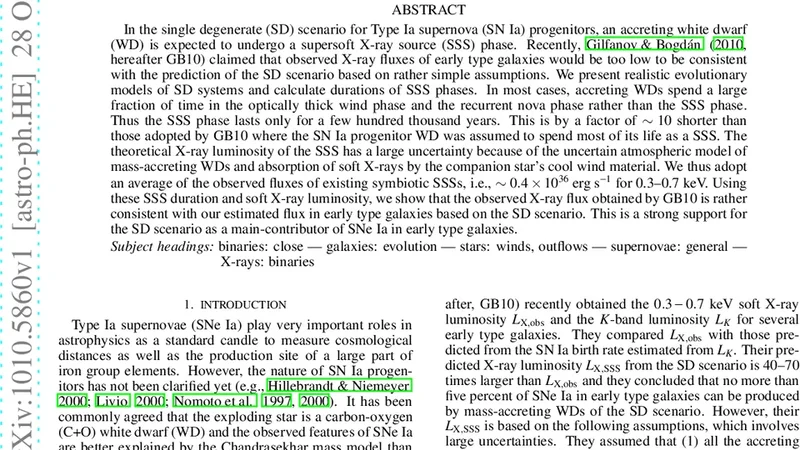
In the single degenerate (SD) scenario for Type Ia supernova (SN Ia) progenitors, an accreting white dwarf (WD) is expected to undergo a supersoft X-ray source (SSS) phase. Recently, Gilfanov & Bogdan (2010, hereafter GB10) claimed that observed X-ray fluxes of early type galaxies would be too low to be consistent with the prediction of the SD scenario based on rather simple assumptions. We present realistic evolutionary models of SD systems and calculate durations of SSS phases. In most cases, accreting WDs spend a large fraction of time in the optically thick wind phase and the recurrent nova phase rather than the SSS phase. Thus the SSS phase lasts only for a few hundred thousand years. This is by a factor of 10 shorter than those adopted by GB10 where the SNIa progenitor WD was assumed to spend most of its life as a SSS. The theoretical X-ray luminosity of the SSS has a large uncertainty because of the uncertain atmospheric model of mass-accreting WDs and absorption of soft X-rays by the companion star’s cool wind material. We thus adopt an average of the observed fluxes of existing symbiotic SSSs, i.e., ~0.4 x 10^{36} erg s^{-1} for 0.3–0.7 keV. Using these SSS duration and soft X-ray luminosity, we show that the observed X-ray flux obtained by GB10 is rather consistent with our estimated flux in early type galaxies based on the SD scenario. This is a strong support for the SD scenario as a main-contributor of SNe Ia in early type galaxies.
💡 Research Summary
The paper revisits the long‑standing debate over the contribution of the single‑degenerate (SD) channel to Type Ia supernovae (SNe Ia) in early‑type galaxies. In the SD scenario a carbon‑oxygen white dwarf (WD) accretes matter from a non‑degenerate companion and, as it approaches the Chandrasekhar mass, is expected to shine as a supersoft X‑ray source (SSS) for a substantial fraction of its pre‑explosion life. Gilfanov & Bogdan (2010, GB10) argued that the observed soft X‑ray luminosities of early‑type galaxies are far below the values predicted by a simple SD model that assumes the WD spends most of its mass‑gaining phase as an SSS. Consequently, they claimed that the SD channel cannot be a major contributor to SNe Ia in such galaxies.
To test this claim the authors construct detailed binary‑evolution models that follow the WD through three distinct phases determined by the mass‑transfer rate (Ṁ) and the WD mass (M_WD): (1) an optically thick wind phase when Ṁ exceeds a critical value (~10⁻⁶ M_⊙ yr⁻¹); (2) a genuine SSS phase when Ṁ falls below the wind threshold but remains high enough for steady hydrogen burning; and (3) a recurrent‑nova (RN) phase when Ṁ is too low for stable burning. Their calculations show that, for typical SD progenitors, the wind phase dominates the evolutionary timescale, lasting of order 1–1.5 Myr, whereas the SSS phase is short, only a few × 10⁵ yr (≈10 % of the total). This is roughly an order of magnitude shorter than the 2 Myr SSS lifetime implicitly assumed by GB10.
The authors also address the large uncertainty in the intrinsic soft X‑ray luminosity of an SSS. Theoretical WD atmosphere models predict a wide range of L_X depending on temperature, composition, and surface gravity, while circumstellar material from the companion’s wind can further absorb soft photons. Rather than relying on uncertain theory, they adopt an empirical average based on the few known symbiotic SSSs (e.g., SMC 3, Lin 358), namely L_X ≈ 0.4 × 10³⁶ erg s⁻¹ in the 0.3–0.7 keV band.
Using the revised SSS lifetime and the empirical L_X, they estimate the number of active SSSs in a galaxy as N_SSS ≈ R_Ia × t_SSS, where R_Ia is the SN Ia rate (≈5 × 10⁻⁴ yr⁻¹ per 10¹⁰ M_⊙ for early‑type galaxies) and t_SSS is the SSS duration (~3 × 10⁵ yr). This yields N_SSS ≈ 150 per 10¹⁰ M_⊙. Multiplying by the average luminosity gives a total soft X‑ray output of L_X,total ≈ 6 × 10³⁸ erg s⁻¹, which is comfortably within the range of the observed values reported by GB10 (2–5 × 10³⁸ erg s⁻¹).
Thus, the apparent discrepancy highlighted by GB10 disappears once realistic evolutionary timescales and empirically calibrated X‑ray luminosities are employed. The paper concludes that the SD channel remains a viable, perhaps dominant, pathway for SNe Ia in early‑type galaxies, contrary to the earlier claim. It also emphasizes that uncertainties remain—particularly in WD atmospheric modeling and wind absorption—and that future high‑sensitivity soft X‑ray observations, combined with refined binary‑population synthesis, are essential to quantify the relative contributions of the SD and double‑degenerate (DD) channels.
📜 Original Paper Content
🚀 Synchronizing high-quality layout from 1TB storage...