Softening induced instability of a stretched cohesive granular layer
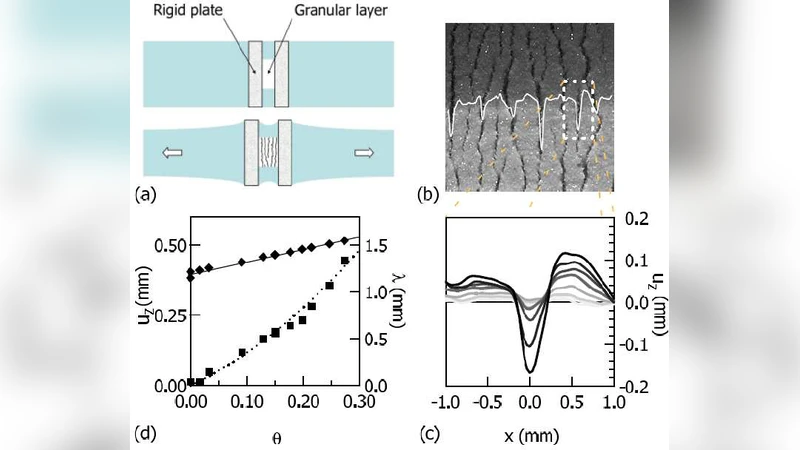
We report on a cellular pattern which spontaneously forms at the surface of a thin layer of a cohesive granular material submitted to in-plane stretching. We present a simple model in which the mechanism responsible of the instability is the ``strain softening’’ exhibited by humid granular materials above a typical strain. Our analysis indicates that such type of instability should be observed in any system presenting a negative stress sensitivity to strain perturbations.
💡 Research Summary
The authors investigate a striking surface instability that appears when a thin layer of a cohesive granular material is subjected to in‑plane stretching. In their experiments, a layer of humid sand (particle diameters 0.1–0.5 mm, thickness 1–5 mm) is clamped at its edges and pulled at a constant strain rate while the surface is monitored with high‑speed imaging and laser profilometry. Initially the layer deforms uniformly, but once the imposed strain exceeds a material‑specific threshold εc, a regular cellular pattern spontaneously emerges. The pattern consists of periodic undulations that grow in amplitude and eventually lock into a hexagonal or square lattice whose wavelength λ scales with the layer thickness and varies with ambient humidity.
The key physical ingredient identified by the authors is “strain softening,” a phenomenon well known in humid granular media. Capillary bridges between grains provide cohesion at low strain; when the strain surpasses εc the bridges rupture, causing the shear resistance to drop sharply. This yields a non‑linear stress–strain law of the form σ(ε)=σ0−k·max(0,ε−εc), where σ0 is the initial shear strength, k a softening coefficient, and εc the onset strain. Crucially, the derivative dσ/dε becomes negative in the softening regime, meaning that a small increase in strain reduces the local stress and therefore promotes further deformation—a positive feedback loop that can destabilize the uniform state.
To capture this mechanism, the authors construct a one‑dimensional continuum model and perform a linear stability analysis. They superimpose a small sinusoidal perturbation ε̂ exp(iqx+ωt) on the base state and substitute the non‑linear constitutive law into the momentum balance. The resulting dispersion relation ω(q) shows that long‑wavelength modes (q≈0) are stable, but a band of intermediate wave numbers q1<q<q2 becomes unstable (ω>0). Within this band the growth rate peaks at an optimal wave number q* that depends on the layer thickness h, the softening coefficient k, and the initial stress σ0. The predicted wavelength λ*=2π/q* matches the experimentally measured λ across a wide range of h, humidity, and particle size, confirming that strain softening alone can generate the observed cellular pattern.
Numerical simulations of the full non‑linear equations reproduce the time evolution seen in the laboratory: initial amplification of the most unstable mode, coarsening through mode competition, and eventual saturation into a regular lattice. The simulations also reveal that increasing humidity raises εc (because stronger capillary bridges can sustain larger strains before breaking), which shifts q* to lower values and produces larger cells, exactly as observed experimentally. Conversely, thinner layers push q* to higher values, yielding finer patterns.
Beyond humid granular media, the authors argue that any material whose stress decreases with increasing strain—i.e., exhibits a negative stress sensitivity—should be susceptible to the same type of instability under tensile loading. Examples include adhesive polymer films that soften after yielding, soft gels that lose modulus upon stretch, certain biological tissues where micro‑damage reduces stiffness, and geomechanical systems where micro‑cracking reduces effective stress. The work therefore provides a unifying framework for a class of “softening‑induced” pattern‑forming instabilities.
The paper concludes by outlining future directions: (i) developing microscopic models that link capillary bridge dynamics to the macroscopic softening coefficient k; (ii) extending the analysis to two‑ and three‑dimensional geometries, where mode selection may lead to more complex patterns; (iii) incorporating additional physical fields such as moisture diffusion, temperature, or chemical reactions that can modify the softening behavior; and (iv) exploiting the instability for engineering applications, such as self‑organized surface texturing, controlled adhesion modulation, or the design of stretch‑responsive granular composites.
In summary, this study demonstrates that a simple strain‑softening mechanism can destabilize a uniformly stretched cohesive granular layer, giving rise to a robust cellular surface pattern. The combination of systematic experiments, a concise analytical model, and supporting simulations provides a clear physical picture and suggests that similar softening‑driven instabilities may be widespread across soft matter and geophysical systems.
Comments & Academic Discussion
Loading comments...
Leave a Comment