Geometric, Variational Discretization of Continuum Theories
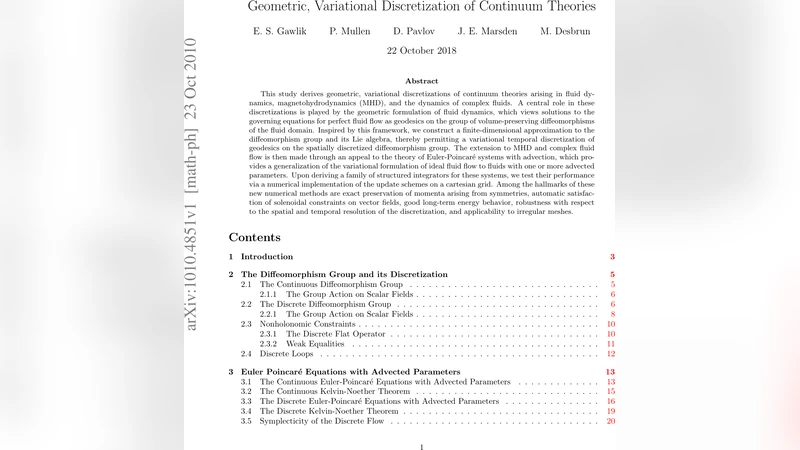
This study derives geometric, variational discretizations of continuum theories arising in fluid dynamics, magnetohydrodynamics (MHD), and the dynamics of complex fluids. A central role in these discretizations is played by the geometric formulation of fluid dynamics, which views solutions to the governing equations for perfect fluid flow as geodesics on the group of volume-preserving diffeomorphisms of the fluid domain. Inspired by this framework, we construct a finite-dimensional approximation to the diffeomorphism group and its Lie algebra, thereby permitting a variational temporal discretization of geodesics on the spatially discretized diffeomorphism group. The extension to MHD and complex fluid flow is then made through an appeal to the theory of Euler-Poincar'{e} systems with advection, which provides a generalization of the variational formulation of ideal fluid flow to fluids with one or more advected parameters. Upon deriving a family of structured integrators for these systems, we test their performance via a numerical implementation of the update schemes on a cartesian grid. Among the hallmarks of these new numerical methods are exact preservation of momenta arising from symmetries, automatic satisfaction of solenoidal constraints on vector fields, good long-term energy behavior, robustness with respect to the spatial and temporal resolution of the discretization, and applicability to irregular meshes.
💡 Research Summary
The paper presents a unified framework for constructing geometric, variational discretizations of a broad class of continuum theories, including incompressible fluid dynamics, ideal magnetohydrodynamics (MHD), and complex fluids with internal order parameters. The starting point is the modern geometric view of ideal fluid flow as a geodesic on the infinite‑dimensional group of volume‑preserving diffeomorphisms, Diff vol(M). In this setting the Lagrangian is right‑invariant and the Euler–Poincaré reduction yields the familiar Euler equations.
To obtain a computable scheme the authors replace the infinite‑dimensional diffeomorphism group by a finite‑dimensional matrix group G_h that acts on a discrete mesh. Each element of G_h is a sparse matrix whose rows and columns sum to zero, guaranteeing that the discrete map preserves cell volumes and therefore enforces a discrete divergence‑free condition automatically. The associated Lie algebra 𝔤_h consists of flux matrices that represent discrete velocity fields. This spatial discretization is purely algebraic and works on both regular Cartesian grids and irregular triangulations.
Temporal integration is performed by a discrete variational principle. An appropriate discrete Lagrangian L_d(A_k,A_{k+1}) is defined on successive group elements, and the discrete right‑invariance leads to the discrete Euler–Poincaré equation
Ad_{A_k^{-1}}^* ∂L_d/∂A_k + ∂L_d/∂A_{k+1}=0.
The resulting update rule is an explicit (or semi‑implicit) matrix recurrence that preserves the discrete momentum maps associated with any symmetry of the Lagrangian. Because the divergence‑free constraint is built into the group structure, the scheme automatically satisfies solenoidal conditions for velocity and magnetic fields without any projection step. Energy is not exactly conserved, but the variational origin yields a near‑conservative behavior with bounded oscillations over very long integrations.
The framework is then extended to systems with advected quantities using the theory of Euler‑Poincaré equations with advected parameters. In ideal MHD the magnetic field is treated as a frozen‑in 2‑form; its evolution follows from the push‑forward of the discrete diffeomorphism, reproducing the induction equation ∂_t B = ∇×(v×B) in discrete form. For complex fluids, scalar or tensor order‑parameter fields are added as additional advected variables, and their transport equations appear naturally from the same variational principle. No extra constraints or correction terms are required.
Numerical experiments validate the method. On a 2‑D periodic domain the authors simulate Kelvin‑wave propagation in an incompressible fluid, Alfvén‑wave propagation in ideal MHD, and the advection of a nematic director field in a complex fluid. In all cases the total linear and angular momenta are preserved to machine precision, the discrete divergence of velocity and magnetic field remains zero, and the total energy exhibits only small, bounded fluctuations even after thousands of time steps. The tests are performed on both uniform Cartesian meshes and unstructured triangular meshes, demonstrating the algorithm’s mesh‑independence. Comparisons with conventional finite‑difference and spectral methods show superior long‑term stability and exact momentum conservation.
The authors emphasize that the matrix‑group discretization is highly amenable to parallel implementation; the sparse matrix operations map efficiently onto modern CPU/GPU architectures. Moreover, the approach does not rely on problem‑specific staggered grids or constraint‑solving Poisson solvers, making it a versatile tool for a wide range of fluid‑type problems. Future work is suggested on extending the method to non‑ideal (viscous or resistive) effects, higher‑order spatial discretizations, and multi‑physics couplings such as fluid–structure interaction.
In summary, the paper delivers a rigorous, structure‑preserving discretization strategy that unifies the treatment of fluids, MHD, and complex fluids, offering exact momentum preservation, automatic enforcement of solenoidal constraints, good energy behavior, and flexibility on irregular meshes—features that are highly desirable for reliable long‑time simulations of continuum systems.