The critical effect of dependency groups on the function of networks
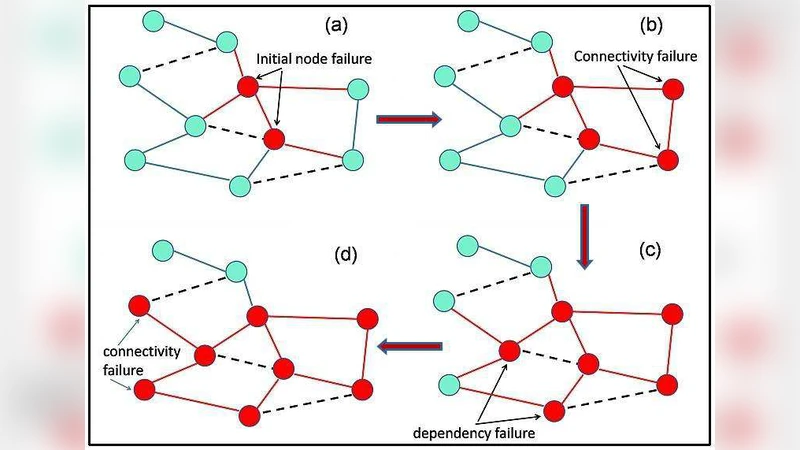
Current network models assume one type of links to define the relations between the network entities. However, many real networks can only be correctly described using two different types of relations. Connectivity links that enable the nodes to function cooperatively as a network and dependency links that bind the failure of one network element to the failure of other network elements. Here we present for the first time an analytical framework for studying the robustness of networks that include both connectivity and dependency links. We show that the synergy between the two types of failures leads to an iterative process of cascading failures that has a devastating effect on the network stability and completely alters the known assumptions regarding the robustness of networks. We present exact analytical results for the dramatic change in the network behavior when introducing dependency links. For a high density of dependency links the network disintegrates in a form of a first order phase transition while for a low density of dependency links the network disintegrates in a second order transition. Moreover, opposed to networks containing only connectivity links where a broader degree distribution results in a more robust network, when both types of links are present a broad degree distribution leads to higher vulnerability.
💡 Research Summary
The paper introduces a novel analytical framework for studying the robustness of complex networks that contain two fundamentally different types of links: connectivity links, which enable cooperative function among nodes, and dependency links, which bind the failure of one node to the failure of others. Traditional network models consider only a single class of edges, implicitly assuming that node failures propagate solely through the connectivity structure. However, many real‑world systems—such as power grids, financial markets, and cloud computing platforms—exhibit strong inter‑dependencies: the malfunction of a component can instantly incapacitate a set of other components, regardless of whether they are directly connected.
To capture this duality, the authors model a network as a random graph (G(N, P(k))) characterized by a degree distribution (P(k)) for connectivity links, together with a set of dependency groups (D(N, Q(s))) described by a size distribution (Q(s)). Each node may belong to one or more connectivity edges and to exactly one dependency group. A dependency group behaves like a “contagion” cluster: if any member fails, the entire group fails simultaneously. The cascade process therefore consists of two intertwined stages. First, after an initial attack that removes a fraction (1-p) of nodes, the remaining nodes undergo a standard percolation process along connectivity edges, forming a giant component of size determined by the usual generating‑function formalism. Second, the surviving component is pruned by the dependency rule: any dependency group that is not fully contained within the giant component is eliminated, causing additional node removals and potentially triggering further percolation steps. This iterative interplay continues until a fixed point is reached.
Mathematically, the authors derive coupled self‑consistency equations for the probabilities (x) (a randomly chosen edge leads to the giant component) and (y) (a randomly chosen dependency group survives). Using generating functions (G_0(z)=\sum_k P(k)z^k) and (H_0(z)=\sum_s Q(s)z^s), the final fraction of functional nodes (S) is expressed as
\
Comments & Academic Discussion
Loading comments...
Leave a Comment