Explosions Triggered by Violent Binary-Star Collisions: Application to Eta Carinae and other Eruptive Transients
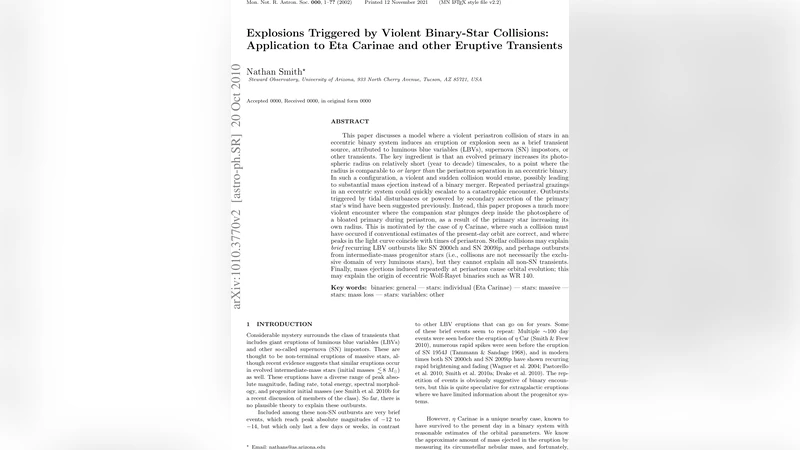
This paper discusses a model where a violent periastron collision of stars in an eccentric binary system induces an eruption or explosion seen as a brief transient source, attributed to LBVs, SN impostors, or other transients. The key ingredient is that an evolved primary increases its photospheric radius on relatively short timescales, to a point where the radius is comparable to or larger than the periastron separation in an eccentric binary. In such a configuration, a violent and sudden collision would ensue, possibly leading to substantial mass ejection instead of a binary merger. Repeated periastral grazings in an eccentric system could quickly escalate to a catastrophic encounter, wherein the companion star actually plunges deep inside the photosphere of a bloated primary during periastron, as a result of the primary star increasing its own radius. This is motivated by the case of $\eta$ Carinae, where such a collision must have occured if conventional estimates of the present-day orbit are correct, and where brief peaks in the light curve coincide with periastron. Stellar collisions may explain brief recurring LBV outbursts like SN 2000ch and SN 2009ip, and perhaps outbursts from relatively low-mass progenitor stars (collisons are not necessarily the exclusive domain of very luminous stars). Finally, mass ejections induced repeatedly at periastron cause orbital evolution; this may explain the origin of very eccentric colliding-wind Wolf-Rayet binaries such as WR140.
💡 Research Summary
The paper proposes a unified physical mechanism to explain a variety of eruptive transients—classical luminous blue variable (LBV) outbursts, super‑nova impostors, and even some low‑mass eruptive events—by invoking violent periastron collisions in highly eccentric binary systems. The central premise is that an evolved primary star can undergo a rapid expansion of its photospheric radius on timescales of decades to centuries, reaching values comparable to or larger than the periastron separation of its companion. When this occurs in an orbit with eccentricity e ≈ 0.8–0.95, the companion plunges into the bloated envelope during each close approach. Rather than a full merger, the encounter can trigger a sudden, violent ejection of a substantial fraction of the primary’s envelope.
The authors first review the physical conditions that can cause a massive star to swell dramatically: reduced core nuclear burning efficiency, opacity‑driven envelope inflation (κ‑mechanism, iron‑group opacity peaks), and convective instabilities. In a binary with a periastron distance of a few astronomical units, such an inflated envelope can be intersected by the companion’s orbit. The relative velocity at periastron in a high‑e orbit is typically several hundred km s⁻¹, producing a strong shock as the companion penetrates the dense photosphere. The shock heats the gas, dramatically raises the local radiation pressure, and drives a rapid, asymmetric outflow.
A key insight is that the outflow need not be isotropic. The companion acts like a “drill” moving through the envelope, creating a focused, high‑velocity stream that can break out preferentially in certain directions. This naturally explains the observed bipolar or highly asymmetric nebular morphologies associated with many LBV eruptions, most famously the Homunculus nebula around η Carinae. The model also accounts for the brief, repeatable luminosity spikes seen in the historical light curve of η Carinae, which line up with the 5.5‑year orbital period and periastron passages.
Repeated periastron collisions have cumulative dynamical consequences. Each mass‑loss episode removes both mass and angular momentum from the system, altering the orbital semi‑major axis and eccentricity. Depending on the symmetry of the ejection, the orbit can either shrink and circularize or become even more eccentric. Over many cycles, the companion may be driven deeper into the primary’s envelope, eventually leading to a full merger or the formation of a compact object surrounded by a massive, expelled shell. Conversely, if mass loss is sufficiently asymmetric, the system can evolve toward a wide, highly eccentric configuration that later manifests as a colliding‑wind Wolf‑Rayet (WR) binary. The authors point to WR 140 as a possible end‑state of such evolution, noting its long period, high eccentricity, and strong wind‑wind interaction as signatures of prior periastron‑driven mass ejection.
Importantly, the mechanism does not require an extremely luminous, very massive star. The authors argue that intermediate‑mass primaries (10–20 M⊙) can also experience envelope inflation and thus undergo similar periastron collisions. This broadens the applicability of the model to events such as SN 2000ch and SN 2009ip, which display repeated, short‑duration outbursts and have been debated as either LBV eruptions or low‑energy supernovae. In these cases, the observed light‑curve peaks and asymmetric ejecta can be interpreted as successive envelope‑penetration events rather than terminal explosions.
The paper concludes by outlining observational predictions. One expects (i) a correlation between outburst timing and orbital phase in known eccentric binaries, (ii) high‑velocity, asymmetric ejecta with signatures of shock heating (e.g., X‑ray flashes coincident with optical peaks), and (iii) long‑term orbital evolution measurable via radial‑velocity monitoring. Future high‑resolution imaging of ejecta morphologies, combined with precise orbital solutions, could directly test whether periastron‑driven envelope collisions are indeed the engine behind many of the most puzzling eruptive transients.
In summary, the authors present a compelling, physically grounded scenario: rapid primary expansion + high‑eccentricity periastron → violent envelope penetration → massive, asymmetric mass ejection → observable transient + orbital evolution. This framework unifies disparate phenomena—from η Carinae’s Great Eruption to low‑mass SN impostors and the formation of eccentric WR colliding‑wind binaries—under a single, testable astrophysical process.
Comments & Academic Discussion
Loading comments...
Leave a Comment