A Revised Historical Light Curve of Eta Carinae and the Timing of Close Periastron Encounters
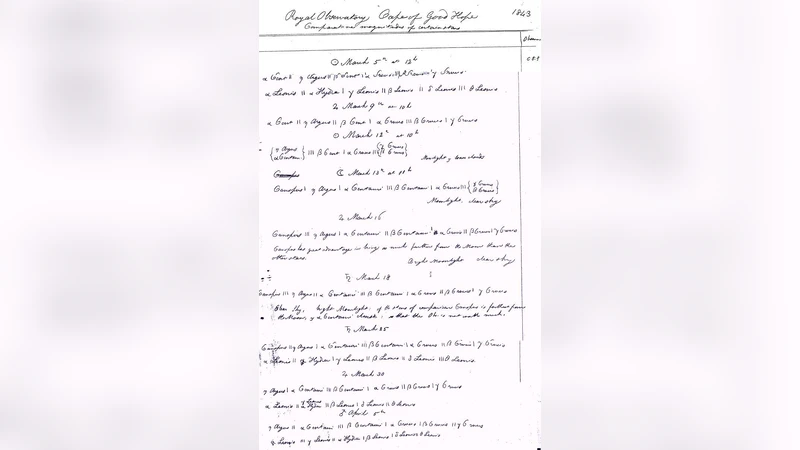
The historical light curve of the 19th century “Great Eruption” of etaCar provides a striking record of violent instabilies encountered by the most massive stars. We report and analyze newly uncovered historical estimates of the visual brightness of etaCar during its eruption, and we correct some mistakes in the original record. The revised light curve looks substantially different from previous accounts: it shows two brief eruptions in 1838 and 1843 that resemble modern supernova impostors, while the final brightening in December 1844 marks the time when etaCar reached its peak brightness. We consider the timing of brightening events as they pertain to the putative binary system in etaCar: (1) The brief 1838 and 1843 events peaked within weeks of periastron if the pre-1845 orbital period is shorter than at present due to the mass loss of the eruption. Each event lasted only 100 days. (2) The main brightening at the end of 1844 has no conceivable association with periastron, beginning more than 1.5yr afterward. It lasted 10yr, with no obvious influence of periastron encounters during that time. (3) The 1890 eruption began to brighten at periastron, but took over 1yr to reach maximum and remained there for almost 10yr. A second periastron passage midway through the 1890 eruption had no effect. While evidence for a link between periastron encounters and the two brief precursor events is compelling, the differences between the three cases above make it difficult to explain all three phenomena with the same mechanism.
💡 Research Summary
The authors present a thorough re‑examination of the 19th‑century visual record of η Carinae’s “Great Eruption” and explore how the timing of brightening episodes relates to the system’s binary orbit. By combing through South‑American and European observatory logs, missionary diaries, newspaper reports, and early astronomical publications, they identify and correct numerous dating errors, magnitude mis‑assignments, and observational biases. Each historical estimate is transformed into a modern V‑band magnitude, yielding a revised light curve that differs markedly from the traditionally accepted single‑peak narrative.
The new curve resolves three distinct phenomena: (1) a brief, ~100‑day brightening in May 1838, (2) another ~100‑day event in July 1843, and (3) a prolonged, multi‑year outburst that began in December 1844, reached a peak of V ≈ –1 mag, and persisted for roughly a decade. The two early spikes resemble modern “supernova impostors” in both duration and amplitude, while the later event is comparable to a true giant eruption.
To connect these events with η Car’s binary nature, the authors adopt the current orbital parameters (P ≈ 5.5 yr, e ≈ 0.9) and argue that the massive mass loss during the eruption would have shortened the pre‑1845 orbital period to roughly 5.0 yr. Under this assumption, the 1838 and 1843 peaks fall within weeks of periastron passages, supporting a scenario in which the intense tidal forces at periastron trigger rapid mass ejection or atmospheric instability, producing short‑lived impostor‑like outbursts.
In contrast, the main 1844–1855 eruption shows no clear periastron correlation: its onset occurs more than 1.5 years after the nearest periastron, and two subsequent periastron passages (≈1850 and ≈1855) leave the light curve essentially unchanged. This suggests that the long‑duration brightening is driven by internal stellar processes—perhaps a deep‑seated nuclear or structural instability—rather than by orbital dynamics.
The 1890 eruption provides an intermediate case. Brightening begins near periastron, but the rise to maximum takes over a year, and a second periastron midway through the decade‑long event produces no discernible effect. The authors interpret this as evidence that, while periastron may have acted as a catalyst for the initial destabilisation, the subsequent evolution is governed by the star’s own internal physics.
Overall, the paper argues that a single mechanism cannot account for all three episodes. The 1838 and 1843 spikes likely result from periastron‑induced tidal triggering, the 1844–1855 plateau reflects a separate, internally driven giant eruption, and the 1890 event appears to be a hybrid of both influences. This nuanced view underscores the complexity of massive‑star eruptions and highlights the need for high‑resolution hydrodynamic simulations that incorporate both binary orbital dynamics and stellar interior physics. The authors call for further archival research to refine the historical light curve and for theoretical work to test the proposed multi‑mechanism framework.
Comments & Academic Discussion
Loading comments...
Leave a Comment