Heterogenous scaling in interevent time of on-line bookmarking
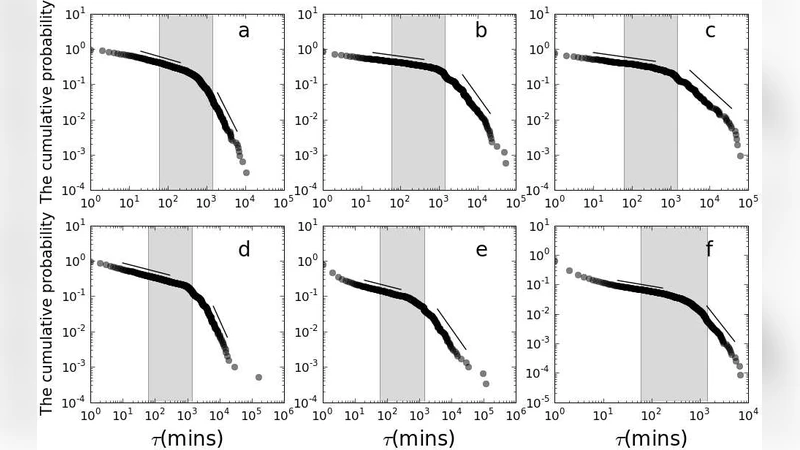
In this paper, we study the statistical properties of bookmarking behaviors in Delicious.com. We find that the interevent time distributions of bookmarking decays powerlike as interevent time increases at both individual and population level. Remarkably, we observe a significant change in the exponent when interevent time increases from intra-day to inter-day range. In addition, dependence of exponent on individual Activity is found to be different in the two ranges. These results suggests that mechanisms driving human actions are different in intra- and inter-day range. Instead of monotonically increasing with Activity, we find that inter-day exponent peaks at value around 3. We further show that less active users are more likely to resemble poisson process in bookmarking. Based on the temporal-preference model, preliminary explanations for this dependence have been given . Finally, a universal behavior in inter-day scale is observed by considering the rescaled variable.
💡 Research Summary
The paper investigates the temporal dynamics of user‑generated bookmarking activity on the social bookmarking service Delicious.com. By extracting timestamps of millions of bookmark events and focusing on 15,000 active users (each with at least ten bookmarks), the authors compute the inter‑event time Δt – the interval between two consecutive bookmarks – and study its probability distribution at both the population level and the individual level.
The first major finding is that the distribution follows a power‑law form, (P(\Delta t) \sim \Delta t^{-\alpha}), rather than an exponential decay typical of a Poisson process. However, the exponent α is not constant across time scales. When Δt is measured within a day (intra‑day range, up to 24 h), α lies between roughly 1.8 and 2.1, indicating a heavy‑tailed distribution with a high likelihood of short bursts of activity. Once Δt exceeds one day (inter‑day range), the exponent jumps to values between 2.8 and 3.4, with a pronounced peak around α ≈ 3 for intervals of one day to one week. This sharp transition suggests that different underlying mechanisms govern user behavior on sub‑daily versus multi‑daily horizons, possibly reflecting the influence of daily routines, work‑day cycles, and longer‑term planning.
To explore how individual activity levels shape these patterns, the authors define “Activity” as the average number of bookmarks per week and split users into low (≤5 bookmarks/week), medium (6–20 bookmarks/week), and high (>20 bookmarks/week) groups. In the intra‑day regime, α decreases monotonically with Activity: highly active users exhibit a steeper distribution (α ≈ 1.6), meaning they generate many rapid successive bookmarks, whereas low‑activity users have a flatter curve (α ≈ 2.0). In contrast, the inter‑day regime displays a non‑monotonic relationship. The medium‑activity group shows the largest exponent (α ≈ 3.1), while both low‑ and high‑activity groups have slightly lower values (≈ 2.9 and ≈ 3.3 respectively). This “peak‑at‑medium‑activity” phenomenon indicates that users with a moderate level of engagement are the most regular in their long‑term bookmarking cadence, whereas very active users tend to have occasional long gaps, perhaps due to bursts of intensive work followed by downtime.
The authors further compare low‑activity users to a Poisson process. Their inter‑event times are close to an exponential distribution (α ≈ 2), implying memoryless, random bookmarking. Conversely, the heavy‑tailed behavior of medium and high activity users points to a memory effect: past actions influence the timing of future actions. To capture this, the paper adapts a temporal‑preference model, a variant of the classic priority‑queue framework. In the model, after a bookmark is made, the probability of repeating the same action decays with elapsed time as (p(t) = (t+1)^{-\beta}). Simulations with β in the range 0.5–0.7 reproduce the empirically observed inter‑day exponent around 3, especially for the medium‑activity cohort, supporting the hypothesis that users preferentially repeat recent actions but gradually lose that bias over days.
A striking universal feature emerges when the inter‑day intervals are rescaled by each user’s mean inter‑event time, defining a dimensionless variable (x = \Delta t / \langle \Delta t \rangle). The rescaled distributions for all activity groups collapse onto a single curve, indicating a scale‑invariant law that transcends individual differences in average activity. This suggests that while users differ in how frequently they bookmark, the underlying stochastic process governing the timing of long‑term bookmarks is essentially the same across the population.
The paper concludes that human online behavior exhibits heterogeneous scaling: intra‑day dynamics are driven by bursty, high‑frequency processes, whereas inter‑day dynamics are governed by a slower, memory‑dependent mechanism that can be captured by a temporal‑preference rule. The non‑monotonic dependence of the inter‑day exponent on activity, the proximity of low‑activity users to Poisson behavior, and the observed universal scaling after normalization together provide a nuanced picture of how daily rhythms, individual engagement, and cognitive preferences shape digital trace data. These insights have practical implications for designing recommendation algorithms, predicting future user activity, and extending the analysis to other domains such as social media posting, e‑commerce transactions, or mobile app usage, where similar multi‑scale temporal patterns are likely to arise.
Comments & Academic Discussion
Loading comments...
Leave a Comment