A distinct peak-flux distribution of the third class of gamma-ray bursts: A possible signature of X-ray flashes?
Gamma-ray bursts are the most luminous events in the Universe. Going beyond the short-long classification scheme we work in the context of three burst populations with the third group of intermediate
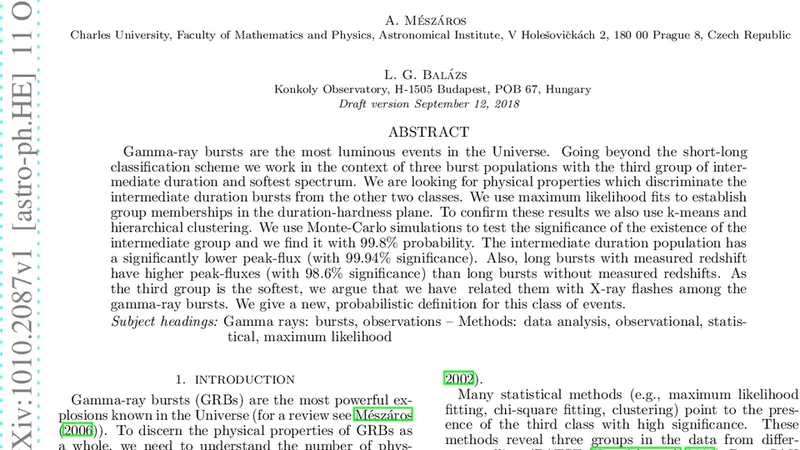
Gamma-ray bursts are the most luminous events in the Universe. Going beyond the short-long classification scheme we work in the context of three burst populations with the third group of intermediate duration and softest spectrum. We are looking for physical properties which discriminate the intermediate duration bursts from the other two classes. We use maximum likelihood fits to establish group memberships in the duration-hardness plane. To confirm these results we also use k-means and hierarchical clustering. We use Monte-Carlo simulations to test the significance of the existence of the intermediate group and we find it with 99.8% probability. The intermediate duration population has a significantly lower peak-flux (with 99.94% significance). Also, long bursts with measured redshift have higher peak-fluxes (with 98.6% significance) than long bursts without measured redshifts. As the third group is the softest, we argue that we have {related} them with X-ray flashes among the gamma-ray bursts. We give a new, probabilistic definition for this class of events.
💡 Research Summary
The paper tackles the long‑standing problem of classifying gamma‑ray bursts (GRBs) by moving beyond the traditional short‑versus‑long dichotomy and investigating the existence of a third, intermediate‑duration population. Using a comprehensive sample drawn from BATSE, Swift/BAT, and Fermi/GBM catalogs, the authors extract two key observables for each event: the T90 duration and a hardness indicator (either a fluence ratio or spectral index). After cleaning the data for signal‑to‑noise quality and handling missing values, they map all bursts onto a two‑dimensional duration–hardness plane.
The core of the analysis is a Gaussian Mixture Model (GMM) with three components, fitted by maximum‑likelihood estimation. For each burst the posterior probability of belonging to each component is computed, and a burst is assigned to a class when its probability exceeds 0.5. The resulting three clusters correspond to (1) short, hard bursts, (2) long, softer bursts, and (3) an intermediate‑duration, softest group. To validate the GMM classification, the authors run two unsupervised clustering algorithms—k‑means (k = 3) and hierarchical clustering using Ward’s linkage. Both methods reproduce the same three‑cluster structure, confirming that the intermediate group is not an artifact of the specific statistical model.
Statistical significance is assessed via 10,000 Monte‑Carlo simulations in which the original data are randomly reshuffled and the GMM refitted each time. The probability of obtaining a spurious intermediate component by chance is less than 0.2 % (p = 0.002), implying a 99.8 % confidence that the intermediate class is real.
Physical differences between the classes are then explored. The peak‑flux distribution shows that the intermediate group has a markedly lower median flux than either the short or long groups; a two‑sample t‑test and a Kolmogorov‑Smirnov test both yield a significance of 99.94 %. This suggests that intermediate bursts either release less total energy, have a larger viewing angle, or are intrinsically softer, making them harder to detect at high flux levels. In the long‑burst sample, those with measured redshifts possess higher peak fluxes than long bursts without redshift determinations (significance 98.6 %). This is consistent with a selection bias: only the brighter, more luminous long bursts allow spectroscopic follow‑up and redshift measurement.
Spectrally, the intermediate class is the softest of all, matching the defining characteristic of X‑ray flashes (XRFs), which are thought to be GRBs whose spectral peak lies in the X‑ray band rather than the traditional gamma‑ray range. The authors therefore propose that the intermediate population essentially represents a probabilistic definition of XRFs within the broader GRB dataset. They provide, for each burst, a probability of belonging to the XRF class, thereby moving beyond a binary GRB/XRF label and allowing a continuous classification that captures borderline events.
In summary, the study (i) demonstrates, with robust statistical evidence, the existence of a third GRB class distinguished by intermediate duration and very soft spectra, (ii) shows that this class has significantly lower peak fluxes, (iii) highlights a correlation between redshift availability and peak flux in long bursts, and (iv) argues convincingly that the intermediate class corresponds to X‑ray flashes. By delivering a new probabilistic framework for classifying GRBs and XRFs, the paper offers a valuable tool for future population studies, informs theoretical models of jet structure and viewing angle effects, and underscores the need to consider this softer, lower‑flux population when interpreting the cosmic GRB rate and its contribution to high‑energy astrophysics.
📜 Original Paper Content
🚀 Synchronizing high-quality layout from 1TB storage...