Quarantine generated phase transition in epidemic spreading
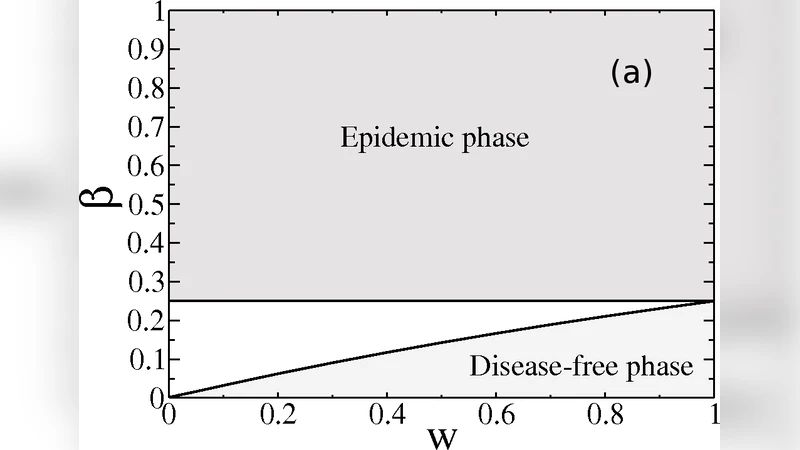
We study the critical effect of quarantine on the propagation of epidemics on an adaptive network of social contacts. For this purpose, we analyze the susceptible-infected-recovered (SIR) model in the presence of quarantine, where susceptible individuals protect themselves by disconnecting their links to infected neighbors with probability w, and reconnecting them to other susceptible individuals chosen at random. Starting from a single infected individual, we show by an analytical approach and simulations that there is a phase transition at a critical rewiring (quarantine) threshold w_c separating a phase (w<w_c) where the disease reaches a large fraction of the population, from a phase (w >= w_c) where the disease does not spread out. We find that in our model the topology of the network strongly affects the size of the propagation, and that w_c increases with the mean degree and heterogeneity of the network. We also find that w_c is reduced if we perform a preferential rewiring, in which the rewiring probability is proportional to the degree of infected nodes.
💡 Research Summary
The paper investigates how quarantine measures affect epidemic spreading on an adaptive social‑contact network by extending the classic susceptible‑infected‑recovered (SIR) model with a rewiring mechanism. In the model, each link between a susceptible node and an infected neighbor is cut with probability w at each time step; the broken link is then re‑attached to a randomly chosen susceptible node. This process creates a dynamically evolving network in which the topology co‑evolves with the disease dynamics.
Using a mean‑field/percolation framework, the authors derive an expression for the basic reproduction number under quarantine:
(R_0 = \frac{\beta}{\gamma + w\beta}).
Here β is the infection probability per contact, γ the recovery probability, and w the rewiring (quarantine) probability. The epidemic can grow only if (R_0>1); solving for w yields a critical rewiring threshold (w_c). When w exceeds (w_c), the effective transmission rate is reduced enough that the outbreak dies out after infecting only a few individuals.
To explore how network structure influences (w_c), the authors perform extensive Monte‑Carlo simulations on two canonical topologies: Erdős‑Rényi (ER) random graphs and Barabási‑Albert (BA) scale‑free networks. They vary the average degree ⟨k⟩ and, for scale‑free graphs, the degree‑distribution exponent (heterogeneity). The results show two systematic trends: (i) (w_c) rises with increasing ⟨k⟩ because a higher mean degree provides more pathways for the disease, requiring stronger quarantine to suppress transmission; (ii) (w_c) also grows with network heterogeneity, as the presence of high‑degree hub nodes dramatically amplifies spreading. Consequently, a uniform quarantine policy is less effective on highly heterogeneous networks.
A key innovation is the introduction of “preferential rewiring,” where the probability of cutting a link is proportional to the infected node’s degree. Mathematically, the rewiring probability for a link attached to node i becomes (w_i = w , k_i / \langle k\rangle). Simulations reveal that this targeted strategy dramatically lowers the required quarantine strength: the critical threshold under preferential rewiring is substantially smaller than under random rewiring. This finding suggests that focusing protective measures on high‑degree individuals (e.g., healthcare workers, super‑spreaders) can achieve epidemic control with fewer overall social disruptions.
The authors also characterize the nature of the transition at (w_c). Near the threshold, the final epidemic size exhibits a sharp, non‑linear change—a classic phase transition. Below (w_c) the outbreak reaches a macroscopic fraction of the population, while above (w_c) it remains confined to the initial seed. The location of the transition depends on β, γ, and the underlying topology, highlighting that small adjustments in quarantine intensity around the critical point can have outsized effects.
In summary, the paper makes three major contributions: (1) it provides a tractable analytical condition for epidemic extinction in the presence of adaptive quarantine; (2) it quantifies how average degree and degree heterogeneity shift the critical quarantine level; and (3) it demonstrates that degree‑aware (preferential) rewiring is a far more efficient containment strategy than uniform random rewiring. These insights bridge network theory and public‑health policy, offering a rigorous basis for designing socially optimal quarantine measures that account for the structural features of real contact networks.
Comments & Academic Discussion
Loading comments...
Leave a Comment