Link Prediction in Complex Networks: A Survey
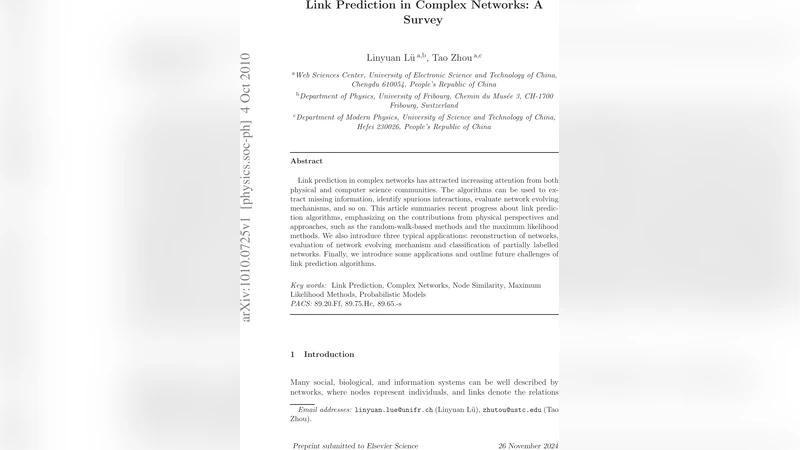
Link prediction in complex networks has attracted increasing attention from both physical and computer science communities. The algorithms can be used to extract missing information, identify spurious interactions, evaluate network evolving mechanisms, and so on. This article summaries recent progress about link prediction algorithms, emphasizing on the contributions from physical perspectives and approaches, such as the random-walk-based methods and the maximum likelihood methods. We also introduce three typical applications: reconstruction of networks, evaluation of network evolving mechanism and classification of partially labelled networks. Finally, we introduce some applications and outline future challenges of link prediction algorithms.
💡 Research Summary
The paper provides a comprehensive survey of link prediction in complex networks, tracing its evolution from early local similarity measures to sophisticated global approaches rooted in physics and statistical inference. It begins by outlining the practical motivations for link prediction—recovering missing interactions, filtering spurious connections, and probing the mechanisms that drive network growth. Classical methods such as Common Neighbors, Jaccard, Adamic‑Adar, and Resource Allocation are reviewed for their computational simplicity and their limitations in capturing long‑range structural dependencies. The authors then shift focus to global techniques that exploit the full topology of a network. Random‑walk‑based algorithms occupy a central place: they compute transition probabilities, mean first‑passage times, and Laplacian‑based similarity scores, thereby incorporating spectral information and enabling the detection of latent long‑distance links that local heuristics overlook. The survey also covers maximum‑likelihood and Bayesian frameworks, including Stochastic Block Models, mixed‑membership extensions, and recent Graph Neural Network (GNN)‑augmented probabilistic models. These approaches treat link formation as a generative process, learn community assignments and edge probabilities via Expectation‑Maximization or variational inference, and often achieve superior performance on sparse or heterogeneous graphs. Empirical evaluations on a diverse set of real‑world networks—social platforms, protein‑protein interaction maps, power grids, and citation graphs—demonstrate that random‑walk methods excel on dense, highly clustered structures, whereas likelihood‑based models are more accurate on sparse, multi‑scale systems. Hybrid schemes that combine local scores with global embeddings are shown to provide robust results across varying topologies. The authors further illustrate three representative applications. In network reconstruction, predicted links are used to fill gaps and prune erroneous edges, improving the fidelity of downstream analyses. For evolutionary mechanism assessment, the pattern of predicted links serves as a diagnostic tool to test hypotheses such as preferential attachment or triadic closure, offering quantitative support for model selection. In semi‑supervised node classification, link prediction augments the graph structure, enabling higher accuracy when only a small fraction of nodes carry labels. The paper concludes by identifying open challenges: real‑time prediction in dynamic or temporal networks, unified models for multiplex and heterogeneous data, interpretability and confidence estimation for predicted edges, and scalable algorithms capable of handling massive graphs. Overall, the survey underscores that link prediction has matured into a versatile analytical framework, and that the convergence of physics‑inspired random‑walk techniques with probabilistic inference will continue to shape future research directions.
Comments & Academic Discussion
Loading comments...
Leave a Comment