Modeling TeV gamma-rays from LS 5039: An active OB star at the extreme
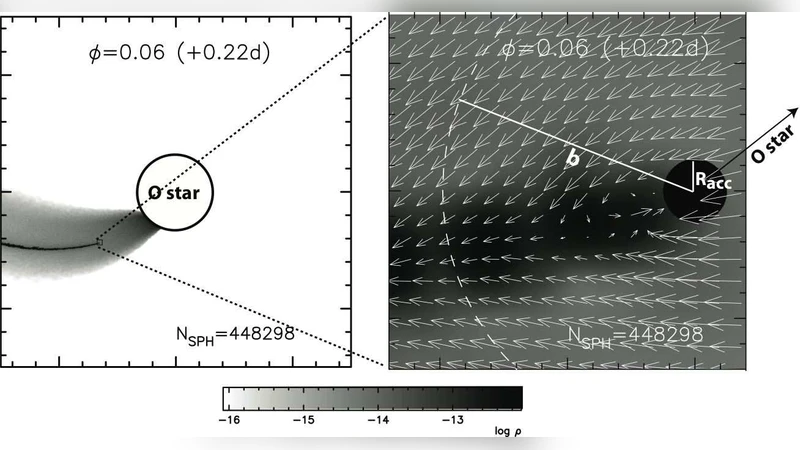
Perhaps the most extreme examples of “Active OB stars” are the subset of high-mass X-ray binaries – consisting of an OB star plus compact companion – that have recently been observed by Fermi and ground-based Cerenkov telescopes like HESS to be sources of very high energy (VHE; up to 30 TeV) gamma-rays. This paper focuses on the prominent gamma-ray source, LS5039, which consists of a massive O6.5V star in a 3.9-day-period, mildly elliptical (e = 0.24) orbit with its companion, assumed here to be a black-hole or unmagnetized neutron star. Using 3-D SPH simulations of the Bondi-Hoyle accretion of the O-star wind onto the companion, we find that the orbital phase variation of the accretion follows very closely the simple Bondi-Hoyle-Lyttleton (BHL) rate for the local radius and wind speed. Moreover, a simple model, wherein intrinsic emission of gamma-rays is assumed to track this accretion rate, reproduces quite well Fermi observations of the phase variation of gamma-rays in the energy range 0.1-10 GeV. However for the VHE (0.1-30 TeV) radiation observed by the HESS Cerenkov telescope, it is important to account also for photon-photon interactions between the gamma-rays and the stellar optical/UV radiation, which effectively attenuates much of the strong emission near periastron. When this is included, we find that this simple BHL accretion model also quite naturally fits the HESS light curve, thus making it a strong alternative to the pulsar-wind-shock models commonly invoked to explain such VHE gamma-ray emission in massive-star binaries.
💡 Research Summary
The paper presents a comprehensive study of the very‑high‑energy (VHE) gamma‑ray emission from the high‑mass X‑ray binary LS 5039, proposing a model that relies solely on Bondi‑Hoyle‑Lyttleton (BHL) accretion of the O‑star wind onto a compact companion (assumed to be an unmagnetized neutron star or a black hole). Using three‑dimensional Smoothed Particle Hydrodynamics (SPH) simulations, the authors compute the time‑dependent mass‑accretion rate as the binary moves along its mildly eccentric (e ≈ 0.24) 3.9‑day orbit. The simulated accretion rate matches the analytic BHL formula to within a few percent, indicating that the complex hydrodynamics of the wind–compact‑object interaction do not significantly alter the simple gravitational capture picture.
The next step is to connect the accretion rate to gamma‑ray production. The authors adopt a phenomenological assumption that the intrinsic gamma‑ray luminosity Lγ is directly proportional to the instantaneous BHL accretion rate (\dot{M}_{\rm BHL}). When this proportionality is applied, the model reproduces the orbital phase dependence observed by the Fermi Large Area Telescope in the 0.1–10 GeV band. The light curve shows a broad maximum near periastron and a minimum near apastron, exactly as measured, demonstrating that the GeV emission can be explained without invoking any additional particle‑acceleration site beyond the immediate vicinity of the compact object.
For the TeV regime (0.1–30 TeV), the situation is more subtle because the dense ultraviolet/optical photon field of the O6.5 V star can annihilate VHE photons via photon‑photon pair production (γγ → e⁺e⁻). The authors calculate the optical depth τ(φ) as a function of orbital phase φ by integrating the star’s radiation field along the line of sight to the observer, taking into account the changing separation and viewing angle. The intrinsic BHL‑scaled TeV flux is then attenuated by a factor exp
Comments & Academic Discussion
Loading comments...
Leave a Comment