Hydrodynamics of a Micro-Hunter: Chemotactic Scenario
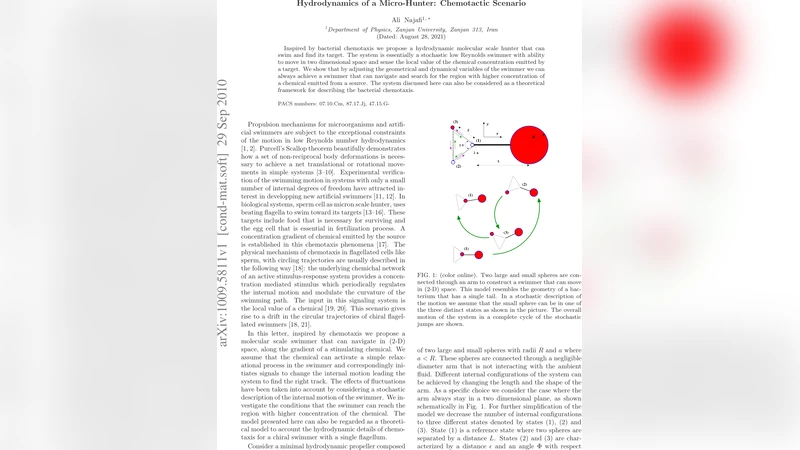
Inspired by bacterial chemotaxis we propose a hydrodynamic molecular scale hunter that can swim and find its target. The system is essentially a stochastic low Reynolds swimmer with ability to move in two dimensional space and sense the local value of the chemical concentration emitted by a target. We show that by adjusting the geometrical and dynamical variables of the swimmer we can always achieve a swimmer that can navigate and search for the region with higher concentration of a chemical emitted from a source. The system discussed here can also be considered as a theoretical framework for describing the bacterial chemotaxis.
💡 Research Summary
The paper presents a theoretical framework for a “micro‑hunter,” a low‑Reynolds‑number swimmer capable of chemotactic navigation toward a chemical source. Building on classic low‑Reynolds swimmers (e.g., three‑sphere or deformable body models), the authors introduce a stochastic actuation scheme combined with a local chemical‑concentration sensor. The swimmer operates in a two‑dimensional fluid domain where inertia is negligible; propulsion is achieved solely through cyclic shape changes characterized by a period (T) and a phase offset (\phi).
A key innovation is the feedback loop that links the measured chemical field (c(\mathbf{r})) and its gradient (\nabla c) to the swimmer’s actuation parameters. The sensor, imagined as a surface‑bound fluorescence or electrochemical probe, provides a real‑time estimate of the local gradient. This information is processed by an internal “signalling network” that modulates the stochastic transition rates (k_{ij}) governing the swimmer’s shape‑change sequence. In effect, the swimmer biases its forward steps toward higher concentration, while retaining a stochastic component that prevents trapping in local minima.
Mathematically, the average velocity can be expressed as
\
Comments & Academic Discussion
Loading comments...
Leave a Comment