An approximative calculation of the fractal structure in self-similar tilings
Fractal structures emerge from statistical and hierarchical processes in urban development or network evolution. In a class of efficient and robust geographical networks, we derive the size distributi
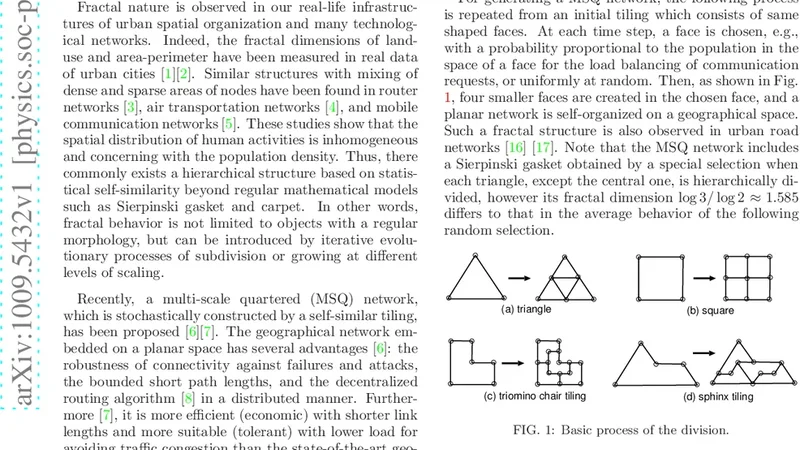
Fractal structures emerge from statistical and hierarchical processes in urban development or network evolution. In a class of efficient and robust geographical networks, we derive the size distribution of layered areas, and estimate the fractal dimension by using the distribution without huge computations. This method can be applied to self-similar tilings based on a stochastic process.
💡 Research Summary
The paper presents a novel, computationally efficient method for estimating the fractal dimension of self‑similar tilings and related geographical networks without resorting to exhaustive box‑counting or mass‑radius calculations. The authors begin by defining “layers” (or shells) as concentric sets of tiles (or nodes) that share the same topological distance from a chosen origin. By measuring the area (or node count) of each layer, they construct a size distribution that captures the hierarchical organization of the pattern.
Central to the approach is the assumption of statistical self‑similarity: the whole pattern can be regarded as a scaled‑down replica of itself, and each scaling step reduces the characteristic area by a factor r. The authors embed this deterministic scaling within a stochastic subdivision process. At each iteration a tile is selected with probability p and split into a random number of sub‑tiles; the relative areas of the sub‑tiles follow a probability density f(α), where α denotes the fraction of the parent’s area taken by a child. The expected value E
📜 Original Paper Content
🚀 Synchronizing high-quality layout from 1TB storage...