The Balmer-dominated Bow Shock and Wind Nebula Structure of Gamma-ray Pulsar PSR J1741-2054
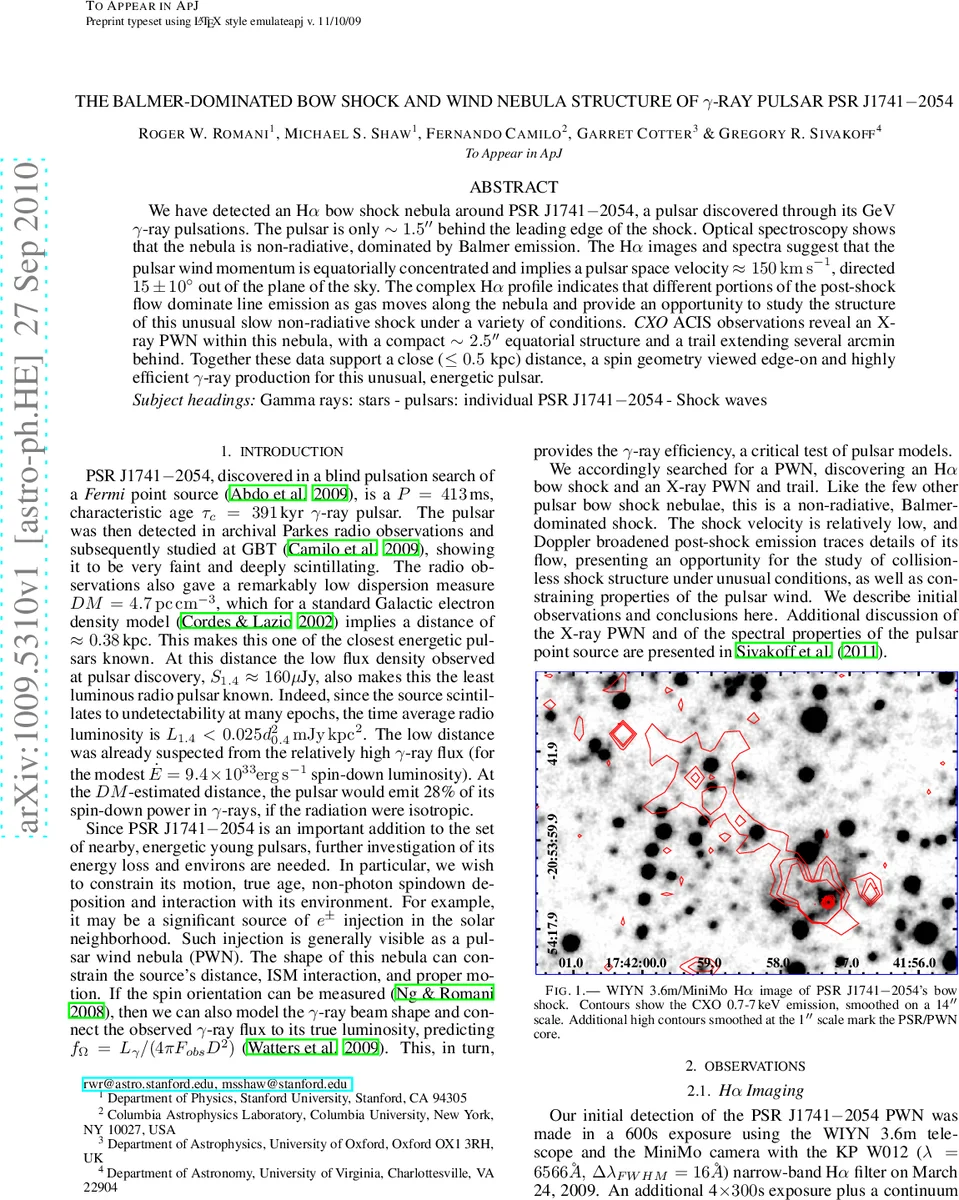
We have detected an Halpha bow shock nebula around PSR J1741-2054, a pulsar discovered through its GeV gamma-ray pulsations. The pulsar is only ~1.5" behind the leading edge of the shock. Optical spectroscopy shows that the nebula is non-radiative, dominated by Balmer emission. The Halpha images and spectra suggest that the pulsar wind momentum is equatorially concentrated and implies a pulsar space velocity ~150km/s, directed 15+/-10deg out of the plane of the sky. The complex Halpha profile indicates that different portions of the post-shock flow dominate line emission as gas moves along the nebula and provide an opportunity to study the structure of this unusual slow non-radiative shock under a variety of conditions. CXO ACIS observations reveal an X-ray PWN within this nebula, with a compact ~2.5" equatorial structure and a trail extending several arcmin behind. Together these data support a close (<0.5kpc) distance, a spin geometry viewed edge-on and highly efficient gamma-ray production for this unusual, energetic pulsar.
💡 Research Summary
We present a multi‑wavelength study of the γ‑ray pulsar PSR J1741‑2054, revealing a Balmer‑dominated Hα bow shock and an X‑ray pulsar wind nebula (PWN). Deep Hα imaging with WIYN and NTT shows an elliptical (13″ × 20″) shell whose bright rim lies only ~1.5″ ahead of the pulsar. Long‑slit spectroscopy obtained with Keck/LRIS resolves the Hα line into narrow (pre‑shock) and broad (post‑shock) components, confirming a non‑radiative shock dominated by Balmer emission. The measured line ratios (Hα/Hβ≈4.0, Hγ/Hβ≈0.30) imply modest extinction, E(B–V)≈0.3–0.45, consistent with the X‑ray derived hydrogen column NH≈1.5×10²¹ cm⁻².
Velocity‑resolved spectra along two slit position angles (PA = 50° and 140°) reveal a complex kinematic pattern: the front of the bow shock is dominated by blue‑shifted emission, while red‑shifted components appear on the far side. This asymmetry is interpreted as the result of a modest inclination of the pulsar’s motion (≈15°±10° out of the plane of the sky) combined with an equatorially concentrated wind. Modeling the standoff distance with the thin‑shell solution of Wilkin (1996, 2000) yields a very small stand‑off angle (θ₀≈2″) consistent with a pulsar space velocity ≈150 km s⁻¹ moving through an interstellar medium of density n≈0.3 cm⁻³ at a distance ≤0.5 kpc. The observed flattening of the apex, however, cannot be reproduced by an isotropic wind; an anisotropic wind with a cos²θ dependence (enhanced in the equatorial plane) reproduces the flattened shape and the slight offset between the symmetry axis of the Hα shell and the X‑ray trail.
Chandra ACIS‑S observations (48.8 ks) detect a bright point source at the pulsar position and a compact, elongated X‑ray structure (≈2.5″ × 0.75″) interpreted as an equatorial torus seen nearly edge‑on. A faint, collimated trail extending ~2′ at PA≈45° follows the same axis as the torus and aligns with the Hα bow‑shock symmetry axis, indicating that the pulsar spin axis and proper‑motion vector are closely aligned, as suggested for other young pulsars. The X‑ray spectrum of the nebular components is well described by an absorbed power law (Γ≈1.6, NH≈1.5×10²¹ cm⁻²), with the point source showing an additional soft thermal component.
Combining the optical and X‑ray data, the authors argue that PSR J1741‑2054 is a nearby (≤0.5 kpc), energetic pulsar with a highly efficient γ‑ray conversion (≈30% of its spin‑down power). Its wind is strongly equatorially focused, producing a thin, non‑radiative Balmer shock and an edge‑on torus‑plus‑trail PWN. The system provides a rare laboratory for studying low‑velocity, non‑radiative shocks, wind anisotropy, and the geometry of pulsar spin‑motion alignment. The results have implications for the contribution of nearby pulsars to the local cosmic‑ray electron/positron population and for modeling γ‑ray beam geometry in pulsar emission theories.
Comments & Academic Discussion
Loading comments...
Leave a Comment