TeV Flux modulation in PSR B1259-63/LS 2883
PSR B1259-63/LS 2883 is a binary system where a 48 ms pulsar orbits a massive Be star with a highly eccentric orbit (e=0.87) with a period of 3.4 years. The system exhibits variable, non-thermal radia
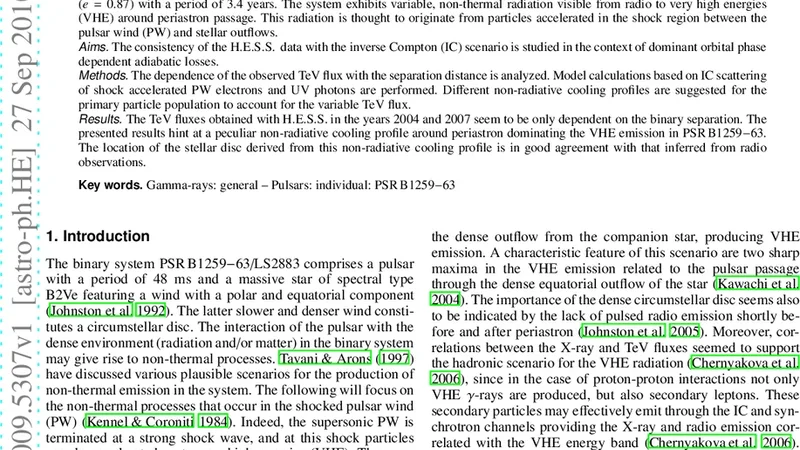
PSR B1259-63/LS 2883 is a binary system where a 48 ms pulsar orbits a massive Be star with a highly eccentric orbit (e=0.87) with a period of 3.4 years. The system exhibits variable, non-thermal radiation visible from radio to very high energies (VHE) around periastron passage. This radiation is thought to originate from particles accelerated in the shock region between the pulsar wind (PW) and stellar outflows. The consistency of the H.E.S.S. data with the inverse Compton (IC) scenario is studied in the context of dominant orbital phase dependent adiabatic losses. The dependence of the observed TeV flux with the separation distance is analyzed. Model calculations based on IC scattering of shock accelerated PW electrons and UV photons are performed. Different non-radiative cooling profiles are suggested for the primary particle population to account for the variable TeV flux. The TeV fluxes obtained with H.E.S.S. in the years 2004 and 2007 seem to be only dependent on the binary separation. The presented results hint at a peculiar non-radiative cooling profile around periastron dominating the VHE emission in PSR B1259-63. The location of the stellar disc derived from this non-radiative cooling profile is in good agreement with that inferred from radio observations.
💡 Research Summary
The paper investigates the origin of the variable very‑high‑energy (VHE) γ‑ray emission observed from the binary system PSR B1259‑63/LS 2883, focusing on the modulation of the TeV flux around periastron. PSR B1259‑63 is a young 48 ms pulsar that orbits a massive Be star (LS 2883) on a highly eccentric (e ≈ 0.87) 3.4‑year orbit. The pulsar wind (PW), a relativistic outflow of electrons, positrons and magnetic fields, collides with the stellar wind and, crucially, with the dense equatorial disc of the Be star. This interaction creates a shock region where particles are accelerated to multi‑TeV energies. The accelerated electrons then up‑scatter the intense ultraviolet (UV) photon field of the star via inverse‑Compton (IC) scattering, producing the observed TeV photons.
The authors analyse H.E.S.S. observations obtained during the 2004 and 2007 periastron passages. Although the TeV light curves show strong variability on timescales of days to weeks, the authors find that the measured fluxes from both epochs collapse onto a single curve when plotted against the instantaneous binary separation. In other words, the TeV flux appears to be a function of distance alone, independent of the absolute orbital phase or epoch. This striking regularity suggests that the dominant factor governing the VHE output is not a change in the seed‑photon density (which also scales with distance) but rather a phase‑dependent, non‑radiative cooling process that modulates the electron population.
To explore this, the paper builds a semi‑analytic model of IC emission from shock‑accelerated electrons. The electron spectrum is assumed to be a power law (index ≈ 2.5) with a high‑energy cutoff determined by the balance between acceleration, radiative (synchrotron and IC) losses, and non‑radiative (adiabatic) losses. The stellar UV field is treated as a blackbody with T ≈ 27 000 K, and the IC scattering is computed in the full Klein‑Nishina regime. The key novelty is the introduction of an orbital‑phase‑dependent adiabatic loss term, γ̇_ad ∝ f(θ), where f(θ) sharply increases when the pulsar traverses the dense equatorial disc of the Be star. Physically, the disc imposes a sudden change in the pressure balance at the shock, causing rapid expansion or compression of the downstream flow and thus strong adiabatic cooling of the electrons.
Model calculations show that when a simple distance‑only scaling of IC emission is used, the predicted TeV light curve fails to reproduce the deep dip observed just before and after periastron. By adding an adiabatic loss “profile” that peaks at the disc crossing points (≈ 10–12 AU from the star), the model reproduces both the depth and the timing of the dip, as well as the subsequent recovery of the flux. Importantly, the location and width of the enhanced adiabatic loss region inferred from the TeV data coincide with the disc geometry derived from radio eclipse measurements, where the pulsar’s radio signal is temporarily absorbed as it passes behind the disc. This agreement provides independent validation that the non‑radiative cooling is indeed linked to the disc crossing.
The authors discuss several implications. First, the dominance of adiabatic cooling around periastron implies that the VHE emission is largely governed by the dynamics of the shock rather than by variations in the seed‑photon field alone. Second, the fact that the 2004 and 2007 TeV fluxes follow the same distance‑dependent trend indicates that the large‑scale wind and disc structure of LS 2883 are stable over at least a few orbital cycles. Third, the methodology demonstrates that TeV observations can be used as a diagnostic of the circumstellar environment, complementing traditional radio and X‑ray probes.
Finally, the paper looks ahead to the Cherenkov Telescope Array (CTA) and other next‑generation VHE facilities. With CTA’s improved sensitivity and temporal resolution, it will be possible to resolve the rapid flux changes associated with disc crossings, to measure the shape of the adiabatic loss profile more precisely, and perhaps to detect signatures of additional processes such as hadronic interactions or magnetic reconnection. In summary, the work establishes that the TeV flux modulation in PSR B1259‑63/LS 2883 can be explained by inverse‑Compton scattering of shock‑accelerated electrons combined with a phase‑dependent, non‑radiative (adiabatic) cooling that is strongest when the pulsar traverses the Be‑star disc. This provides a coherent picture that links high‑energy γ‑ray variability with the geometry and dynamics of the stellar disc, and it opens a new avenue for probing massive‑star environments through VHE astronomy.
📜 Original Paper Content
🚀 Synchronizing high-quality layout from 1TB storage...