Discs, outflows, and feedback in collapsing magnetized cores
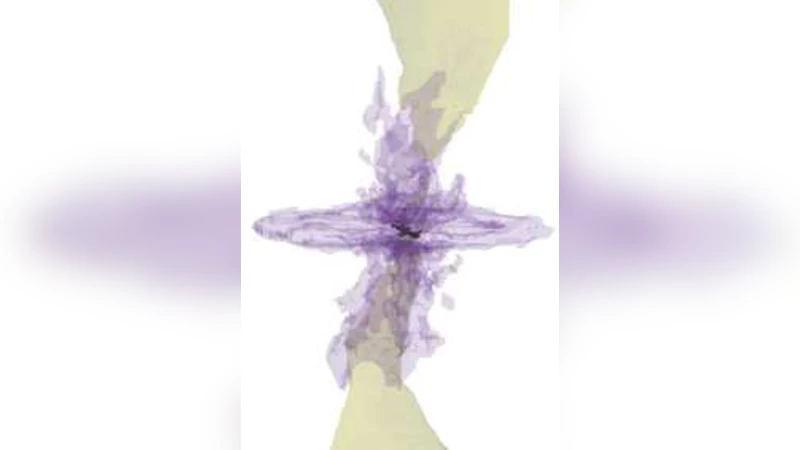
The pre-stellar cores in which low mass stars form are generally well magnetized. Our simulations show that early protostellar discs are massive and experience strong magnetic torques in the form of magnetic braking and protostellar outflows. Simulations of protostellar disk formation suggest that these torques are strong enough to suppress a rotationally supported structure from forming for near critical values of mass-to-flux. We demonstrate through the use of a 3D adaptive mesh refinement code – including cooling, sink particles and magnetic fields – that one produces transient 1000 AU discs while simultaneously generating large outflows which leave the core region, carrying away mass and angular momentum. Early inflow/outflow rates suggest that only a small fraction of the mass is lost in the initial magnetic tower/jet event.
💡 Research Summary
The paper investigates how magnetic fields influence the earliest stages of low‑mass star formation, focusing on the formation of protostellar disks, magnetic braking, and outflow-driven feedback. Using a state‑of‑the‑art three‑dimensional adaptive mesh refinement (AMR) code that couples ideal magnetohydrodynamics (MHD) with radiative cooling, sink‑particle creation, and self‑gravity, the authors simulate the collapse of a magnetized pre‑stellar core with a range of mass‑to‑flux ratios (μ). The simulations reveal a consistent evolutionary sequence. In the first phase, gravitational collapse drives material toward the rotation axis, producing a massive, transient disk of order 1000 AU in radius that contains roughly 10–15 % of the core’s mass. This disk is not rotationally supported for long; strong magnetic torques—arising from the large‑scale poloidal field threading the disk—extract angular momentum efficiently. The magnetic braking term, proportional to B·∇(v·B), rapidly reduces the azimuthal velocity, causing the disk to thin and eventually dissipate.
The angular momentum removed from the disk is not lost but redirected into two distinct outflow components. A high‑velocity, well‑collimated jet (the “magnetic tower”) reaches speeds >100 km s⁻¹ and propagates out of the core, while a broader, slower wind (≈10 km s⁻¹) expands laterally, forming a cavity that can extend several thousand AU. Although the mass ejected in the initial outburst accounts for only about 5–10 % of the core’s total mass, the outflows carry away more than 30 % of the system’s angular momentum. Consequently, the combination of magnetic braking and outflow feedback prevents the long‑term survival of a rotationally supported disk when μ is near the critical value (μ≈2).
Parameter studies show a clear dependence on the mass‑to‑flux ratio. For μ significantly larger than the critical value (μ > 3), magnetic braking weakens, allowing a more stable, longer‑lived disk to develop, though outflows still operate and gradually sap angular momentum. Conversely, for μ close to or below the critical threshold, the disk is suppressed almost entirely, and the system is dominated by a powerful magnetic tower and a wide‑angle wind. These findings provide a quantitative framework for the “magnetic braking catastrophe” and reconcile it with observations of young protostars that display both large‑scale, low‑velocity outflows and compact, high‑velocity jets.
The authors conclude that early protostellar evolution in magnetized cores is governed by a delicate balance between disk formation, magnetic torques, and outflow feedback. Their high‑resolution AMR simulations demonstrate that even modest magnetic fields can dramatically reshape the angular momentum budget, leading to transient disks and efficient mass‑loss channels. The work suggests that future high‑resolution interferometric observations (e.g., with ALMA) targeting the morphology and kinematics of disks and outflows can directly test the predicted dependence on μ, thereby refining our theoretical understanding of star formation under realistic magnetic conditions.