A damage model based on failure threshold weakening
A variety of studies have modeled the physics of material deformation and damage as examples of generalized phase transitions, involving either critical phenomena or spinodal nucleation. Here we study
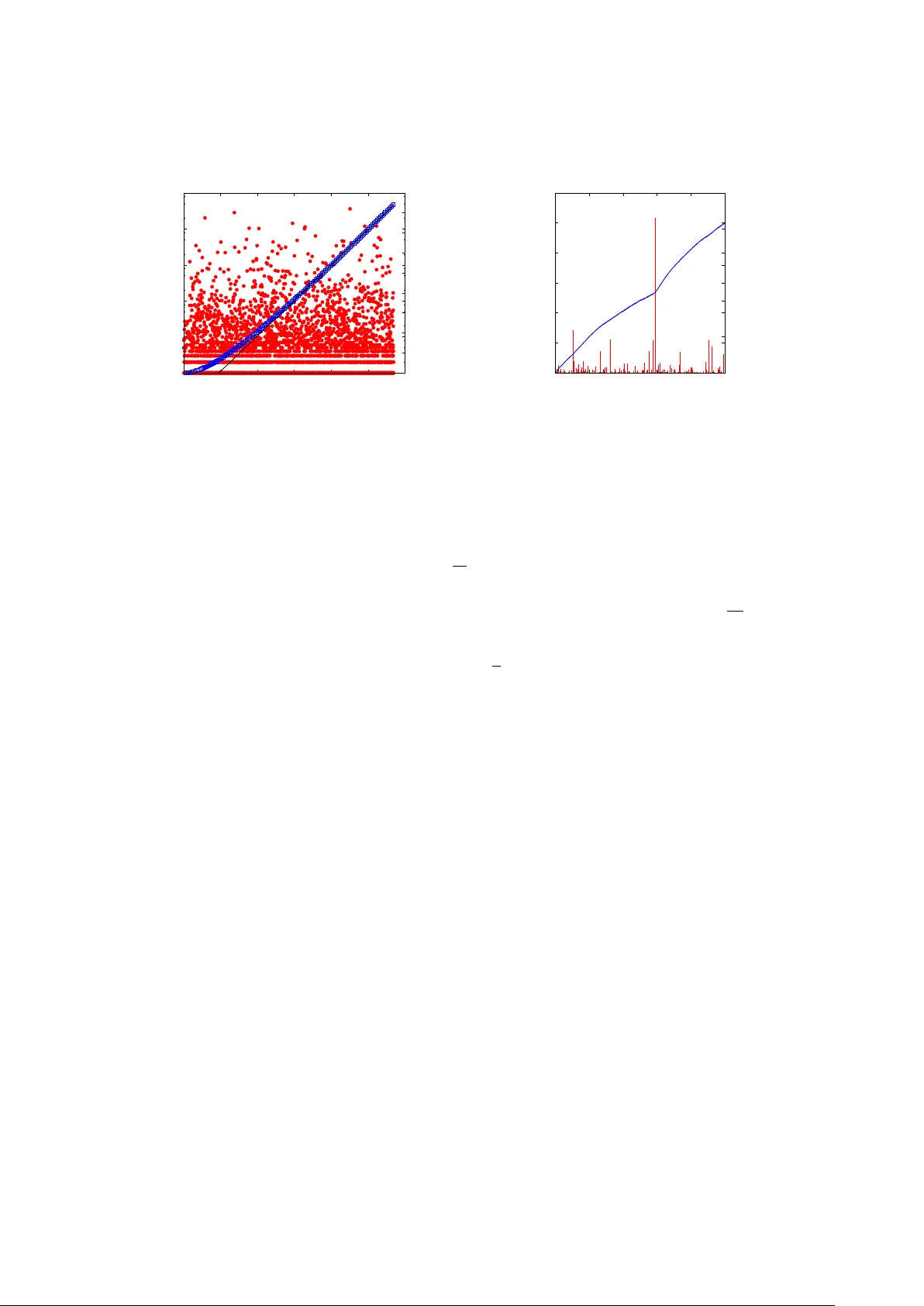
A variety of studies have modeled the physics of material deformation and damage as examples of generalized phase transitions, involving either critical phenomena or spinodal nucleation. Here we study a model for frictional sliding with long range interactions and recurrent damage that is parameterized by a process of damage and partial healing during sliding. We introduce a failure threshold weakening parameter into the cellular-automaton slider-block model which allows blocks to fail at a reduced failure threshold for all subsequent failures during an event. We show that a critical point is reached beyond which the probability of a system-wide event scales with this weakening parameter. We provide a mapping to the percolation transition, and show that the values of the scaling exponents approach the values for mean-field percolation (spinodal nucleation) as lattice size $L$ is increased for fixed $R$. We also examine the effect of the weakening parameter on the frequency-magnitude scaling relationship and the ergodic behavior of the model.
💡 Research Summary
The paper extends the classic cellular‑automaton slider‑block model, which is widely used to study frictional sliding and earthquake‑like failure, by introducing a “failure‑threshold weakening” parameter w. In the original model each block has a fixed failure threshold; when the shear stress on a block exceeds this threshold the block slips, redistributing stress to neighboring blocks within a range R. The new rule allows a block that has slipped during an event to suffer permanent weakening: its failure threshold is reduced by a factor (1 – w) for the remainder of that event. Consequently, a single block can fail multiple times in one avalanche, mimicking the physical situation where damaged material becomes easier to re‑rupture.
The authors explore how varying w influences the collective dynamics. By scanning w from zero upward they identify a critical value w_c at which the probability P(L,R,w) of a system‑wide event (all L² blocks failing in a single avalanche) becomes non‑zero and then grows as a power law, P ∝ (w – w_c)^β. Finite‑size analysis shows that the exponent β approaches the mean‑field percolation value (β≈1) as the lattice size L increases while the interaction range R is held fixed. Parallel measurements of cluster‑size distributions reveal a complementary exponent γ that also converges to the mean‑field percolation value (γ≈1). This mapping to percolation indicates that the weakening parameter plays the same role as the occupation probability in standard percolation, and the transition is analogous to a spinodal nucleation (mean‑field) transition.
Beyond the binary classification of events, the authors examine the magnitude–frequency (Gutenberg‑Richter) relationship. For small w the event‑size distribution is dominated by many small avalanches and follows an exponential tail. As w approaches w_c, large avalanches become increasingly probable, and the size distribution acquires a power‑law regime. The corresponding b‑value (the slope of the log‑frequency versus magnitude plot) decreases with increasing w, meaning that stronger weakening leads to relatively more large events—a behavior observed in real seismic catalogs where stress‑weakening zones tend to produce larger earthquakes.
The paper also investigates ergodicity. When w < w_c, time averages over a single long simulation coincide with ensemble averages over many realizations, indicating an ergodic regime. For w > w_c, the two averages diverge, revealing a non‑ergodic, memory‑bearing state: the system’s evolution becomes trapped in particular damage configurations, and its statistical properties depend on the specific history of weakening.
The authors provide a theoretical mapping that connects the weakening‑induced transition to classic percolation and spinodal nucleation frameworks. Because the interaction range R is long‑range, the system behaves as a mean‑field model when the lattice size grows, which explains why the measured scaling exponents converge to the mean‑field values. This contrasts with short‑range slider‑block models that exhibit non‑mean‑field critical exponents.
In summary, the study demonstrates that a single, physically motivated parameter—failure‑threshold weakening—can drive a slider‑block system through a well‑defined critical point. At this point, the system exhibits mean‑field percolation scaling, a shift in the magnitude–frequency law, and a loss of ergodicity. These findings bridge the gap between abstract statistical‑physics models of fracture and the complex, damage‑healing dynamics observed in real materials, earthquakes, and other networked failure systems. The work thus offers a versatile, analytically tractable framework for exploring how localized weakening and partial healing shape collective failure phenomena across many disciplines.
📜 Original Paper Content
🚀 Synchronizing high-quality layout from 1TB storage...