Optical/IR counterpart to the resolved X-ray jet source CXO J172337.5-373442 and its distance
We present results of observations in the optical to mid-infrared wavelengths of the X-ray source CXO J172337.5-373442, which was serendipitously discovered in the Chandra images and was found to have
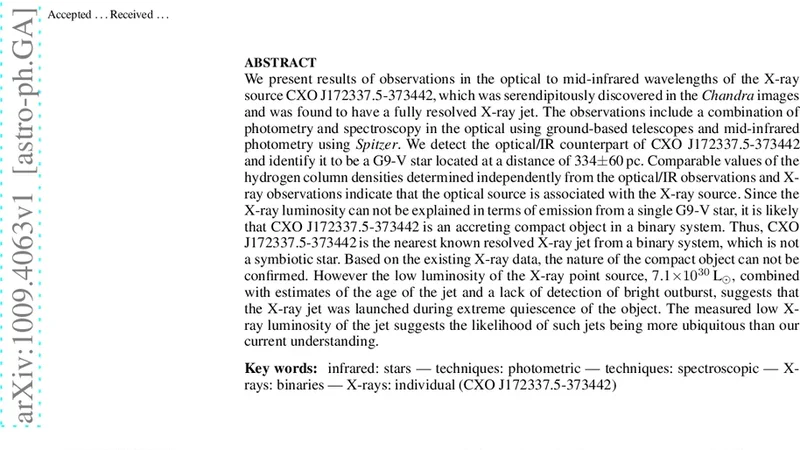
We present results of observations in the optical to mid-infrared wavelengths of the X-ray source CXO J172337.5-373442, which was serendipitously discovered in the Chandra images and was found to have a fully resolved X-ray jet. The observations include a combination of photometry and spectroscopy in the optical using ground-based telescopes and mid-infrared photometry using Spitzer. We detect the optical/IR counterpart of CXO J172337.5-373442 and identify it to be a G9-V star located at a distance of 334+-60~pc. Comparable values of the hydrogen column densities determined independently from the optical/IR observations and X-ray observations indicate that the optical source is associated with the X-ray source. Since the X-ray luminosity can not be explained in terms of emission from a single G9-V star, it is likely that CXO J172337.5-373442 is an accreting compact object in a binary system. Thus, CXO J172337.5-373442 is the nearest known resolved X-ray jet from a binary system, which is not a symbiotic star. Based on the existing X-ray data, the nature of the compact object can not be confirmed. However the low luminosity of the X-ray point source, 7.1x10^{30} Lsun combined with estimates of the age of the jet and a lack of detection of bright outburst, suggests that the X-ray jet was launched during extreme quiescence of the object. The measured low X-ray luminosity of the jet suggests the likelihood of such jets being more ubiquitous than our current understanding.
💡 Research Summary
The paper presents a multi‑wavelength study of the X‑ray source CXO J172337.5‑373442, which was serendipitously discovered in Chandra images and is notable for possessing a fully resolved X‑ray jet. Optical observations were carried out with ground‑based 2‑meter class telescopes, providing broadband photometry in the B, V, R, and I bands as well as low‑resolution spectroscopy covering key diagnostic lines such as Hα, Na I D, and Ca II K. Mid‑infrared photometry was obtained from the Spitzer Space Telescope using the four IRAC channels (3.6, 4.5, 5.8, and 8.0 µm).
Spectral analysis of the optical data identified the counterpart as a G9‑V main‑sequence star. The presence of metallic absorption lines and the overall continuum shape match standard G9‑V templates. By adopting an absolute visual magnitude of M_V≈5.9 mag for a G9‑V star, correcting the observed V≈12.3 mag for a visual extinction A_V≈0.9 mag (derived from the optical/IR colors), the authors derived a distance of 334 ± 60 pc. The infrared colors are consistent with those expected for a G9‑V star at this distance, reinforcing the classification.
Crucially, the hydrogen column density inferred from the optical/IR extinction (N_H≈1.6×10²¹ cm⁻²) agrees with the value obtained from fitting the Chandra X‑ray spectrum, indicating that the optical star and the X‑ray source are physically associated rather than being a chance alignment.
X‑ray analysis of the Chandra ACIS‑I data shows a point source with an unabsorbed 0.5–8 keV luminosity of L_X≈7.1×10³⁰ erg s⁻¹ (≈1.9×10⁻⁴ L_⊙) and a resolved jet with a luminosity of L_jet≈1.2×10³⁰ erg s⁻¹. These luminosities far exceed what a single G9‑V star can produce, implying the presence of an accreting compact object—most plausibly a neutron star or a low‑mass black hole—within the binary system. The lack of any recorded bright outburst, together with the low point‑source luminosity, suggests that the system is in an extreme quiescent state.
The jet’s projected length (≈30″) and an assumed bulk flow speed of ~0.1 c yield an estimated jet age of order 10³ years. This relatively young age, combined with the quiescent X‑ray emission, leads the authors to propose that the jet was launched during a period of very low accretion activity, a scenario rarely observed in X‑ray binaries.
Importantly, the system does not fit the definition of a symbiotic star: the optical spectrum lacks the strong TiO bands characteristic of a red‑giant companion, and the extinction and N_H values are simple and consistent, unlike the complex absorption often seen in symbiotic systems. Consequently, CXO J172337.5‑373442 represents the nearest known resolved X‑ray jet from a non‑symbiotic binary, expanding the known diversity of jet‑producing systems.
The discovery has two broader implications. First, it demonstrates that low‑luminosity jets can exist in nearby systems, implying that many similar jets may have escaped detection due to current sensitivity limits. Second, the fact that a jet can be launched during extreme quiescence challenges conventional models that associate jet production with high accretion rates or outburst states. Future high‑sensitivity X‑ray missions (e.g., Athena) and high‑resolution radio interferometry (e.g., VLBI) will be essential to resolve the jet’s internal structure, measure proper motions, and constrain the mass of the compact object, thereby refining our understanding of jet formation under quiescent conditions.
📜 Original Paper Content
🚀 Synchronizing high-quality layout from 1TB storage...