Optical afterglows of Gamma-Ray Bursts: peaks, plateaus, and possibilities
The optical light-curves of GRB afterglows display either peaks or plateaus. We identify 16 afterglows of the former type, 17 of the latter, and 4 with broad peaks, that could be of either type. The
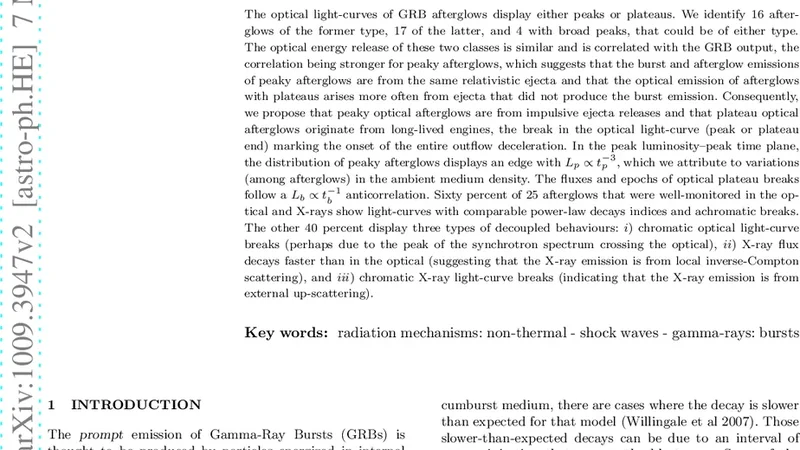
The optical light-curves of GRB afterglows display either peaks or plateaus. We identify 16 afterglows of the former type, 17 of the latter, and 4 with broad peaks, that could be of either type. The optical energy release of these two classes is similar and is correlated with the GRB output, the correlation being stronger for peaky afterglows, which suggests that the burst and afterglow emissions of peaky afterglows are from the same relativistic ejecta and that the optical emission of afterglows with plateaus arises more often from ejecta that did not produce the burst emission. Consequently, we propose that peaky optical afterglows are from impulsive ejecta releases and that plateau optical afterglows originate from long-lived engines, the break in the optical light-curve (peak or plateau end) marking the onset of the entire outflow deceleration. In the peak luminosity–peak time plane, the distribution of peaky afterglows displays an edge with L_p \propto t_p^{-3}, which we attribute to variations (among afterglows) in the ambient medium density. The fluxes and epochs of optical plateau breaks follow a L_b \propto t_b^{-1} anticorrelation. Sixty percent of 25 afterglows that were well-monitored in the optical and X-rays show light-curves with comparable power-law decays indices and achromatic breaks. The other 40 percent display three types of decoupled behaviours: i) chromatic optical light-curve breaks (perhaps due to the peak of the synchrotron spectrum crossing the optical), ii) X-ray flux decays faster than in the optical (suggesting that the X-ray emission is from local inverse-Compton scattering), and iii) chromatic X-ray light-curve breaks (indicating that the X-ray emission is from external up-scattering).
💡 Research Summary
This paper presents a systematic study of the temporal behavior of optical afterglows associated with gamma‑ray bursts (GRBs), focusing on the distinction between two principal light‑curve morphologies: sharp peaks and extended plateaus. By compiling a sample of 37 well‑observed optical afterglows, the authors identify 16 events that exhibit a clear, isolated peak, 17 that display a prolonged plateau phase, and an additional four that possess broad, ambiguous structures that could be classified as either.
The authors first compare the total optical energy output of the two groups. Although the mean energy release is comparable, the correlation between optical energy and the prompt gamma‑ray fluence is significantly stronger for the peaky afterglows. This suggests that the optical emission in peaky events originates from the same relativistic ejecta that produced the prompt gamma‑ray burst, whereas plateau afterglows more often involve material that did not participate directly in the burst emission. Consequently, the authors propose that peaky afterglows arise from impulsive ejecta releases (a short‑lived, single‑pulse engine), while plateau afterglows are powered by a long‑lived central engine that continuously injects energy into the outflow.
In the peak‑luminosity versus peak‑time (Lp–tp) plane, the distribution of peaky afterglows shows a well‑defined edge that follows Lp ∝ tp⁻³. The authors interpret this as a manifestation of variations in the ambient medium density among different bursts: higher external densities cause the forward shock to decelerate earlier, producing an earlier, dimmer peak, whereas lower densities delay deceleration, yielding a later, brighter peak. For plateau afterglows, the break (or end) of the plateau follows an anticorrelation Lb ∝ tb⁻¹, indicating that the plateau termination marks the onset of the full outflow deceleration.
The paper then examines the relationship between optical and X‑ray light curves for 25 afterglows that were densely sampled in both bands. Sixty percent of these display achromatic breaks: the optical and X‑ray fluxes decay with nearly identical power‑law indices before and after a common break time, consistent with the standard external‑shock synchrotron model where both bands arise from the same electron population. The remaining 40 percent exhibit three distinct types of decoupled behavior:
-
Chromatic optical breaks – the optical light curve shows a break not mirrored in the X‑ray band. This is plausibly explained by the synchrotron peak frequency (νm) or cooling frequency (νc) crossing the optical band, altering the decay slope only there.
-
Faster X‑ray decay – the X‑ray flux declines more steeply than the optical. The authors argue that this points to a dominant inverse‑Compton (IC) component in the X‑ray band, where electrons up‑scatter synchrotron photons locally, leading to a more rapid energy loss than in the purely synchrotron‑dominated optical band.
-
Chromatic X‑ray breaks – the X‑ray light curve exhibits a break absent in the optical. This suggests that the X‑ray emission may be produced by external up‑scattering of ambient photons (e.g., dust‑scattered or reverse‑shock photons) rather than by the same forward‑shock electrons that generate the optical synchrotron radiation.
Overall, the study demonstrates that the simple dichotomy of peak versus plateau optical afterglows encodes valuable information about the central engine’s activity duration, the nature of the ejecta, and the density structure of the surrounding medium. By linking optical morphology to multi‑wavelength behavior, the authors provide a framework for interpreting future GRB afterglow observations, guiding both observational strategies (e.g., the importance of simultaneous optical/X‑ray monitoring) and theoretical modeling of relativistic blast‑wave dynamics.
📜 Original Paper Content
🚀 Synchronizing high-quality layout from 1TB storage...