Deep XMM-Newton observation of the Eta Chamaleontis cluster
The members of the Eta Chamaleontis cluster are in an evolutionary stage in which disks are rapidly evolving. It also presents some peculiarities, such as the large fraction of binaries and accretion
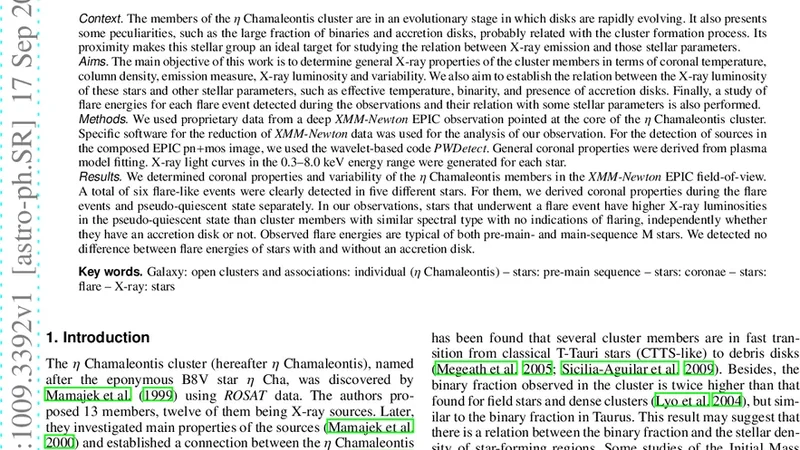
The members of the Eta Chamaleontis cluster are in an evolutionary stage in which disks are rapidly evolving. It also presents some peculiarities, such as the large fraction of binaries and accretion disks, probably related with the cluster formation process. Its proximity makes this stellar group an ideal target for studying the relation between X-ray emission and those stellar parameters. The main objective of this work is to determine general X-ray properties of the cluster members in terms of coronal temperature, column density, emission measure, X-ray luminosity and variability. We also aim to establish the relation between the X-ray luminosity of these stars and other stellar parameters, such as binarity and presence of accretion disks. A study of flare energies for each flare event and their relation with some stellar parameters is also performed. We used proprietary data from a deep XMM-Newton observation pointed at the core of the Eta Chamaleontis cluster. Specific software for the reduction of XMM-Newton data was used for the analysis of our observation. For the detection of sources, we used the wavelet-based code PWDetect. General coronal properties were derived from plasma model fitting. We also determined variability of the Eta Chamaleontis members in the EPIC field-of-view. A total of six flare-like events were clearly detected in five different stars. For them, we derived coronal properties during the flare events and pseudo-quiescent state separately. In our observations, stars that underwent a flare event have higher X-ray luminosities in the pseudo-quiescent state than cluster members with similar spectral type with no indications of flaring, independently whether they have an accretion disk or not. Observed flare energies are typical of both pre-main and main-sequence M stars. We detected no difference between flare energies of stars with and without an accretion disk.
💡 Research Summary
The paper presents a comprehensive X‑ray study of the η Chamaleontis (Eta Chamaleontis) stellar cluster using a deep XMM‑Newton observation centered on the cluster core. The authors aim to characterize the coronal properties of the cluster members—temperature, column density, emission measure, X‑ray luminosity (L_X), and variability—and to explore how these properties relate to stellar parameters such as binarity and the presence of accretion disks. They also investigate flare energetics and their dependence on stellar characteristics.
Data reduction followed the standard XMM‑Newton Science Analysis System (SAS) pipeline, and source detection was performed with the wavelet‑based PWDetect code at a 5σ threshold, yielding 23 X‑ray sources, of which 14 correspond to known cluster members. Spectral analysis employed the APEC plasma model within XSPEC. For most stars a two‑temperature model was required, providing low‑temperature components (T₁ ≈ 3–8 MK) and high‑temperature components (T₂ ≈ 15–35 MK), together with column densities N_H ≈ 10²⁰ cm⁻² and emission measures EM₁, EM₂. Absorption‑corrected L_X values in the 0.3–8 keV band span 10²⁹․⁵–10³¹ erg s⁻¹, decreasing with later spectral type as expected for young low‑mass stars.
Temporal analysis identified six clear flare‑like events in five different stars. By separating the “pseudo‑quiescent” (pre‑flare) interval from the flare peak and decay phases, the authors derived flare‑specific coronal parameters. During flares the hot plasma temperature rises to 30–50 MK and the emission measure increases by roughly an order of magnitude, reaching EM ≈ 10⁵³–10⁵⁴ cm⁻³. Integrated flare energies (∫L_X dt) lie between 10³⁴ and 10³⁶ erg, comparable to typical flares observed on both pre‑main‑sequence and main‑sequence M dwarfs. Importantly, stars that exhibited flares already possessed higher pseudo‑quiescent L_X (∼10³⁰․⁵ erg s⁻¹) than non‑flaring stars of the same spectral type, suggesting that a higher baseline coronal activity level predisposes a star to flare.
The study explicitly tests whether the presence of an accretion disk (classical T Tauri stars versus weak‑line T Tauri stars) influences X‑ray output or flare energetics. Statistical comparisons (Kolmogorov–Smirnov tests) reveal no significant differences in L_X distributions, flare frequencies, or flare energies between disk‑bearing and disk‑less members. Similarly, binary status does not produce measurable variations in X‑ray luminosity or flare occurrence. These results imply that, within this young cluster, the dominant factor governing coronal activity is intrinsic magnetic dynamo processes rather than external influences such as circumstellar material or close companions.
Overall, the paper demonstrates that η Chamaleontis, at an age of roughly 5–10 Myr and a distance of ~97 pc, serves as an excellent laboratory for probing the early evolution of stellar coronae. The authors provide a robust dataset of coronal temperatures, emission measures, and flare properties, and they establish that higher baseline X‑ray luminosity correlates with flare propensity, independent of disk presence or binarity. The findings reinforce the view that magnetic reconnection drives both quiescent and eruptive X‑ray emission in young low‑mass stars. Future work combining high‑resolution X‑ray spectroscopy with longer‑term monitoring could further elucidate the detailed physics of flare initiation and the interplay between stellar rotation, magnetic field topology, and coronal heating in pre‑main‑sequence environments.
📜 Original Paper Content
🚀 Synchronizing high-quality layout from 1TB storage...