Jet propagations, breakouts and photospheric emissions in collapsing massive progenitors of long duration gamma ray bursts
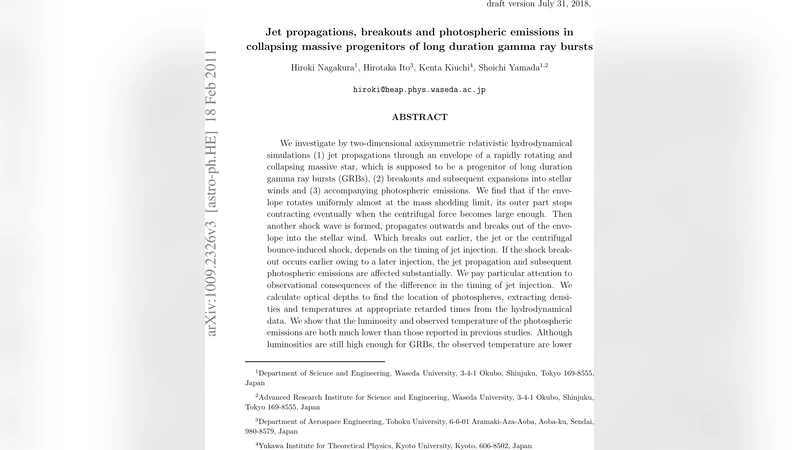
We investigate by two-dimensional axisymmetric relativistic hydrodynamical simulations (1) jet propagations through an envelope of a rapidly rotating and collapsing massive star, which is supposed to be a progenitor of long duration gamma ray bursts (GRBs), (2) breakouts and subsequent expansions into stellar winds and (3) accompanying photospheric emissions. We find that if the envelope rotates uniformly almost at the mass shedding limit, its outer part stops contracting eventually when the centrifugal force becomes large enough. Then another shock wave is formed, propagates outwards and breaks out of the envelope into the stellar wind. Which breaks out earlier, the jet or the centrifugal bounce-induced shock, depends on the timing of jet injection. If the shock breakout occurs earlier owing to a later injection, the jet propagation and subsequent photospheric emissions are affected substantially. We pay particular attention to observational consequences of the difference in the timing of jet injection. We calculate optical depths to find the location of photospheres, extracting densities and temperatures at appropriate retarded times from the hydrodynamical data. We show that the luminosity and observed temperature of the photospheric emissions are both much lower than those reported in previous studies. Although luminosities are still high enough for GRBs, the observed temperature are lower than the energy at the spectral peak expected by the Yonetoku-relation. This may imply that energy exchanges between photons and matter are terminated deeper inside or some non-thermal processes are operating to boost photon energies.
💡 Research Summary
The authors performed two‑dimensional axisymmetric relativistic hydrodynamic simulations to explore three interconnected aspects of long‑duration gamma‑ray burst (GRB) progenitors: (1) the propagation of a relativistic jet through the envelope of a rapidly rotating, collapsing massive star, (2) the breakout of both the jet and a centrifugal‑bounce‑induced shock wave into the surrounding stellar wind, and (3) the resulting photospheric emission. The stellar model is set close to the mass‑shedding (Keplerian) limit, with uniform rotation that eventually halts the contraction of the outer layers because centrifugal support becomes comparable to gravity. This deceleration generates an outward‑moving shock (“centrifugal bounce”) that travels through the envelope and can break out before or after the jet, depending on when the jet is injected.
Four injection times were examined (t_inj = 0, 2, 5 s, etc.). When the jet is injected early, it punches through the envelope first; the later‑emerging shock then propagates through the already‑formed jet channel, redistributing energy and momentum. Conversely, if the jet is injected later, the centrifugal shock reaches the surface first, creating a low‑density cavity that the jet subsequently expands into. This timing difference dramatically alters the density and temperature structure encountered by the jet, and consequently the location of the τ = 1 photosphere.
The authors computed optical depths directly from the simulation outputs, extracting the density, temperature, and velocity fields at the appropriate retarded times. The photosphere in all cases lies at radii of order 10⁹–10¹⁰ cm, with temperatures of only ∼10⁶ K (∼0.1 keV) and luminosities of 10⁴⁹–10⁵⁰ erg s⁻¹. These values are one to two orders of magnitude lower than those reported in earlier one‑dimensional or simplified two‑dimensional studies, which typically predicted photospheric temperatures of ∼1 MeV and luminosities ≳10⁵¹ erg s⁻¹.
Because the observed temperature (or spectral peak energy) is far below the value expected from the empirical Yonetoku relation (E_p ∝ L^{0.5}), the authors argue that the photon–matter coupling must terminate deeper inside the flow, leaving the emerging photons under‑heated. They suggest two possible resolutions: (i) additional non‑thermal processes (internal shocks, magnetic reconnection, or inverse‑Compton scattering) operating above the photosphere could boost photon energies, or (ii) the photospheric emission itself is only a sub‑dominant component of the observed GRB spectrum, with the dominant peak produced by later dissipation.
The study also highlights an observational implication: the centrifugal shock breakout could generate a brief, soft X‑ray/γ‑ray flash preceding the main GRB pulse. This “pre‑burst” would be faint and short‑lived, making it difficult to detect with current instruments but potentially observable with next‑generation high‑sensitivity missions (e.g., THESEUS, SVOM).
In summary, the paper demonstrates that the interplay between a relativistic jet and a rotation‑driven shock in a collapsing massive star can substantially modify the dynamics of jet breakout and the characteristics of photospheric emission. The lower luminosities and temperatures found challenge the conventional picture that photospheric radiation alone accounts for the GRB prompt emission, and they underscore the necessity of incorporating non‑thermal dissipation mechanisms and three‑dimensional effects in future models.
Comments & Academic Discussion
Loading comments...
Leave a Comment