The Extended Chandra Deep Field-South Survey: Optical spectroscopy of faint X-ray sources with the VLT and Keck
We present the results of a program to acquire high-quality optical spectra of X-ray sources detected in the E-CDF-S and its central area. New spectroscopic redshifts are measured for 283 counterparts
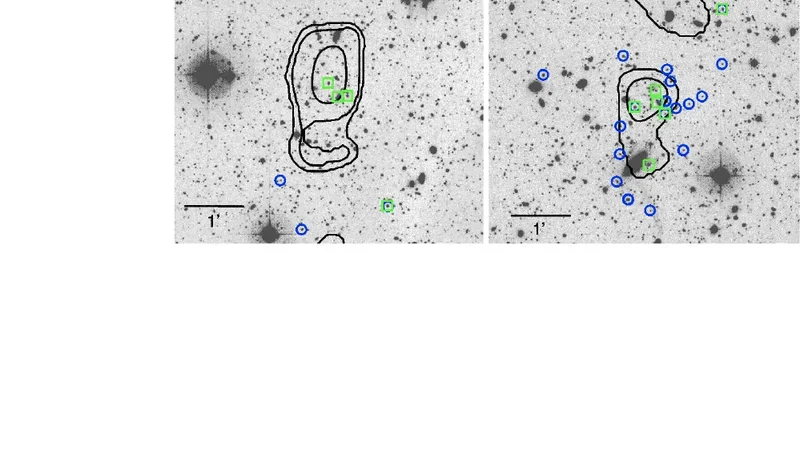
We present the results of a program to acquire high-quality optical spectra of X-ray sources detected in the E-CDF-S and its central area. New spectroscopic redshifts are measured for 283 counterparts to Chandra sources with deep exposures (t2-9 hr per pointing) using multi-slit facilities on both the VLT and Keck thus bringing the total number of spectroscopically-identified X-ray sources to over 500 in this survey field. We provide a comprehensive catalog of X-ray sources detected in the E-CDF-S including the optical and near-infrared counterparts, and redshifts (both spectroscopic and photometric) that incorporate published spectroscopic catalogs thus resulting in a final sample with a high fraction (80%) of X-ray sources having secure identifications. We demonstrate the remarkable coverage of the Lx-z plane now accessible from our data while emphasizing the detection of AGNs that contribute to the faint end of the luminosity function at 1.5<z<3. Our redshift catalog includes 17 type 2 QSOs that significantly increases such samples (2x). With our deepest VIMOS observation, we identify “elusive” optically-faint galaxies (R25) at z2-3 based upon the detection of interstellar absorption lines; we highlight one such case, an absorption-line galaxy at z=3.208 having no obvious signs of an AGN in its optical spectrum. In addition, we determine distances to eight galaxy groups with extended X-ray emission. Finally, we measure the physical extent of known large-scale structures (z0.7) evident in the CDF-S. While a thick sheet (radial size of 67.7 Mpc) at z0.67 extends over the full field, the z0.73 structure is thin (18.8 Mpc) and filamentary as traced by both AGNs and galaxy groups. In the appendix, we provide spectroscopic redshifts for 49 counterparts to fainter X-ray sources detected only in the 1 and 2 Ms catalogs, and 48 VLA radio sources not detected in X-rays.
💡 Research Summary
The paper presents a comprehensive spectroscopic campaign targeting X‑ray sources detected in the Extended Chandra Deep Field‑South (E‑CDFS) and its central region. Using multi‑object spectrographs on the Very Large Telescope (VLT) – specifically VIMOS and FORS2 – and on the Keck telescopes – DEIMOS and LRIS, the authors obtained deep exposures ranging from roughly two to nine hours per mask. This effort yielded high‑quality optical spectra for 283 previously un‑identified counterparts, raising the total number of spectroscopically confirmed X‑ray sources in the field to more than 500, and achieving a secure identification fraction of about 80 %.
The methodology began with the assembly of a master X‑ray catalog that combines the 250 ks, 1 Ms, and 2 Ms Chandra observations. Counterparts were identified through a likelihood‑ratio analysis applied to deep optical and near‑infrared imaging (HST/ACS, VLT/ISAAC, Spitzer/IRAC). Multi‑slit masks were designed to target the most probable counterparts, and standard reduction pipelines were employed to produce calibrated one‑dimensional spectra. Redshifts were derived from both emission lines (e.g.,
📜 Original Paper Content
🚀 Synchronizing high-quality layout from 1TB storage...