Dynamics and stability of relativistic GRB blast waves
In gamma-ray-bursts (GRB), ultra-relativistic blast waves are ejected into the circumburst medium. We analyse in unprecedented detail the deceleration of a self-similar Blandford-McKee blast wave from
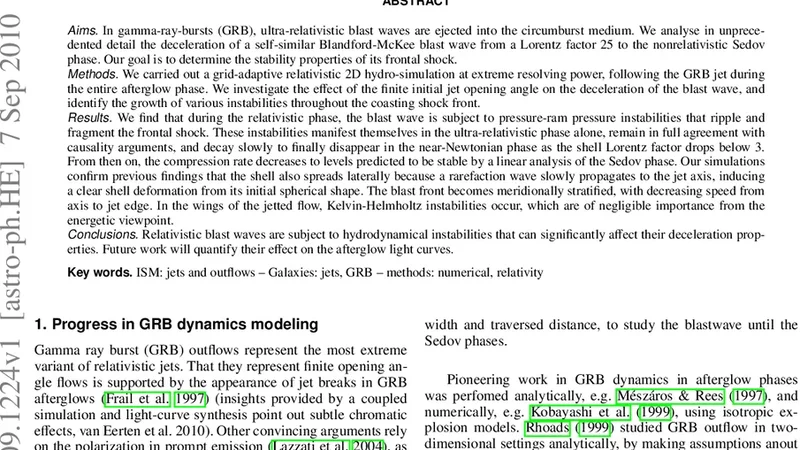
In gamma-ray-bursts (GRB), ultra-relativistic blast waves are ejected into the circumburst medium. We analyse in unprecedented detail the deceleration of a self-similar Blandford-McKee blast wave from a Lorentz factor 25 to the nonrelativistic Sedov phase. Our goal is to determine the stability properties of its frontal shock. We carried out a grid-adaptive relativistic 2D hydro-simulation at extreme resolving power, following the GRB jet during the entire afterglow phase. We investigate the effect of the finite initial jet opening angle on the deceleration of the blast wave, and identify the growth of various instabilities throughout the coasting shock front. We find that during the relativistic phase, the blast wave is subject to pressure-ram pressure instabilities that ripple and fragment the frontal shock. These instabilities manifest themselves in the ultra-relativistic phase alone, remain in full agreement with causality arguments, and decay slowly to finally disappear in the near-Newtonian phase as the shell Lorentz factor drops below 3. From then on, the compression rate decreases to levels predicted to be stable by a linear analysis of the Sedov phase. Our simulations confirm previous findings that the shell also spreads laterally because a rarefaction wave slowly propagates to the jet axis, inducing a clear shell deformation from its initial spherical shape. The blast front becomes meridionally stratified, with decreasing speed from axis to jet edge.
💡 Research Summary
The paper presents a comprehensive numerical investigation of the deceleration and stability of ultra‑relativistic gamma‑ray‑burst (GRB) blast waves, following a self‑similar Blandford‑McKee (BM) solution from an initial Lorentz factor of γ≈25 down to the non‑relativistic Sedov‑Taylor phase. Using a state‑of‑the‑art, grid‑adaptive relativistic hydrodynamics code, the authors perform two‑dimensional simulations with extreme spatial resolution (down to 10⁻⁴ R of the shock radius) that capture the entire afterglow evolution. The initial configuration consists of a conical jet with finite opening angles (5°, 10°, and 20°) embedded in a uniform circumburst medium, allowing the study of both spherical and jet‑like geometries.
Key findings can be grouped into three interrelated aspects. First, during the relativistic stage (γ > 3) the forward shock is subject to a pressure‑ram‑pressure instability. Small perturbations on the shock surface grow because the post‑shock pressure scales as γ² while the causal horizon is limited by the speed of light. The instability manifests as ripples that quickly fragment the shock front into a “rippled” or “lumpy” structure. The growth rate follows roughly γ⁻¹, and the instability becomes ineffective once γ drops below ≈10, after which the amplitude decays slowly.
Second, as the blast wave transitions into the near‑Newtonian regime (γ < 3) the compression ratio settles to the Sedov‑Taylor value (~4), and linear stability analysis predicts a stable configuration. The fragmented shock front gradually smooths out, and the overall morphology returns to a nearly spherical shape. Energy conservation remains intact throughout this process, indicating that the fragmentation does not lead to significant radiative losses but merely redistributes kinetic energy locally.
Third, the finite opening angle of the jet drives a lateral rarefaction wave that propagates toward the axis. This wave causes the jet to spread sideways, producing a meridional stratification: the axial region retains a higher Lorentz factor (β≈0.99 c) while the edge slows to β≈0.8 c. Consequently, the shock speed and compression vary with polar angle, which in turn modifies the afterglow light‑curve and spectral evolution, potentially generating observable anisotropies such as polarization swings or small‑scale flux fluctuations.
The authors also compare their results with analytic expectations. The relativistic instability they identify is absent in the classic BM solution, which assumes perfect spherical symmetry and infinite causal connectivity. Their simulations demonstrate that causality constraints naturally limit the growth of perturbations, reconciling the numerical findings with theoretical limits. In the Sedov phase, the simulated compression and stability match the predictions of linear perturbation theory, confirming that the system behaves as a classic non‑relativistic blast wave once the Lorentz factor is sufficiently low.
Overall, the study provides (i) the first high‑resolution, long‑duration 2D simulation of a GRB blast wave that captures both relativistic instabilities and the transition to the Sedov phase, (ii) a quantitative description of the pressure‑ram‑pressure instability, its growth law, and its eventual damping, and (iii) a clear illustration of how finite jet opening angles shape the lateral structure and speed stratification of the shock. These insights are directly relevant for interpreting afterglow observations, especially high‑time‑resolution light curves, radio imaging of expanding fireballs, and polarization measurements that can probe the predicted meridional stratification. The work thus bridges the gap between idealized analytic models and the complex, multi‑dimensional reality of GRB afterglows.
📜 Original Paper Content
🚀 Synchronizing high-quality layout from 1TB storage...