Rapidly Decaying Supernova 2010X: A Candidate ".Ia" Explosion
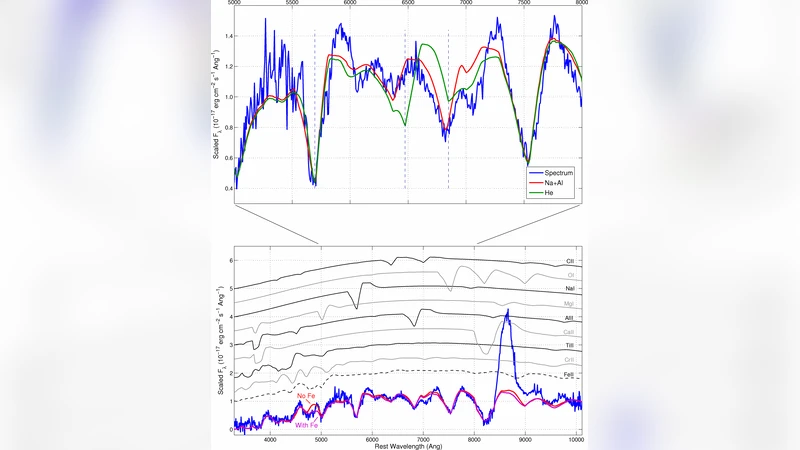
We present the discovery, photometric and spectroscopic follow-up observations of SN 2010X (PTF 10bhp). This supernova decays exponentially with tau_d=5 days, and rivals the current recordholder in speed, SN 2002bj. SN 2010X peaks at M_r=-17mag and has mean velocities of 10,000 km/s. Our light curve modeling suggests a radioactivity powered event and an ejecta mass of 0.16 Msun. If powered by Nickel, we show that the Nickel mass must be very small (0.02 Msun) and that the supernova quickly becomes optically thin to gamma-rays. Our spectral modeling suggests that SN 2010X and SN 2002bj have similar chemical compositions and that one of Aluminum or Helium is present. If Aluminum is present, we speculate that this may be an accretion induced collapse of an O-Ne-Mg white dwarf. If Helium is present, all observables of SN 2010X are consistent with being a thermonuclear Helium shell detonation on a white dwarf, a “.Ia” explosion. With the 1-day dynamic-cadence experiment on the Palomar Transient Factory, we expect to annually discover a few such events.
💡 Research Summary
The paper reports the discovery and follow‑up observations of SN 2010X (also known as PTF 10bhp), an exceptionally fast‑declining supernova identified by the Palomar Transient Factory (PTF) using its one‑day cadence experiment. Photometrically, SN 2010X rises to a peak absolute magnitude of M_r ≈ ‑17 mag and then fades exponentially with a characteristic decay time τ_d ≈ 5 days, making it one of the quickest transients known, comparable only to SN 2002bj. Spectra obtained at several epochs reveal broad absorption features with typical expansion velocities of ~10 000 km s⁻¹. The most prominent lines are Si II λ6355, Ca II near‑infrared triplet, and Fe II λ5169; weaker features around 7300 Å could be attributed either to Al II or He I, suggesting the presence of aluminum or helium in the ejecta.
The authors model the light curve assuming radioactive heating. The best‑fit parameters imply a very low ejecta mass (M_ej ≈ 0.16 M_⊙) and a modest kinetic energy (E ≈ 10⁵⁰ erg). To reproduce the observed luminosity, the required ^56Ni mass is only M_Ni ≈ 0.02 M_⊙, far smaller than in normal Type Ia supernovae (≈0.6 M_⊙). Because of the tiny nickel reservoir and the low total mass, the ejecta become optically thin to γ‑rays very quickly, which naturally explains the rapid exponential decline.
Two physical interpretations are explored. If the 7300 Å feature is due to aluminum, the event could be an accretion‑induced collapse (AIC) of an O‑Ne‑Mg white dwarf, a scenario that predicts the synthesis of neutron‑rich isotopes such as ^27Al. If, instead, helium is present, the observations are consistent with a thermonuclear detonation of a thin helium shell on a carbon‑oxygen white dwarf, the so‑called “.Ia” explosion first proposed by Bildsten et al. (2007). The .Ia model predicts exactly the combination of low ejecta mass, low ^56Ni yield, fast light‑curve evolution, and modest peak luminosity observed in SN 2010X. Moreover, the rapid transition to γ‑ray transparency is a hallmark of such helium‑shell detonations.
The paper emphasizes the importance of high‑cadence surveys for uncovering these fleeting transients. The one‑day dynamic cadence of PTF is expected to discover a few such events per year, providing a valuable statistical sample to test the rates of helium‑shell detonations versus AIC events. Future surveys with even higher cadence and deeper reach (e.g., ZTF, LSST) will be able to refine the occurrence rate, probe the diversity of chemical signatures, and ultimately clarify the progenitor channels responsible for the fastest supernovae known.
Comments & Academic Discussion
Loading comments...
Leave a Comment