Does Youngs equation hold on the nanoscale? A Monte Carlo test for the binary Lennard-Jones fluid
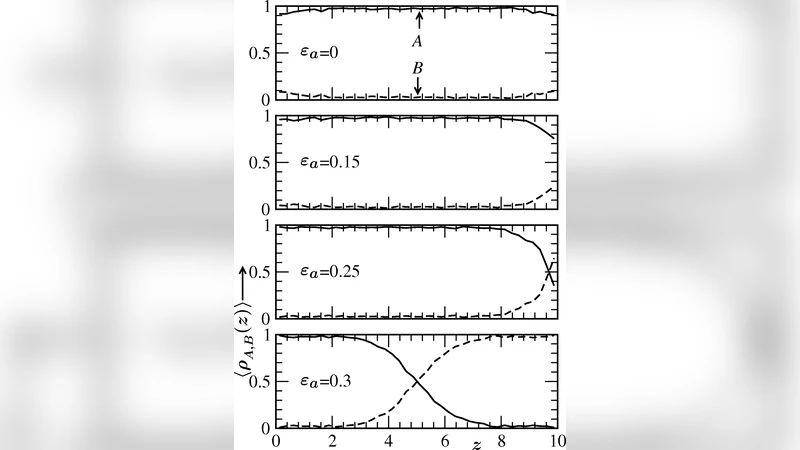
When a phase-separated binary ($A+B$) mixture is exposed to a wall, that preferentially attracts one of the components, interfaces between A-rich and B-rich domains in general meet the wall making a contact angle $\theta$. Young’s equation describes this angle in terms of a balance between the $A-B$ interfacial tension $\gamma_{AB}$ and the surface tensions $\gamma_{wA}$, $\gamma_{wB}$ between, respectively, the $A$- and $B$-rich phases and the wall, $\gamma {AB} \cos \theta =\gamma{wA}-\gamma_{wB}$. By Monte Carlo simulations of bridges, formed by one of the components in a binary Lennard-Jones liquid, connecting the two walls of a nanoscopic slit pore, $\theta$ is estimated from the inclination of the interfaces, as a function of the wall-fluid interaction strength. The information on the surface tensions $\gamma_{wA}$, $\gamma_{wB}$ are obtained independently from a new thermodynamic integration method, while $\gamma_{AB}$ is found from the finite-size scaling analysis of the concentration distribution function. We show that Young’s equation describes the contact angles of the actual nanoscale interfaces for this model rather accurately and location of the (first order) wetting transition is estimated.
💡 Research Summary
The authors address a fundamental question in interfacial physics: does Young’s equation, which relates the contact angle θ of a fluid–fluid interface meeting a solid wall to the balance of interfacial tensions, remain valid when the system size is reduced to the nanometer scale? To answer this, they perform extensive Monte Carlo simulations of a binary Lennard‑Jones (LJ) fluid confined in a slit‑pore geometry. The fluid consists of two species, A and B, whose mutual LJ parameters are chosen so that the mixture phase‑separates into A‑rich and B‑rich domains near the critical temperature. Two parallel, structureless walls bound the pore; the wall–particle interaction is modeled by a 9‑3 LJ potential with independently tunable strengths ε_wA and ε_wB, allowing the walls to preferentially attract either component.
When one component is strongly favored by the walls, it forms a “bridge” that connects the two walls, essentially a slab of the favored phase bounded by two AB interfaces. The inclination of these interfaces with respect to the wall defines the contact angle θ. The authors extract θ by averaging the interface height profile h(x) and fitting a straight line to obtain the slope dh/dx = tan θ.
Three independent surface‑tension quantities are required for Young’s equation: the AB interfacial tension γ_AB, and the wall–A and wall–B surface tensions γ_wA and γ_wB. γ_AB is obtained via finite‑size scaling of the concentration distribution function P(x_A). By simulating systems of different lateral sizes L, the free‑energy barrier ΔF_AB = −k_BT ln
Comments & Academic Discussion
Loading comments...
Leave a Comment