Effect of Rain Scavenging on Altitudinal Distribution of Soluble Gaseous Pollutants in the Atmosphere
We suggest a model of rain scavenging of soluble gaseous pollutants in the atmosphere. It is shown that below-cloud gas scavenging is determined by non-stationary convective diffusion equation with th
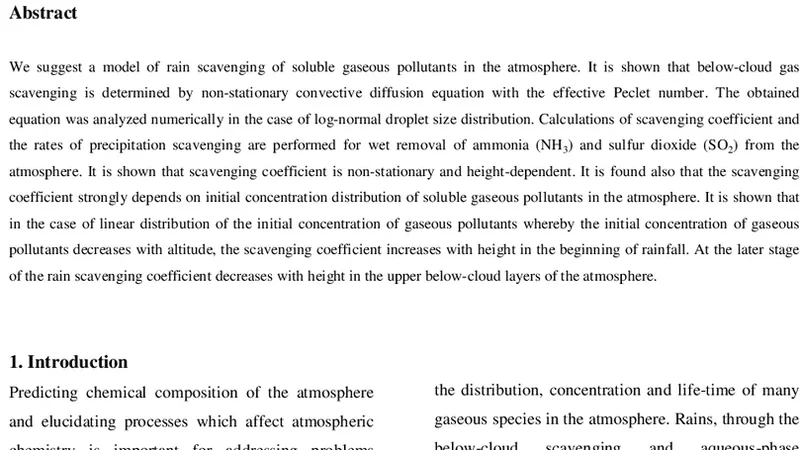
We suggest a model of rain scavenging of soluble gaseous pollutants in the atmosphere. It is shown that below-cloud gas scavenging is determined by non-stationary convective diffusion equation with the effective Peclet number. The obtained equation was analyzed numerically in the case of log-normal droplet size distribution. Calculations of scavenging coefficient and the rates of precipitation scavenging are performed for wet removal of ammonia (NH3) and sulfur dioxide (SO2) from the atmosphere. It is shown that scavenging coefficient is non-stationary and height-dependent. It is found also that the scavenging coefficient strongly depends on initial concentration distribution of soluble gaseous pollutants in the atmosphere. It is shown that in the case of linear distribution of the initial concentration of gaseous pollutants whereby the initial concentration of gaseous pollutants decreases with altitude, the scavenging coefficient increases with height in the beginning of rainfall. At the later stage of the rain scavenging coefficient decreases with height in the upper below-cloud layers of the atmosphere.
💡 Research Summary
This paper presents a comprehensive model for the removal of soluble gaseous pollutants—specifically ammonia (NH₃) and sulfur dioxide (SO₂)—by rain scavenging below cloud base. The authors argue that conventional approaches, which treat the scavenging coefficient (kₛ) as a static, height‑independent parameter, are insufficient for capturing the true dynamics of pollutant removal during precipitation events. To address this, they formulate a non‑stationary one‑dimensional convection‑diffusion equation for the gas concentration C(z, t) as a function of height (z) and time (t). The equation incorporates a convective term representing the bulk motion of raindrops and a diffusive term accounting for turbulent mixing. These two processes are combined into an effective Peclet number (Pe* = vL/D), where v is the mean vertical velocity induced by falling droplets, L a characteristic vertical length scale, and D the turbulent diffusivity.
A key innovation of the study is the explicit treatment of the raindrop size distribution. Rather than assuming a monodisperse population, the authors adopt a log‑normal distribution characterized by a mean radius (r̄) and a geometric standard deviation (σ). This choice reflects observed variability in natural rain and allows the model to explore a wide range of precipitation intensities, from light drizzle to heavy downpours. The mass transfer between droplets and gas is modeled through a surface‑area‑based transfer coefficient (kₜ) that scales with the square of the droplet radius, thereby linking droplet microphysics directly to the scavenging efficiency.
Numerical integration of the governing equation is performed using a fourth‑order Runge‑Kutta scheme with a time step small enough to resolve the rapid changes that occur during the first few minutes of rain. Two initial vertical concentration profiles are examined: (1) a linear decrease with height (C₀(z) = C₀·(1 − αz)), representing typical atmospheric stratification where pollutant sources are near the surface, and (2) a uniform profile, which serves as a baseline for comparison. The simulations span a rain duration of up to 30 minutes, covering the full evolution from the onset of precipitation to its cessation.
The results reveal several important and previously unquantified behaviors. First, the scavenging coefficient is highly non‑stationary: it varies both temporally and with altitude. At the very beginning of a rain event, kₛ is larger at higher altitudes. This counter‑intuitive increase is explained by the fact that, for a given droplet fall speed, the residence time of droplets in the upper layers is longer, and the effective surface area for gas uptake per unit volume is greater. As rain continues, the upper layers become depleted of gas more quickly than the lower layers, causing the peak of kₛ to migrate downward. Consequently, during the later stages of the event, the strongest scavenging occurs near the surface.
Second, the shape of the initial concentration profile strongly influences the height dependence of kₛ. When the initial profile declines linearly with height, the early‑stage increase of kₛ with altitude is pronounced, whereas a uniform initial profile yields a much flatter kₛ(z) curve. This finding underscores the importance of accurately representing source distributions in atmospheric chemistry models.
Third, sensitivity to droplet size distribution parameters is significant. Increasing the mean droplet radius r̄ enhances the total interfacial area, leading to higher kₛ values across all heights. Conversely, broadening the distribution (larger σ) raises the proportion of small droplets, which reduces the overall surface area per unit volume and thus diminishes the scavenging efficiency. These trends suggest that real‑time measurements of raindrop spectra could be used to dynamically adjust kₛ in operational air‑quality models.
The chemical differences between NH₃ and SO₂ are also reflected in the simulations. Ammonia, with a high Henry’s law constant (≈ 1.6 × 10⁴ M atm⁻¹), is rapidly transferred into raindrops, resulting in a larger kₛ and faster removal. Sulfur dioxide, possessing a lower solubility (≈ 1.2 × 10³ M atm⁻¹), exhibits slower scavenging; however, the model indicates that once dissolved, SO₂ can undergo further aqueous-phase reactions, potentially augmenting its overall removal beyond pure physical uptake.
In the discussion, the authors argue that incorporating a time‑ and height‑dependent scavenging coefficient can substantially improve the fidelity of atmospheric transport‑chemistry models, especially in regions with complex topography or strong vertical gradients in emissions. They propose that coupling the presented framework with radar‑derived rain microphysics and lidar‑based gas profiling could enable near‑real‑time estimation of pollutant washout rates, a capability that would be valuable for both air‑quality forecasting and climate impact assessments.
In conclusion, the paper advances the state of knowledge on rain scavenging by moving beyond static parameterizations to a dynamic, physically based description that accounts for droplet size spectra, turbulent transport, and initial pollutant distributions. The demonstrated non‑stationarity and altitude dependence of the scavenging coefficient, together with the sensitivity analyses for NH₃ and SO₂, provide a robust foundation for future model development and for the integration of observational data into predictive frameworks.
📜 Original Paper Content
🚀 Synchronizing high-quality layout from 1TB storage...