Particle Acceleration in Relativistic Magnetized Collisionless Electron-Ion Shocks
We investigate shock structure and particle acceleration in relativistic magnetized collisionless electron-ion shocks by means of 2.5D particle-in-cell simulations with ion-to-electron mass ratios (m_
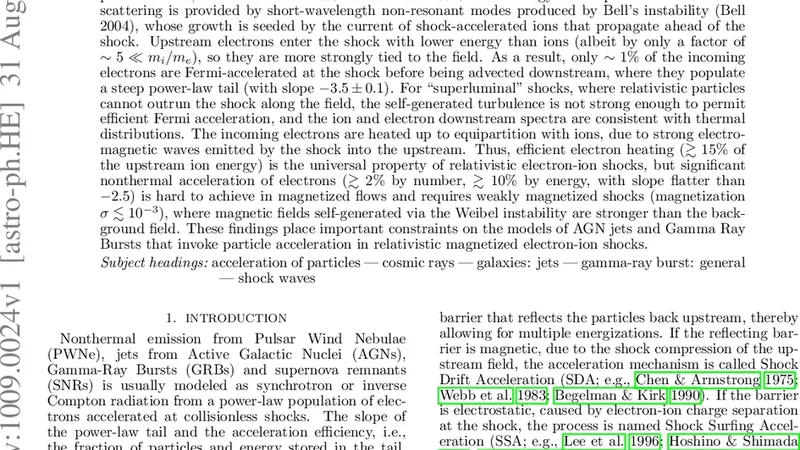
We investigate shock structure and particle acceleration in relativistic magnetized collisionless electron-ion shocks by means of 2.5D particle-in-cell simulations with ion-to-electron mass ratios (m_i/m_e) ranging from 16 to 1000. We explore a range of inclination angles between the pre-shock magnetic field and the shock normal. In “subluminal” shocks, where relativistic particles can escape ahead of the shock along the magnetic field lines, ions are efficiently accelerated via a Fermi-like mechanism. The downstream ion spectrum consists of a relativistic Maxwellian and a high-energy power-law tail, which contains ~5% of ions and ~30% of ion energy. Its slope is -2.1. Upstream electrons enter the shock with lower energy than ions, so they are more strongly tied to the field. As a result, only ~1% of the incoming electrons are Fermi-accelerated at the shock before being advected downstream, where they populate a steep power-law tail (with slope -3.5). For “superluminal” shocks, where relativistic particles cannot outrun the shock along the field, the self-generated turbulence is not strong enough to permit efficient Fermi acceleration, and the ion and electron downstream spectra are consistent with thermal distributions. The incoming electrons are heated up to equipartition with ions, due to strong electromagnetic waves emitted by the shock into the upstream. Thus, efficient electron heating (>15% of the upstream ion energy) is the universal property of relativistic electron-ion shocks, but significant nonthermal acceleration of electrons (>2% by number, >10% by energy, with slope flatter than -2.5) is hard to achieve in magnetized flows and requires weakly magnetized shocks (magnetization <1e-3). These findings place important constraints on the models of AGN jets and Gamma Ray Bursts that invoke particle acceleration in relativistic magnetized electron-ion shocks.
💡 Research Summary
The authors investigate the structure and particle acceleration mechanisms of relativistic, magnetized, collisionless electron‑ion shocks using two‑and‑a‑half‑dimensional particle‑in‑cell (PIC) simulations. They explore a wide range of ion‑to‑electron mass ratios (m_i/m_e = 16, 100, 400, 1000) and vary the inclination angle θ between the upstream magnetic field and the shock normal, thereby covering both “subluminal” (θ < θ_crit) and “superluminal” (θ > θ_crit) regimes. In subluminal shocks, relativistic particles can outrun the shock along magnetic field lines, allowing repeated shock crossings. Ions undergo efficient Fermi‑type acceleration, producing a downstream spectrum that consists of a relativistic Maxwellian plus a high‑energy power‑law tail with index ≈ −2.1. This tail contains roughly 5 % of the ions but carries about 30 % of the ion energy. Electrons, being more tightly tied to the field, are only modestly accelerated: ≈ 1 % of incoming electrons join a steep power‑law tail (index ≈ −3.5).
In superluminal shocks, particles cannot escape ahead of the shock; the self‑generated turbulence is too weak to enable multiple shock crossings. Consequently, both ions and electrons downstream are well described by thermal Maxwellian distributions, and non‑thermal tails are absent. Nevertheless, a strong electromagnetic precursor emitted by the shock efficiently heats the incoming electrons, bringing their temperature to near equipartition with ions. This electron heating accounts for more than 15 % of the upstream ion energy, a universal feature of relativistic magnetized shocks irrespective of the sub‑ or super‑luminal nature.
A systematic scan of the magnetization parameter σ (magnetic energy density relative to kinetic energy density) shows that significant non‑thermal electron acceleration (≥ 2 % of electrons by number, ≥ 10 % of the energy, with a spectral slope flatter than −2.5) only occurs when σ < 10⁻³, i.e., in weakly magnetized flows. For σ ≥ 10⁻³, the magnetic field constrains particle trajectories and suppresses Fermi acceleration.
These findings have direct implications for models of active‑galactic‑nucleus (AGN) jets and gamma‑ray bursts (GRBs) that rely on relativistic magnetized shocks to produce the observed high‑energy radiation. The results suggest that while ion acceleration can be efficient in subluminal, moderately magnetized shocks, efficient electron acceleration requires either very low magnetization or additional mechanisms (e.g., turbulence generated by kinetic instabilities). Electron heating to equipartition, however, appears to be a robust outcome of relativistic magnetized shocks and must be accounted for in any realistic emission model. The paper thus places stringent constraints on the parameter space (θ, σ, m_i/m_e) in which relativistic magnetized electron‑ion shocks can simultaneously provide strong ion acceleration, substantial electron heating, and the non‑thermal electron populations required to explain observed astrophysical spectra.
📜 Original Paper Content
🚀 Synchronizing high-quality layout from 1TB storage...