A Theory of Mulicolor Black Body Emission from Relativistically Expanding Plasmas
We consider the emission of photons from the inner parts of a relativistically expanding plasma outflow, characterized by a constant Lorentz factor, Gamma. Photons that are injected in regions of high
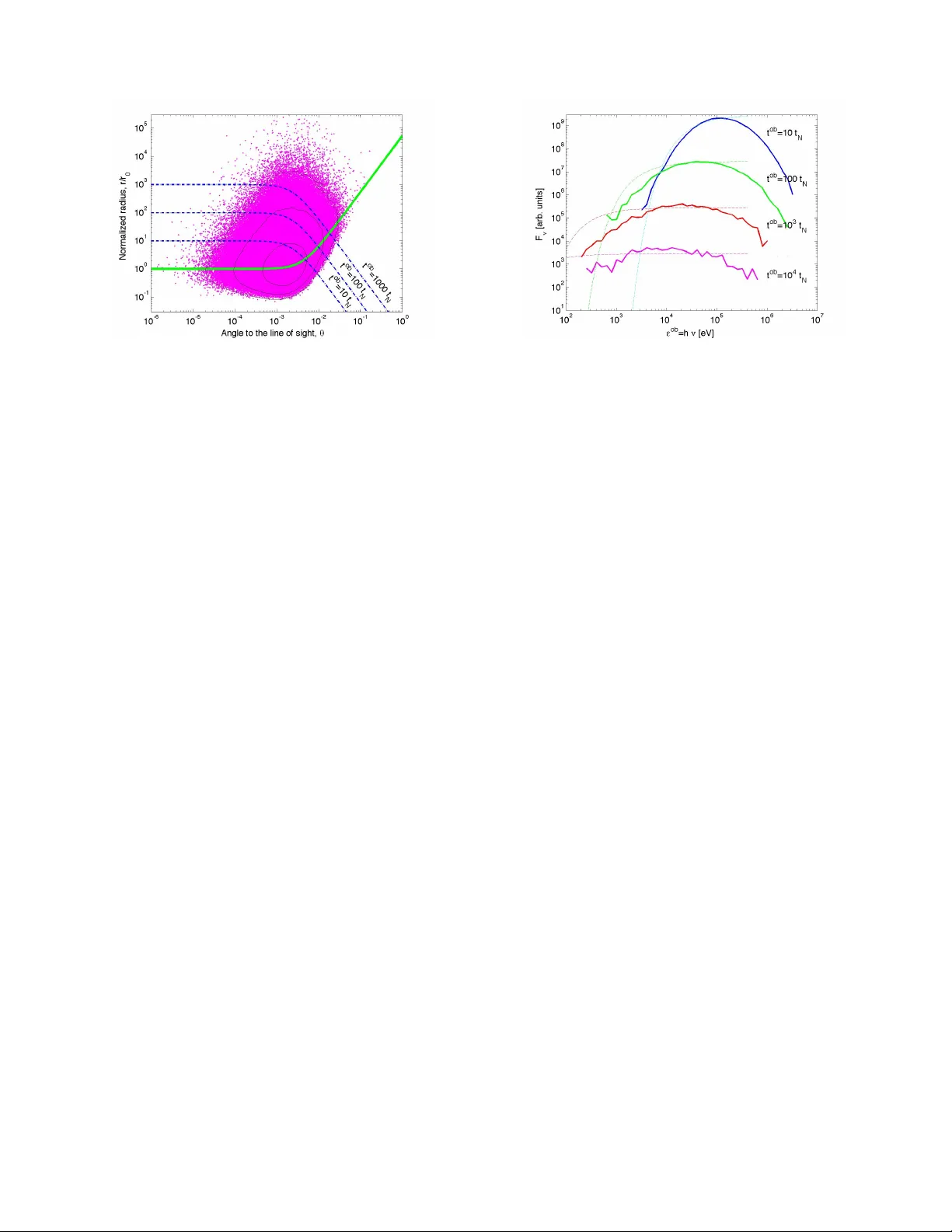
We consider the emission of photons from the inner parts of a relativistically expanding plasma outflow, characterized by a constant Lorentz factor, Gamma. Photons that are injected in regions of high optical depth are advected with the flow until they escape at the photosphere. Due to multiple scattering below the photosphere, the locally emerging comoving photon distribution is thermal. However, as an observer sees simultaneously photons emitted from different angles, hence with different Doppler boosting, the observed spectrum is a multi-color black-body. We calculate here the properties of the observed spectrum at different observed times. Due to the strong dependence of the photospheric radius on the angle to the line of sight, for parameters characterizing gamma-ray bursts (GRBs) thermal photons are seen up to tens of seconds following the termination of the inner engine. At late times, following the inner engine termination, both the number flux and energy flux of the thermal spectrum decay as F ~ t^{-2}. At these times, the multicolor black body emission results in a power law at low energies (below the thermal peak), with power law index F_\nu ~ \nu^{0}. This result is remarkably similar to the average value of the low energy spectral slope index (``\alpha’’) seen in fitting the spectra of large GRB sample.
💡 Research Summary
The paper presents a comprehensive theoretical framework for the emission of photons from the inner regions of a relativistically expanding plasma outflow, a scenario directly relevant to the prompt and early afterglow phases of gamma‑ray bursts (GRBs). The authors assume a steady, spherically symmetric outflow with a constant bulk Lorentz factor Γ. Photons are injected deep inside the flow where the Thomson optical depth τ≫1, so they are advected with the plasma until they reach the photosphere, the surface where τ≈1. Below the photosphere, repeated Thomson scatterings thermalize the photon distribution in the comoving frame, producing a pure black‑body spectrum locally.
Because an observer receives photons emitted over a range of angles θ relative to the line of sight, each angular element experiences a different Doppler boost δ(θ)=1/
📜 Original Paper Content
🚀 Synchronizing high-quality layout from 1TB storage...