Shortest paths between shortest paths and independent sets
We study problems of reconfiguration of shortest paths in graphs. We prove that the shortest reconfiguration sequence can be exponential in the size of the graph and that it is NP-hard to compute the
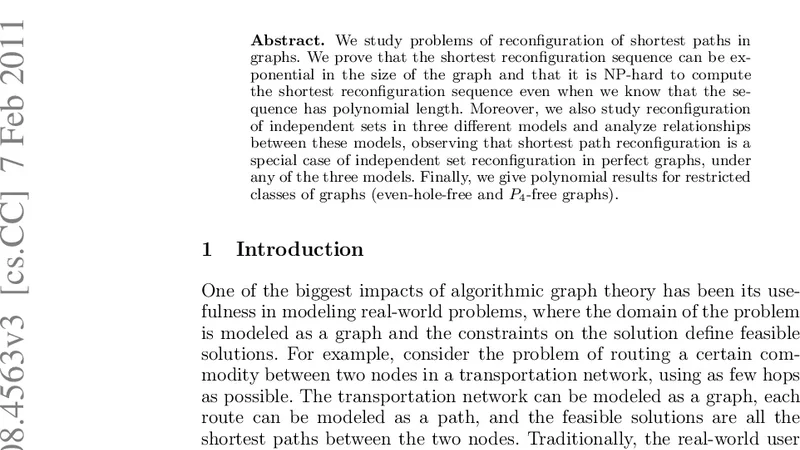
We study problems of reconfiguration of shortest paths in graphs. We prove that the shortest reconfiguration sequence can be exponential in the size of the graph and that it is NP-hard to compute the shortest reconfiguration sequence even when we know that the sequence has polynomial length. Moreover, we also study reconfiguration of independent sets in three different models and analyze relationships between these models, observing that shortest path reconfiguration is a special case of independent set reconfiguration in perfect graphs, under any of the three models. Finally, we give polynomial results for restricted classes of graphs (even-hole-free and $P_4$-free graphs).
💡 Research Summary
The paper investigates the reconfiguration of two fundamental combinatorial objects in graphs—shortest paths and independent sets—through the lens of computational complexity. A reconfiguration problem asks whether one feasible solution can be transformed into another by a sequence of elementary steps, each of which must also be a feasible solution. The authors first formalize the shortest‑path reconfiguration problem: given an undirected graph G and two distinct shortest s‑t paths P₁ and P₂, a step consists of replacing a single vertex of the current path while preserving the property of being a shortest s‑t path. The central question is how many such steps are required in the shortest possible sequence (the “shortest reconfiguration sequence”).
The first major contribution is a constructive lower bound showing that the length of a shortest reconfiguration sequence can be exponential in the number of vertices. By designing a family of graphs that encode binary choices at each step, they demonstrate that any valid sequence must traverse a path of length Θ(2ⁿ). This result separates the difficulty of finding a single shortest path (polynomial‑time via Dijkstra or BFS) from the difficulty of moving between two shortest paths, highlighting a hidden source of combinatorial explosion.
Next, the authors address the algorithmic problem of computing the minimum number of steps when a polynomial‑length sequence is guaranteed to exist. They prove that even under this promise, determining the exact length is NP‑hard. The proof proceeds via a polynomial‑time reduction from a known NP‑complete problem (e.g., SAT or a variant of the Minimum Vertex Cover reconfiguration) to the shortest‑path reconfiguration length problem. The reduction carefully encodes logical constraints into the structure of the graph so that any optimal reconfiguration corresponds to a satisfying assignment, thereby establishing the hardness of the optimization version. Consequently, the decision version (“does a sequence of length ≤ k exist?”) remains intractable even when k is polynomially bounded.
The paper then shifts focus to independent‑set reconfiguration, considering three widely studied models: Token Sliding (TS), Token Jumping (TJ), and Token Addition/Removal (TAR). In TS a token (representing a vertex in the independent set) may slide along an edge to an adjacent empty vertex; in TJ a token may jump to any empty vertex; in TAR a token may be added to or removed from the set, respecting the independence constraint. The authors analyze the relationships among these models, proving inclusion results (e.g., any TS sequence is also a TJ sequence) and identifying cases where the converse fails.
A particularly insightful observation is that shortest‑path reconfiguration can be viewed as a special case of independent‑set reconfiguration on perfect graphs. In a perfect graph, the complement of a maximum independent set is a minimum vertex cover, and cliques and independent sets are dual. By mapping each vertex of a shortest s‑t path to a token placed on a corresponding vertex of a perfect graph, the authors show that each elementary replacement of a path vertex corresponds exactly to a token move in any of the three independent‑set models. Thus, the hardness results for shortest‑path reconfiguration immediately transfer to independent‑set reconfiguration on perfect graphs.
Finally, the authors identify graph classes where the reconfiguration problems become tractable. For even‑hole‑free graphs (graphs without induced cycles of even length) they devise a breadth‑first search on the reconfiguration graph that runs in polynomial time, exploiting the fact that such graphs have a tree‑like decomposition that limits the ways shortest paths can diverge. For P₄‑free graphs (co‑graphs), they use the recursive cotree representation to break the reconfiguration problem into independent subproblems, each solvable in polynomial time for all three models. In both cases the algorithms compute the exact shortest reconfiguration distance, not merely a feasible sequence.
In summary, the paper establishes four key contributions: (1) an exponential lower bound on the length of shortest‑path reconfiguration sequences; (2) NP‑hardness of computing the optimal length even with a polynomial‑length guarantee; (3) a unifying framework that embeds shortest‑path reconfiguration into independent‑set reconfiguration on perfect graphs across TS, TJ, and TAR models; and (4) polynomial‑time algorithms for both reconfiguration problems on even‑hole‑free and P₄‑free graph families. These results deepen our understanding of the intrinsic difficulty of reconfiguration, reveal surprising connections between seemingly unrelated combinatorial structures, and open avenues for future work on identifying further tractable graph classes and on designing approximation algorithms for the general case.
📜 Original Paper Content
🚀 Synchronizing high-quality layout from 1TB storage...