Gravitational wave background from sub-luminous GRBs: prospects for second and third generation detectors
We assess the detection prospects of a gravitational wave background associated with sub-luminous gamma-ray bursts (SL-GRBs). We assume that the central engines of a significant proportion of these bu
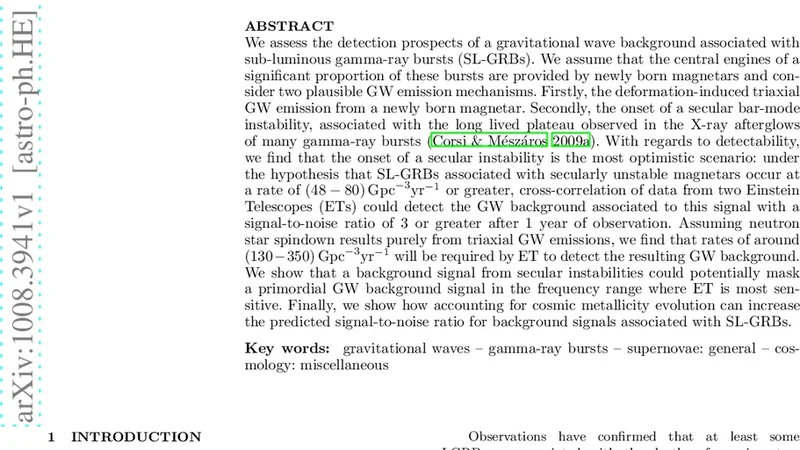
We assess the detection prospects of a gravitational wave background associated with sub-luminous gamma-ray bursts (SL-GRBs). We assume that the central engines of a significant proportion of these bursts are provided by newly born magnetars and consider two plausible GW emission mechanisms. Firstly, the deformation-induced triaxial GW emission from a newly born magnetar. Secondly, the onset of a secular bar-mode instability, associated with the long lived plateau observed in the X-ray afterglows of many gamma-ray bursts (Corsi & Meszaros 2009a). With regards to detectability, we find that the onset of a secular instability is the most optimistic scenario: under the hypothesis that SL-GRBs associated with secularly unstable magnetars occur at a rate of (48; 80)Gpc^{-3}yr^{-1} or greater, cross-correlation of data from two Einstein Telescopes (ETs) could detect the GW background associated to this signal with a signal-to-noise ratio of 3 or greater after 1 year of observation. Assuming neutron star spindown results purely from triaxial GW emissions, we find that rates of around (130;350)Gpc^{-3}yr^{-1} will be required by ET to detect the resulting GW background. We show that a background signal from secular instabilities could potentially mask a primordial GW background signal in the frequency range where ET is most sen- sitive. Finally, we show how accounting for cosmic metallicity evolution can increase the predicted signal-to-noise ratio for background signals associated with SL-GRBs.
💡 Research Summary
The paper investigates the stochastic gravitational‑wave (GW) background that could arise from sub‑luminous gamma‑ray bursts (SL‑GRBs) if a substantial fraction of them are powered by newly born, rapidly rotating magnetars. Two plausible GW emission mechanisms are examined. The first is continuous triaxial emission caused by a permanent deformation of the magnetar; the second is a transient burst associated with the onset of a secular bar‑mode instability, a process that has been invoked to explain the long‑lasting X‑ray plateaus observed in many GRB afterglows (Corsi & Mészáros 2009a).
For each mechanism the authors construct a population model that incorporates (i) the local SL‑GRB rate density, (ii) its redshift evolution, and (iii) the effect of cosmic metallicity evolution on the formation of magnetars. The metallicity correction boosts the high‑redshift contribution because low‑metallicity environments favor the birth of fast‑spinning, highly magnetized neutron stars. The GW energy spectra of individual events are calculated using standard formulae: for triaxial emission the power scales as (P_{\rm GW}\propto \epsilon^{2}\Omega^{6}) (with (\epsilon) the ellipticity and (\Omega) the angular frequency), while for the secular bar‑mode the emitted GW energy is roughly 10 % of the rotational energy and is concentrated in the 100–500 Hz band.
Integrating over the cosmological source distribution yields the dimensionless energy density spectrum (\Omega_{\rm GW}(f)). The triaxial scenario produces a relatively low background, (\Omega_{\rm GW}\sim10^{-10}) at its peak, whereas the secular instability can reach (\Omega_{\rm GW}\sim10^{-8}). The authors then assess detectability with the planned third‑generation Einstein Telescope (ET) using the standard cross‑correlation statistic for two co‑located detectors. The signal‑to‑noise ratio (SNR) depends on the observation time (taken as one year), the detector noise curves, and the overlap reduction function.
The results are strikingly different for the two mechanisms. Detecting the triaxial‑emission background would require a local SL‑GRB rate of order (130–350\ {\rm Gpc^{-3},yr^{-1}}), far above current observational estimates (≈10 Gpc⁻³ yr⁻¹). By contrast, the secular bar‑mode background could be observed with an SNR ≥ 3 after one year if the rate is as modest as (48–80\ {\rm Gpc^{-3},yr^{-1}}). Including metallicity evolution raises the SNR by roughly 20–30 % because more events occur at high redshift where the GW energy is redshifted into the ET’s most sensitive frequency band.
A further implication is that the secular‑instability background occupies the same 100 Hz region where ET will be most sensitive to a primordial stochastic background (e.g., from inflation). Consequently, the astrophysical background from SL‑GRBs could mask or bias measurements of the cosmological signal unless it is accurately modeled and subtracted.
In summary, the paper provides a comprehensive framework for estimating the GW background from magnetar‑driven SL‑GRBs, demonstrates that the secular bar‑mode instability offers the most optimistic detection prospect for third‑generation detectors, and highlights the importance of accounting for metallicity evolution and source‑rate uncertainties. The findings suggest that future GW observatories should incorporate astrophysical foreground models into their data‑analysis pipelines to both exploit the potential detection of this background and safeguard searches for primordial GW signals.
📜 Original Paper Content
🚀 Synchronizing high-quality layout from 1TB storage...