Testing the No-Hair Theorem with Observations of Black Holes in the Electromagnetic Spectrum
According to the no-hair theorem, astrophysical black holes are uniquely described by their mass and spin. In this paper, we review a new framework for testing the no-hair hypothesis with observations
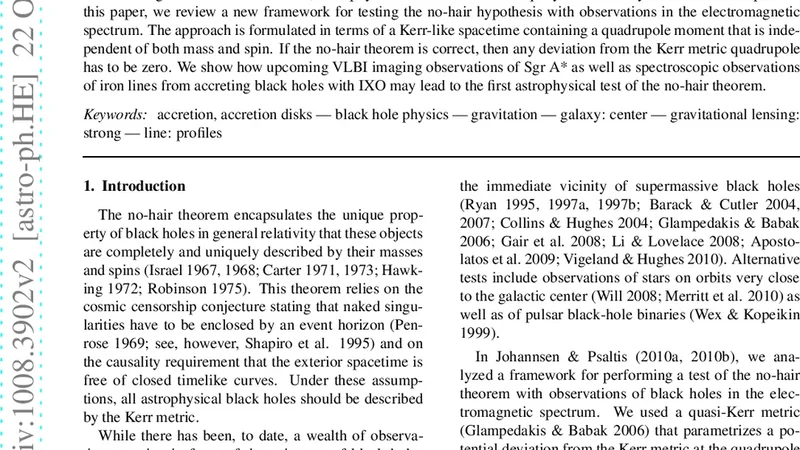
According to the no-hair theorem, astrophysical black holes are uniquely described by their mass and spin. In this paper, we review a new framework for testing the no-hair hypothesis with observations in the electromagnetic spectrum. The approach is formulated in terms of a Kerr-like spacetime containing a quadrupole moment that is independent of both mass and spin. If the no-hair theorem is correct, then any deviation from the Kerr metric quadrupole has to be zero. We show how upcoming VLBI imaging observations of Sgr A* as well as spectroscopic observations of iron lines from accreting black holes with IXO may lead to the first astrophysical test of the no-hair theorem.
💡 Research Summary
The paper presents a concrete observational framework for testing the no‑hair theorem, which posits that astrophysical black holes are fully described by only two parameters: mass (M) and spin (a). The authors introduce a Kerr‑like spacetime that includes an independent quadrupole moment, parameterized by a dimensionless deviation ε. In this generalized metric the quadrupole moment is Q = −a²M + εM³; the Kerr solution is recovered when ε = 0, while any non‑zero ε signals a violation of the no‑hair hypothesis.
The theoretical development proceeds in three stages. First, the authors derive the modified line element, discuss its impact on the location of the event horizon, and show how the additional quadrupole term alters the geodesic structure. Second, they perform extensive ray‑tracing simulations to predict how images of the black‑hole shadow and surrounding accretion flow would change as a function of ε. The simulations reveal that even modest deviations (ε ≈ 0.1) produce a measurable asymmetry in the shadow shape and a shift in its overall diameter of order a few percent. Third, they compute the relativistically broadened iron‑Kα line profiles from thin accretion disks, demonstrating that ε introduces a subtle but distinctive skewness in the red wing of the line, which can be quantified with high‑resolution X‑ray spectroscopy.
Two observational avenues are identified as the most promising for constraining ε. The first is very‑long‑baseline interferometry (VLBI) at millimeter wavelengths, exemplified by the Event Horizon Telescope (EHT) and future upgrades. By imaging the shadow of Sgr A* with sub‑microarcsecond resolution, the EHT can detect deviations in the shadow diameter at the 1 % level, translating into a sensitivity to ε of roughly 0.02. The second avenue is high‑throughput, high‑resolution X‑ray spectroscopy with the planned International X‑ray Observatory (IXO). IXO’s anticipated energy resolution of a few eV will allow precise measurements of the Fe Kα line shape; a deviation ε = 0.05 would alter the line profile by ∼10 eV, well within IXO’s capabilities.
Statistical inference is carried out using a Bayesian framework. The authors construct a likelihood function that combines the simulated observables (shadow geometry and line profile) with realistic noise models, and they explore the posterior distribution of ε via Markov Chain Monte Carlo sampling. The analysis shows that, given the projected data quality, ε can be constrained to be consistent with zero at the 2‑σ level, or a non‑zero ε can be detected with high confidence if the true deviation exceeds the instrumental thresholds.
The paper also discusses systematic uncertainties that could mimic or mask a genuine quadrupole deviation. These include plasma scattering effects in the Galactic center, uncertainties in the accretion‑disk emissivity profile, calibration errors in VLBI amplitude and phase, and modeling assumptions in the ray‑tracing code. To mitigate these, the authors advocate a multi‑wavelength, multi‑technique approach: combining VLBI imaging with X‑ray spectroscopy, and eventually with gravitational‑wave measurements of the same sources, to break degeneracies and cross‑validate results.
In conclusion, the study provides a realistic roadmap for the first astrophysical test of the no‑hair theorem using electromagnetic observations. With the imminent deployment of next‑generation VLBI arrays and X‑ray observatories, it will be possible to either confirm that ε is indistinguishable from zero—thereby reinforcing the Kerr description of black holes—or to detect a finite quadrupole deviation, which would signal new physics beyond general relativity and open a new window onto the strong‑gravity regime.
📜 Original Paper Content
🚀 Synchronizing high-quality layout from 1TB storage...