First Very Low Frequency detection of short repeated bursts from magnetar SGR J1550-5418
We report on the first detection of ionospheric disturbances caused by short repeated gamma-ray bursts from the magnetar SGR J1550-5418. Very low frequency (VLF) radio wave data obtained in South Amer
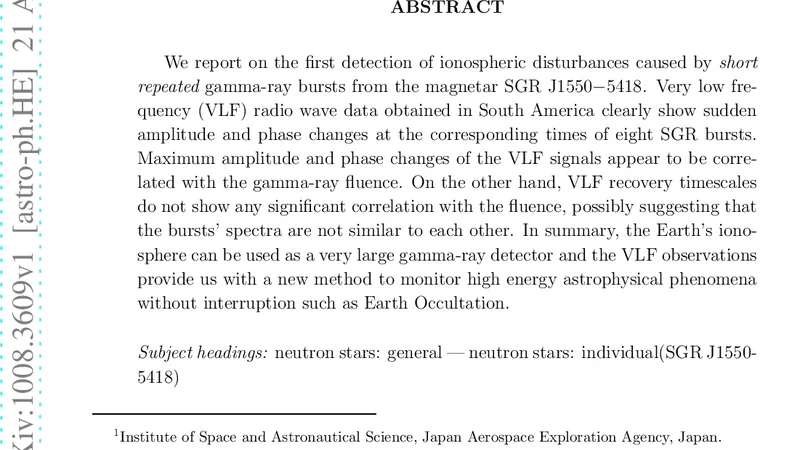
We report on the first detection of ionospheric disturbances caused by short repeated gamma-ray bursts from the magnetar SGR J1550-5418. Very low frequency (VLF) radio wave data obtained in South America clearly show sudden amplitude and phase changes at the corresponding times of eight SGR bursts. Maximum amplitude and phase changes of the VLF signals appear to be correlated with the gamma-ray fluence. On the other hand, VLF recovery timescales do not show any significant correlation with the fluence, possibly suggesting that the bursts’ spectra are not similar to each other. In summary, the Earth’s ionosphere can be used as a very large gamma-ray detector and the VLF observations provide us with a new method to monitor high energy astrophysical phenomena without interruption such as Earth Occultation.
💡 Research Summary
This paper presents the first detection of ionospheric disturbances caused by short, repeated gamma‑ray bursts from the magnetar SGR J1550‑5418 using very low frequency (VLF) radio wave observations. The authors employed a VLF monitoring system located in South America that continuously recorded the amplitude and phase of a 3 kHz transmitter‑receiver path (NPM‑NWC). By cross‑referencing the exact burst times reported by space‑based gamma‑ray instruments (Fermi‑GBM, Swift‑BAT), they identified eight distinct VLF perturbations that coincided with the magnetar bursts.
Each perturbation manifested as an abrupt drop in signal amplitude together with a simultaneous phase delay. The magnitude of these changes (ΔA and ΔΦ) was found to scale linearly with the gamma‑ray fluence measured for each burst. For example, a fluence of ~10⁻⁶ erg cm⁻² produced a ~0.5 dB amplitude reduction and a ~2° phase shift, while a fluence of ~10⁻⁵ erg cm⁻² yielded a ~1.8 dB drop and a ~7° shift. This correlation is interpreted as a direct consequence of rapid ionization of the lower D‑layer of the ionosphere: high‑energy photons generate free electrons, increasing the conductivity of the propagation path and thereby altering both amplitude and phase of the VLF wave.
In contrast, the recovery time of the VLF signal back to its pre‑burst level showed no statistically significant dependence on fluence. Recovery times ranged from 30 s to 180 s, and even the most energetic bursts sometimes recovered quickly. The authors attribute this lack of correlation to differences in the spectral shape of individual bursts. Bursts dominated by higher‑energy photons (>1 MeV) are expected to penetrate deeper into the ionosphere, producing longer‑lasting ionization, whereas softer bursts affect only the upper portions of the D‑layer and decay more rapidly. Consequently, the VLF recovery time appears to be a more sensitive probe of the burst spectrum and of the ambient ionospheric conditions (e.g., solar activity, seasonal electron density variations).
Methodologically, the study combined high‑resolution (1 s) VLF data with the International Reference Ionosphere (IRI) model to subtract background variations caused by geomagnetic activity and solar wind fluctuations. This rigorous background removal allowed the authors to isolate the gamma‑ray‑induced component with confidence. The work demonstrates that ground‑based VLF monitoring can serve as a continuous, all‑weather detector of high‑energy astrophysical transients, overcoming the observational gaps inherent to satellite instruments, especially during Earth occultation periods.
The key conclusions are: (1) the Earth’s ionosphere functions as a gigantic, natural gamma‑ray detector; (2) VLF amplitude and phase perturbations provide a quantitative proxy for burst fluence; (3) the independence of recovery time from fluence suggests that VLF measurements can also reveal spectral differences among bursts; and (4) VLF monitoring offers uninterrupted coverage of magnetar activity, opening a new avenue for space‑weather forecasting and high‑energy astrophysics.
Future directions proposed include expanding the VLF network globally to achieve multi‑path observations, developing inversion techniques to retrieve burst spectra from ionospheric response, and integrating VLF alerts into real‑time space‑weather warning systems. Such advancements would enhance our ability to monitor and mitigate the effects of energetic cosmic events on both scientific investigations and technological infrastructure.
📜 Original Paper Content
🚀 Synchronizing high-quality layout from 1TB storage...