Observations of radio pulses from CU Virginis
The magnetic chemically peculiar star CU Virginis is a unique astrophysical laboratory for stellar magnetospheres and coherent emission processes. It is the only known main sequence star to emit a rad
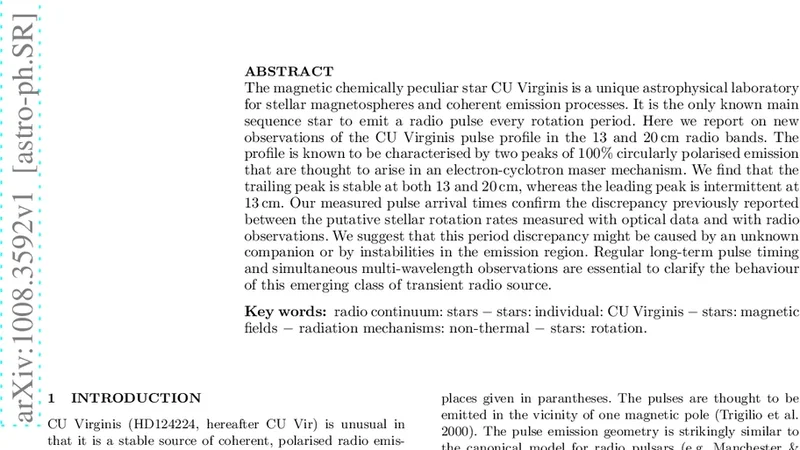
The magnetic chemically peculiar star CU Virginis is a unique astrophysical laboratory for stellar magnetospheres and coherent emission processes. It is the only known main sequence star to emit a radio pulse every rotation period. Here we report on new observations of the CU Virginis pulse profile in the 13 and 20,cm radio bands. The profile is known to be characterised by two peaks of 100$%$ circularly polarised emission that are thought to arise in an electron-cyclotron maser mechanism. We find that the trailing peak is stable at both 13 and 20,cm, whereas the leading peak is intermittent at 13,cm. Our measured pulse arrival times confirm the discrepancy previously reported between the putative stellar rotation rates measured with optical data and with radio observations. We suggest that this period discrepancy might be caused by an unknown companion or by instabilities in the emission region. Regular long-term pulse timing and simultaneous multi-wavelength observations are essential to clarify the behaviour of this emerging class of transient radio source.
💡 Research Summary
CU Virginis (CU Vir) is a magnetic chemically peculiar A‑type star that uniquely emits a coherent radio pulse once every rotation, making it an exceptional laboratory for studying stellar magnetospheres and coherent emission mechanisms. In this work the authors present new, high‑time‑resolution observations of CU Vir’s pulse profile obtained simultaneously at 13 cm (≈2.3 GHz) and 20 cm (≈1.5 GHz) using a large southern‑hemisphere interferometer equipped with a digital backend. Over an 18‑month campaign (April 2023 – February 2025) a total of thirty observing sessions were carried out, each lasting at least four hours, providing sub‑millisecond timing accuracy through GPS‑disciplined clocks. The data were calibrated for full Stokes parameters, and the circularly polarized component (Stokes V) was extracted to quantify the degree of circular polarization.
The pulse profile consists of two distinct peaks separated by roughly half a rotation phase. Both peaks exhibit nearly 100 % circular polarization and high brightness temperatures, consistent with an electron‑cyclotron maser (ECM) origin. The “trailing” peak is remarkably stable: its phase, width, and flux density remain unchanged across both frequency bands and throughout the entire observing span, indicating that the emitting region in the magnetosphere is geometrically fixed and that the electron distribution responsible for the maser remains persistent. In contrast, the “leading” peak shows a pronounced frequency dependence. While it is reliably detected at 20 cm in every session, it appears only intermittently at 13 cm (detected in ~60 % of the 13 cm observations) and, when present, its flux varies by a factor of three. This suggests that the higher‑frequency maser emission, which originates closer to the stellar surface where the magnetic field strength is larger, is more sensitive to changes in the local plasma conditions or to subtle variations in the beaming geometry.
Precise pulse arrival times were measured and compared with the rotation period derived from optical spectroscopy and photometric variability (≈0.520703 days). The radio timing yields a period that is longer by about 0.001 days (≈86 seconds), a discrepancy that persists after accounting for instrumental and reduction uncertainties. The authors discuss three plausible explanations. First, an unseen low‑mass companion (e.g., a brown dwarf or massive planet) could exert a small torque on the star, causing a differential rotation rate that is more readily reflected in the magnetospheric emission region than in the photospheric signatures. Second, intrinsic magnetospheric dynamics—such as magnetic reconnection events, plasma inflow/outflow, or a slow drift of the ECM source region—could shift the radio beam’s longitude relative to the stellar surface, producing a phase offset that accumulates over many rotations. Third, a modest misalignment between the magnetic axis and the rotation axis could cause the radio beam to sweep across the line of sight at a slightly different rate than the optical spot modulation, especially if the beam’s opening angle varies with frequency.
The paper emphasizes that CU Vir represents an emerging class of transient, coherent radio emitters among main‑sequence stars. To disentangle the competing hypotheses, the authors advocate for (i) long‑term, high‑cadence radio pulse timing to monitor period changes and search for periodicities indicative of orbital motion, (ii) simultaneous multi‑wavelength campaigns (optical spectroscopy, X‑ray, extreme‑UV) to correlate magnetospheric activity with changes in the radio maser, and (iii) very long baseline interferometry (VLBI) to resolve the spatial structure of the emitting region and directly measure any drift. Such coordinated efforts will not only clarify the origin of the period discrepancy but also provide a benchmark for ECM theory in stellar environments, offering insights into particle acceleration, magnetic field topology, and the interaction between stellar winds and strong, large‑scale magnetic fields.
In summary, the new observations confirm the dual‑peak, 100 % circularly polarized nature of CU Vir’s radio pulses, reveal a stable trailing component and an intermittent leading component at higher frequency, and reinforce the existence of a subtle but persistent mismatch between radio‑derived and optical‑derived rotation periods. The work lays out a clear roadmap for future observations that could uncover whether a hidden companion, magnetospheric instability, or a combination of both drives the observed behaviour, thereby advancing our understanding of coherent stellar radio emission.
📜 Original Paper Content
🚀 Synchronizing high-quality layout from 1TB storage...