Synthesising, using, and correcting for telluric features in high-resolution astronomical spectra
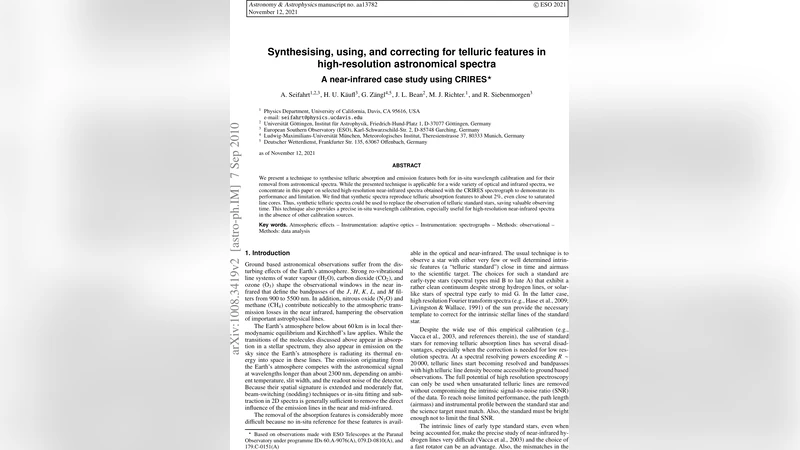
We present a technique to synthesise telluric absorption and emission features both for in-situ wavelength calibration and for their removal from astronomical spectra. While the presented technique is applicable for a wide variety of optical and infrared spectra, we concentrate in this paper on selected high-resolution near-infrared spectra obtained with the CRIRES spectrograph to demonstrate its performance and limitation. We find that synthetic spectra reproduce telluric absorption features to about 2%, even close to saturated line cores. Thus, synthetic telluric spectra could be used to replace the observation of telluric standard stars, saving valuable observing time. This technique also provides a precise in-situ wavelength calibration, especially useful for high-resolution near-infrared spectra in the absence of other calibration sources.
💡 Research Summary
The paper presents a comprehensive method for synthesising and applying telluric (Earth‑atmosphere) absorption and emission features to high‑resolution near‑infrared (NIR) spectra, with a focus on data obtained with the CRIRES spectrograph at the VLT. Traditional telluric correction relies on observing bright “standard” stars close in time and airmass to the science target. This approach suffers from several drawbacks: mismatched airmass, differing adaptive‑optics performance, intrinsic stellar lines contaminating the correction, and the loss of valuable telescope time. Moreover, conventional wavelength calibration sources (ThAr, HeNe, Xe lamps) provide insufficient line density in the NIR for the resolving powers (R ≈ 50 000–100 000) of CRIRES, and their light does not travel the same optical path as the science target, limiting calibration precision.
To overcome these limitations, the authors develop a pipeline that (1) builds a realistic atmospheric model for Cerro Paranal, (2) computes high‑fidelity transmission and radiance spectra using a line‑by‑line radiative‑transfer code (LBLRTM), and (3) fits these synthetic spectra directly to the observed data to retrieve atmospheric parameters (airmass, water‑vapour column, temperature profile) and to refine the instrumental profile. The atmospheric model starts from the 1976 US Standard Atmosphere but is customised with local meteorological data (GDAS/MM5) to capture the actual water‑vapour distribution up to ~26 km. Molecular line data are taken from the latest HITRAN and GEISA databases, ensuring accurate line positions, strengths, and pressure‑broadening coefficients.
Data reduction follows standard CRIRES procedures: non‑linearity correction, pairwise subtraction of AB nods to remove sky emission, flat‑fielding, and optimal extraction of 1‑D spectra. Because CRIRES’s adaptive optics often under‑fills the slit, the authors model the instrumental profile as a convolution of the true slit function with the point‑spread function (PSF) of the source, allowing for small shifts (as little as 30 m s⁻¹, i.e., 1/50 of a pixel) that would otherwise degrade telluric correction.
The synthetic telluric spectra are then fitted to the observed spectra across a range of airmasses and wavelengths. The fit reproduces the depth and shape of even saturated lines to within ~2 % on average, including line cores that are traditionally difficult to model. This level of accuracy demonstrates that synthetic telluric spectra can replace empirical standard‑star observations, saving significant telescope time and eliminating mismatches caused by differing AO performance or stellar features.
In addition to telluric removal, the dense forest of atmospheric absorption lines provides an excellent in‑situ wavelength reference. Because the telluric lines experience exactly the same instrumental profile as the science target, they enable wavelength solutions with precision at the few‑meter‑per‑second level, surpassing what is achievable with sparse NIR lamp lines. The authors show that a shift of only 30 m s⁻¹ can be detected and corrected using the telluric model, highlighting the method’s suitability for high‑precision radial‑velocity work in the NIR.
The paper also discusses limitations. Residual errors arise from incomplete line lists (especially for molecules like CH₄ and N₂O), uncertainties in pressure‑broadening parameters, and detector non‑linearity near saturated pixels. Temporal atmospheric variability not captured by the static GDAS model can introduce mismatches, suggesting that real‑time meteorological monitoring would further improve performance. Moreover, the method requires accurate knowledge of the instrument’s PSF and slit illumination, which may vary with observing conditions.
Overall, the study delivers a robust, physics‑based framework for both telluric correction and wavelength calibration of high‑resolution NIR spectra. By integrating atmospheric modelling, up‑to‑date molecular databases, and careful treatment of the instrument’s line spread function, the authors achieve telluric residuals at the 2 % level and wavelength precision at the few‑m s⁻¹ level, without the need for dedicated standard‑star observations. This approach promises to enhance observing efficiency, improve data quality, and enable precise NIR radial‑velocity measurements essential for exoplanet detection and stellar astrophysics.
Comments & Academic Discussion
Loading comments...
Leave a Comment