A new globular cluster black hole in NGC 4472
We discuss CXOU~1229410+075744, a new black hole candidate in a globular cluster in the elliptical galaxy NGC~4472. By comparing two Chandra observations of the galaxy, we find a source that varies by
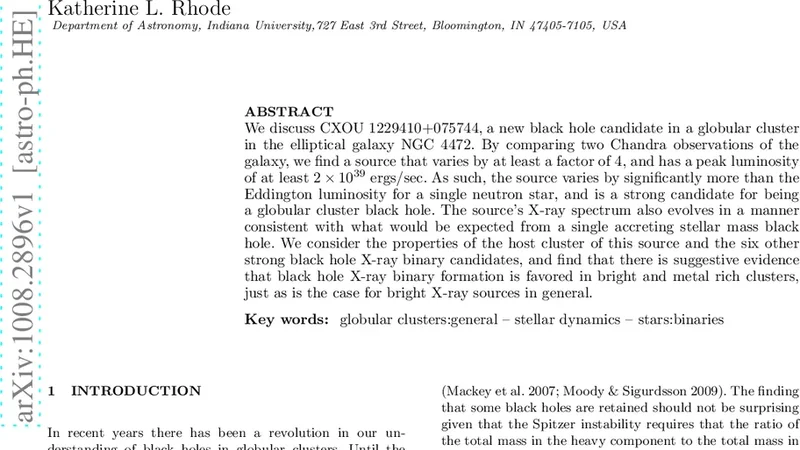
We discuss CXOU1229410+075744, a new black hole candidate in a globular cluster in the elliptical galaxy NGC4472. By comparing two Chandra observations of the galaxy, we find a source that varies by at least a factor of 4, and has a peak luminosity of at least $2\times10^{39}$ ergs/sec. As such, the source varies by significantly more than the Eddington luminosity for a single neutron star, and is a strong candidate for being a globular cluster black hole. The source’s X-ray spectrum also evolves in a manner consistent with what would be expected from a single accreting stellar mass black hole. We consider the properties of the host cluster of this source and the six other strong black hole X-ray binary candidates, and find that there is suggestive evidence that black hole X-ray binary formation is favored in bright and metal rich clusters, just as is the case for bright X-ray sources in general.
💡 Research Summary
This paper reports the discovery and characterization of a new black‑hole (BH) candidate, CXOU 1229410+075744, residing in a globular cluster (GC) associated with the massive elliptical galaxy NGC 4472. The authors analyzed two archival Chandra ACIS‑S observations of the galaxy, taken in 2000 (ObsID 321, ~40 ks) and 2009 (ObsID 11274, ~30 ks). After standard re‑processing with CIAO and careful source detection using wavdetect, they extracted source and background spectra for the object and measured its flux in the 0.5–8 keV band.
The source exhibits dramatic long‑term variability: the count rate in the later observation is at least four times higher than in the earlier one. Assuming a distance of 16.7 Mpc and a modest Galactic column density (N_H ≈ 2 × 10²⁰ cm⁻²), the peak X‑ray luminosity reaches ≥ 2 × 10³⁹ erg s⁻¹. This exceeds the Eddington limit for a canonical 1.8 M_⊙ neutron star (≈ 2 × 10³⁸ erg s⁻¹) by an order of magnitude, immediately ruling out a simple neutron‑star accretor and strongly suggesting a black‑hole primary.
Spectral fitting was performed with XSPEC using both an absorbed power‑law (Γ ≈ 1.5–2.0) and an absorbed multicolor disk blackbody (kT_in ≈ 0.9 keV). The earlier observation is best described by a relatively hard power‑law (Γ ≈ 1.7) and a cooler disk (kT_in ≈ 0.85 keV), whereas the later, brighter observation shows a softer power‑law (Γ ≈ 2.0) and a modestly hotter disk (kT_in ≈ 1.0 keV). The χ² values for both models are acceptable (reduced χ² ≈ 1.1), and the modest spectral evolution mirrors the classic hard‑to‑soft transition observed in stellar‑mass black‑hole X‑ray binaries (XRBs). The inferred inner‑disk temperature and luminosity are consistent with a ~10 M_⊙ black hole accreting at a few percent of its Eddington rate.
The host GC was identified in Hubble Space Telescope ACS imaging. Photometry yields an absolute V‑band magnitude M_V ≈ –9.5 and a (V–I) color of ~1.2, indicating a metal‑rich cluster with
📜 Original Paper Content
🚀 Synchronizing high-quality layout from 1TB storage...